

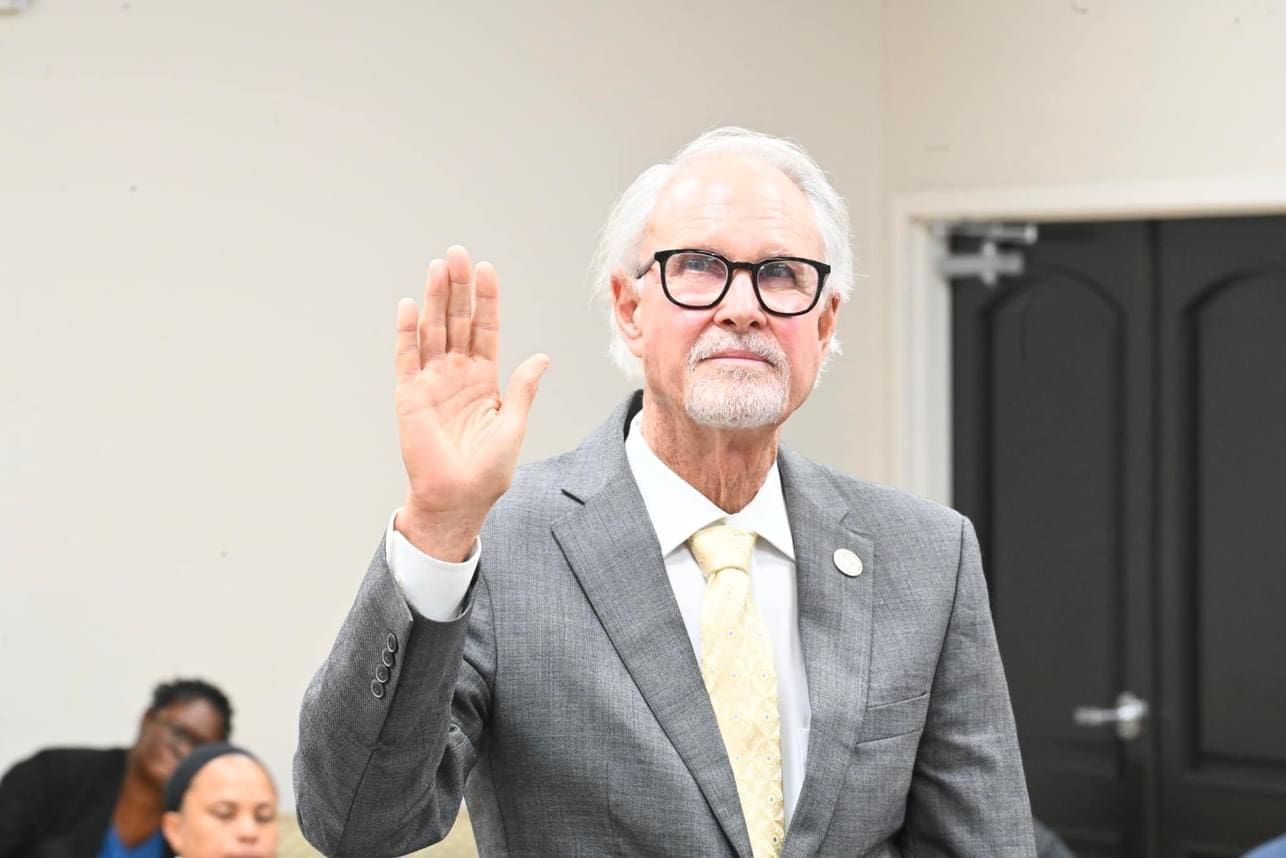
Gov. Albert Bryan’s nomination of Gordon Rhea to be the next U.S. Virgin Islands attorney general was approved by the Senate’s Rules and Judiciary Committee Thursday, as was the nomination of Vance Pinney to join the St. Thomas Coastal Zone Management Commission.
Rhea said the police and Attorney General’s Office needed to work together better, sharing information that could allow court cases to move to resolutions faster, reducing the slow pace of the Justice Department in the territory.
Rhea said he’d been working to resolve the rift between the Virgin Islands Police Department and Department of Justice. Police want speedier warrants and the Justice Department wanted information from police faster, he said. Rhea hoped to foster close collaboration between the law enforcement agencies.
“My philosophy is basically that the Department of Justice, Police, the U.S. Attorney’s Office, all of us are involved in law enforcement on the physical ground, let’s work together,” he said. “I’m very encouraged by what’s been happening.”
He outlined other areas of need, including information technology upgrades, filling open positions, the need for more attorneys and increased coordination of pretrial diversion programs for young and non-violent offenders. He also wanted to get a functioning morgue on St. Croix so bodies needn’t be transported for St. Thomas for autopsy.
The white-collar crime division which investigates corruption and other financial crimes was particularly thin, Rhea said. It was “run on a shoestring,” he said.
Rhea had been acting attorney general since May 20 after Bryan nominated him in April following the resignation of Arial Smith in March. Rhea said he did not know the details of why previous attorneys general left, and did not want to know.
“Politics plays no part in my interpretation of the law,” Rhea said, adding that he did not see himself as the governor’s attorney but the people’s attorney.
A member of the Virgin Islands Bar for more than 40 years, Rhea has been involved in some of the territory’s most prominent legal cases, bringing suits against the Hess Oil refinery and the Martin Marietta bauxite refinery for allegedly injuring workers by exposing them to toxic materials.
“We also prosecuted ground-breaking product liability cases against automobile manufacturers for injuries caused by vehicle instability, firewall failures, and occupant protection failures; handled litigation involving airplane crashes, turbulence encounters, and a wide range of catastrophic worker-related injuries; and served as co-counsel in litigation against Exxon, ESSO, and Texaco for contaminating the sole-source Tutu aquifer on St. Thomas with petroleum and chlorinated hydrocarbons,” Rhea told the Committee on Rules and Judiciary.
Rhea said enforcing environmental law was extremely important to him, having written Stanford University’s Environmental Law Handbook while getting his legal degree there.
Rhea has roots in the territory going back to 1968 when he trained in St. Croix for a Peace Corps teaching assignment in Ethiopia’s highlands and Ogaden Desert. In 1973, while in law school, Rhea returned to clerk at a St. Croix law firm where he met prominent legal figures.
His first job out of law school was with one of the top criminal law firms in Los Angeles, where he specialized in complex criminal cases and appeals to the 9th Circuit Federal Court of Appeals, he said.
In 1975 Rhea took a lead role in the famed bi-partisan Church Commission, where the U.S. Senate investigated alleged abuses by federal intelligence agencies.
“I participated in uncovering and documenting several of those abuses. My work included acquiring documents, deposing witnesses, writing reports, drafting legislation, and preparing Sens. Frank Church and Walter Mondale to testify in public hearings. I was the chief investigator and drafter of the Committee’s report on the CIA’s attempts to assassinate Fidel Castro, Patrice Lumumba, and other foreign leaders, and of its report on the FBI’s disgraceful attempts to discredit Dr. Martin Luther King, Jr. and undermine the Civil Rights Movement,” he said.
Rhea returned in 1981 as an assistant U.S. attorney, then formed a private practice the next year specializing in personal injury litigation, including toxic tort cases, product liability cases, and complex white-collar criminal cases.
“I won the largest civil jury verdict ever rendered in the Virgin Islands in a landmark case against R.J. Reynolds tobacco company involving cancer deaths caused by its cigarettes. I also recently represented hospital CEO Amos Carty in his trial and subsequent appeal, in which the Virgin Islands Supreme Court ruled that he had acted in good faith and vacated his conviction. In sum, I have extensive experience in civil, criminal, and appellate litigation, much of it in the Virgin Islands. I am humbled by the Virgin Islands Bar Association’s decision last year to grant me its highest honor, the Winston Hodge Award,” Rhea said.
Rhea said he would recuse himself from any future investigations into former clients, including Carty and Gov. John de Jongh. He said he’d also recuse himself from any matters related to convicted sex offender Jeffery Epstein. Rhea had represented an accountant who was an executor of the Epstein estate after his death.
“I have never met, communicated with, or represented Mr. Epstein and am as shocked and disgusted by his conduct as I believe we all are,” Rhea said.
Rhea and the accountant, Richard Kahn, agreed money from the estate should go to Epstein’s victims.
“To that end, we requested the court to appoint a special master to interview Epstein’s female victims in private, determine the amount that each should receive, relay that amount to the estate, and the estate would pay it without question. Altogether, the estate paid the women victimized by Epstein approximately $155,000,000, averaging over $900,000 per victim,” he said.
Rhea also helped net the territory $116.5 million in taxes dodged by the disgraced financier.
“Significantly, the Justice Department dismissed the charges against Mr. Kahn. As for myself, I felt that I did a good job securing justice for my client, for the women victimized by Epstein, and for the Virgin Islands. As Attorney General, I swear to you that I will represent my clients, the people of the Virgin Islands, with that same zeal, dedication, and commitment to justice,” he said.
Rhea said, learning of his nomination, friends congratulated him and, in the same breath, said he’d be crazy to take the job. Rhea shook off those concerns, saying he didn’t need the money and had no interest in using the position as a stepping stone to anything else.
“This is a chance for me to do good. This is part of who I am,” he said. “This is a chance for me to give back.
Despite early reservations by Sen. Kenneth Gittins and Sen. Franklin Johnson, Rhea’s nomination was approved by a unanimous vote. After the vote, Rhea said it was one of the highlights of his life.
“It means a tremendous amount to me,” he said. “I wanted this job so I could feel like I, in many ways, crowned my legal career by doing something really positive and really good for the Virgin Islands. And, the Virgin Islands having been a huge part of my life for the last, well, 50 years, it’s my home.”
Pinney, an architect and engineer, said he had worked to balance environmental sustainability and proper development throughout his career. Pinney said a holistic understanding of the diversity and richness of the Virgin Islands’ natural resources was vital for responsible development.
With the Department of Public Works, Department of Education, and the Virgin Islands Housing Authority, Pinney said he brought green practices to each project. He was also an eager and thoughtful instructor of future engineers, he said. It was a two-way street as it kept him abreast of new ways of thinking while passing on the knowledge he’d gathered in his career.
“As an engineering instructor, I have a passion for education and community engagement. I understand the importance of raising awareness about coastal zone issues and fostering a culture of stewardship. I plan to leverage this experience to enhance the committee’s outreach efforts, ensuring that the public is informed and involved in our conservation initiatives,” Pinney said. “I am deeply committed to serving the people of the Virgin Islands and to protecting our coastal zones for future generations.”
Pinney said protecting the territory’s water and coastal areas was paramount.
His nomination was approved by a unanimous vote.
The committee also approved a bill handing 25B Hill Street, Christiansted over to the Virgin Islands Housing Finance Authority.