


Good Hope Country Day School (GHCDS) opened its theater season with performances of the comedy “You Can’t Take It With You” on Friday and Saturday. Three more productions will be presented on Nov. 1 – 3 at the GHCD Pavilion on St. Croix.
Tickets are $10.00 and can be purchased in advance or at the door.
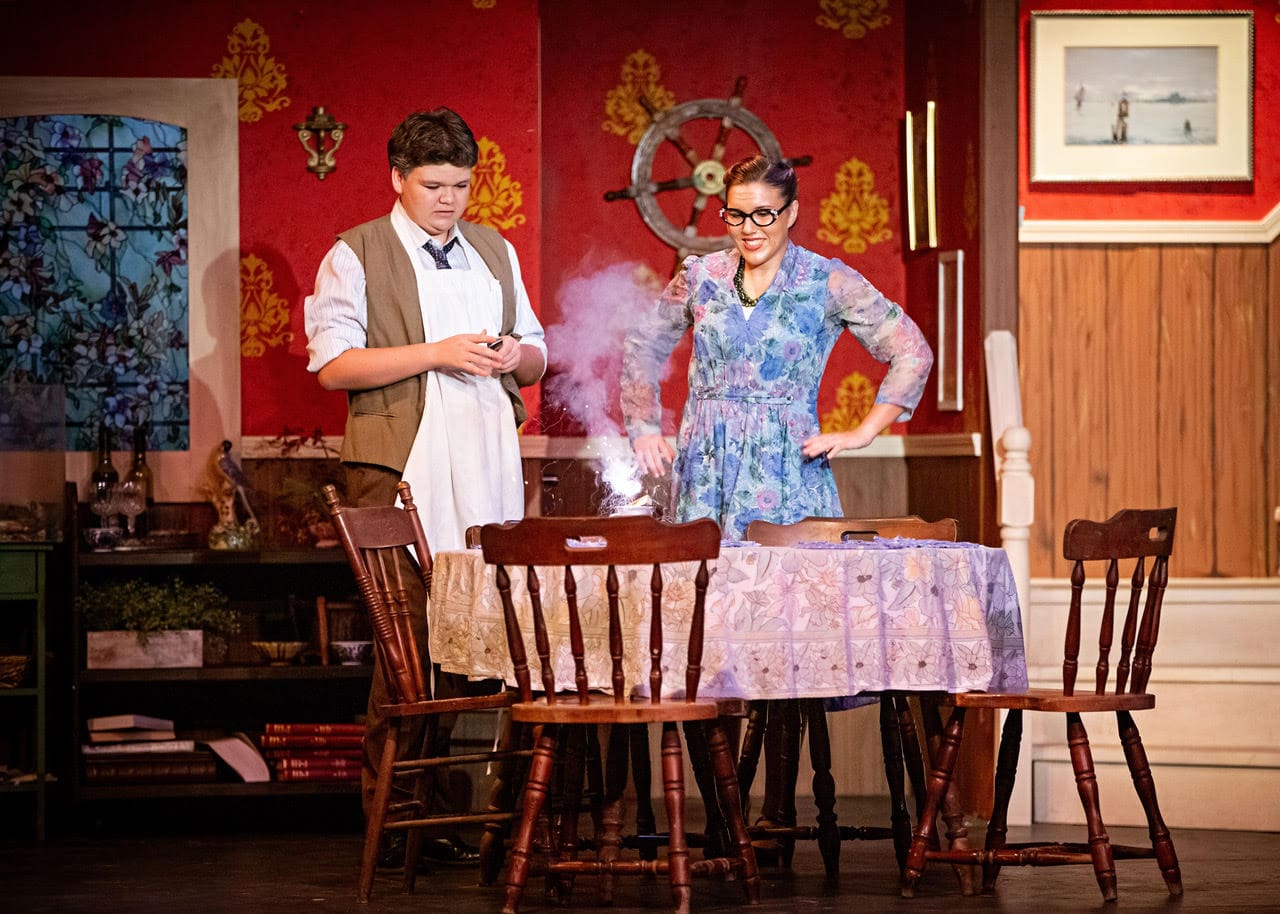
Directed by Micheal Armendariz and Kiomie Pedrini, the cast of 27 enthusiastic and gifted students in grades seven through 12 bring the play to life. Behind the scenes, Technical Director Joseph Barnwell, Stage Manager Isabel Coursey, and Costumers Cathy Mares and Carolyn Forno work to support the actors. Photographer Lindsay Kammerzelt captures the production in pictures that bring it to life.
“These student actors have put together a fabulous show in two weeks less rehearsal time than normal. Considering the amount of characters and blocking required, they rose to the challenge. Seeing the students’ character development and general all-around confidence in themselves is very rewarding as a director,” Armendariz said. Michael has served as director, co-director, and choreographer for numerous Good Hope Country Day School productions.

“The story unfolds around the delightfully eccentric Sycamore family, a lively group living on Manhattan’s Upper West Side. With pursuits as varied as snake collecting, firework crafting, unfinished playwriting, and xylophone playing, the Sycamores are anything but ordinary. Their world collides with that of the Kirbys—a more conventional family—when the Sycamores, one ‘normal’ daughter, invites her fiance, an investment banker, and his family over for dinner. When the Kirbys arrive a day early, the resulting clash between quirky and conservative lifestyles creates an evening of hilarious chaos. You Can’t Take It With You reminds audiences of the joys of embracing life’s peculiarities and pursuing happiness wholeheartedly,” Kiomie Pedrini said.

Pedrini has been producing theater productions at GHCDS for 10 years, saying: “I am always humbled by the exponential growth I witness in each student as they become courageous and take risks.” This production guides students through the full journey of theater-making—from auditions to the final set breakdown—instilling a strong sense of accomplishment and pride in their work.”

In an age dominated by technology, Pedrini notes, “Experiencing the moment is becoming a foreign concept to our younger generations, but the performing arts help center and engage them in the present.”
The cast of “You Can’t Take It With You” includes:
PENELOPE “PENNY” SYCAMORE – ANNA SIMON
MARTIN “GRANDPA” VANDERHOF – TRISTAN SAMUEL
ALICE SYCAMORE – AVA MORMON
TONY KIRBY – NICO FORNO D’ADAMO
ANTHONY W. KIRBY – CAMERON CULLINAN
ESSIE CARMICHAEL – KALYANI WALTER-SUNDARAM
BORIS KOLENKHOV – CONNOR SHEPHERD
PAUL SYCAMORE – WILLIAM GENTILUCCI
ED CARMICHAEL – DAVID HARDESTY
MR. DE PINNA – AVERY ADAMS
DONNA – LENA KAMMERZELT
RHEBA – KIMAYA JACKSON
WILBUR C. HENDERSON – IAN AINGER
MIRIAM KIRBY – MIA BENTON-HUGGINS
THE GRAND DUCHESS OLGA KATRINA -ALLEGRA FERRERAS
GAY WELLINGTON – PEYTON SCHINDLER
The comedic play by George S. Kaufman and Moss Hart originated in 1936. In 1937 it was awarded the Pulitzer Prize for Drama. The play has been adapted for the screen and television starring well known actors including James Earl Jones, James Stewart, Blythe Danner, and Jean Stapleton. The screen adaptation won the 1938 Academy Awards for Best Picture and Best Director.
One of the 10 most produced school plays every year since 1939; the timeless comedy continues to delight audiences.