

The V.I. Police Department will hold a two-day summit in December to identify obstacles to achieving compliance with the federal consent decree it has been under since 2009 to address allegations of a pattern of uses of force by its officers.
According to the 72-page third quarter report the independent monitoring team filed in V.I. District Court on Friday, the goal of the summit scheduled for Dec. 10-11 for the ranks of sergeant and above “is to identify obstacles to achieving compliance and develop strategies to overcome them.”
The team’s most recent report covering June 1 through Aug. 31 found continued “sustained compliance” with most of the consent decree mandates concerning police use of force and citizen complaint investigations. However, some deficiencies remain in completing thorough and timely investigations and holding those that fall short to account, it said.
While the consent decree includes 51 compliance paragraphs directly targeting the policing practices of the VIPD, the summit will focus on helping the department’s supervisors and leadership “work in earnest to achieve substantial compliance with paragraphs 37, 64 and 71.”
Those paragraphs concern deputy chiefs’ evaluations of performance reviews by supervisors to identify and correct any deficiencies in use of force cases; adherence to the 11 protocols for using the department’s electronic risk management system, called IAPro; and training in use of force standards.
“Consistent with previous quarters, VIPD has demonstrated partial compliance with these three paragraphs and continues to make incremental progress,” according to the third quarter report by monitor Sydney Roberts, who was appointed in November 2022 following the 2021 death of her predecessor, Charles Gruber, who had served since 2014.
“To bring about meaningful change, the supervisors responsible for untimely investigations must be held accountable, especially when retraining has not resulted in improved performance or enhanced organizational commitment,” Roberts wrote. “Appropriate disciplinary and/or non-disciplinary action should be taken every time a supervisor fails to conduct a timely and/or thorough investigation.”
When deadlines continue to be viewed as only suggestions, it is difficult to create a culture of accountability and a functional disciplinary process, the report states.
For example, a partial audit of supervisors responsible for untimely investigations, “absent the presence of a valid stay or waiver, provided evidence of investigators receiving documented counseling after a single incident of failing to complete a case on time, while others involved with multiple untimely investigations have nothing in their file documenting the corrective action. The department’s efforts must be consistent to ensure the effectiveness of the accountability structure and disciplinary process and to improve the timeliness of these investigations,” the report states.
In one case, a deputy chief directed a lieutenant to complete seven outstanding personnel investigations (four use of force cases, two citizen complaints and one vehicle accident) by a specific date, according to the report. When the lieutenant failed to complete the work on time they were given a second deadline, which they also missed, and a command investigation was initiated that found they violated “Category B:39 — Refusal to obey any lawful order or directive,” it said.
“Although the lieutenant did not complete the seven investigations as directed, the island’s police chief served as the hearing officer and did not sustain the charge,” because the charging document used one word from an outdated VIPD policy that had been modified to read “failure” instead of “refusal” to obey a lawful order, the report states. The acting commissioner concurred with the findings, it says.
“Thanks to the tenacity and initiative of the Deputy Commissioner and the St. Croix deputy chief, the charges were refiled,” but while they were sustained, “the charged officer was only ordered to serve a one-day suspension without pay and a two-day suspension held in abeyance for a period of six months,” the report states.
Of note, this was the first quarter wherein the monitoring team observed operations personnel express frustration that their peers were not completing assigned investigations in a timely manner, whereas in the past, the citizen complaint and use of force investigation inspectors “were the only people addressing investigators for untimely or incomplete investigations,” it said.
During one of the weekly “VIPD Commander Calls” for the St. Thomas-St. John district, held to review all open use of force and citizen complaint cases, for example, “an Operations commander commented, ‘We look at facts and hold people liable for crime, but we cannot do the same and hold people accountable for not doing their job.’ In another call, a supervisor said, ‘Why take it [completing investigations timely] serious if no one [is] ever terminated or seriously suspended for not doing it?’ and suggested there is a ‘need to make [an] example of those not doing their job,’” according to the report.
On a positive note, the department has completed all outstanding quarterly audits from 2023, is current with its audits so far this year and “is positioned to maintain the timely completion of its audits moving forward,” according to the report.
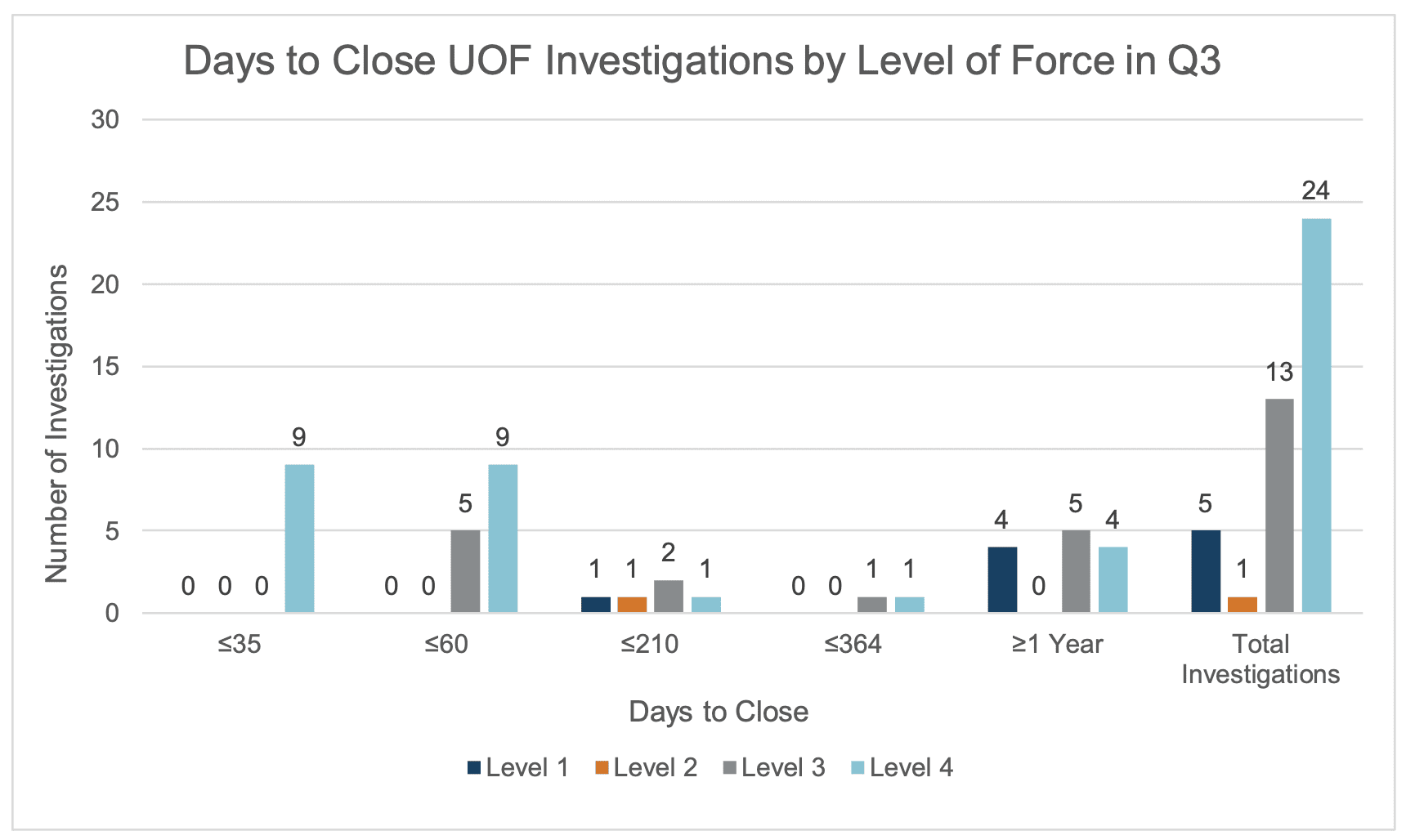
Additionally, “VIPD has made progress in investigative timeliness, particularly relative to the closure of some of its oldest [Use of Force] investigations. Of note, VIPD was successful in reducing the overall number of pending cases for the third consecutive quarter,” according to the report, which cites 43 cases closed from June through the end of August.
However, while the monitoring team is encouraged by accountability measures imposed for the untimely completion and/or review of investigations, “corrective action has been intermittent and inconsistent,” it said.
“To facilitate organizational compliance with the timeliness mandates under paragraphs 37 and 71, VIPD must be vigilant and unwavering in its commitment to holding personnel accountable for violating the timelines set forth in VIPD policy,” the report states.
Still, the monitors are optimistic that with the right leadership, full compliance will come, said Roberts.
“The key to achieving substantial compliance with paragraphs 37, 64 and 71 is an inspired commitment, driven by [the commissioner] and reinforced throughout the organization, that prioritizes completing administrative investigations in a timely manner, analyzing risk data and ensuring accountability when standards are not met,” according to Roberts’ summary of the third quarter report.
“Successful compliance with the remaining paragraphs is within reach and can be realized if approached strategically, buttressed with realistic benchmarks, and given the full and active support of VIPD leadership,” she said.
Read the full report here.