

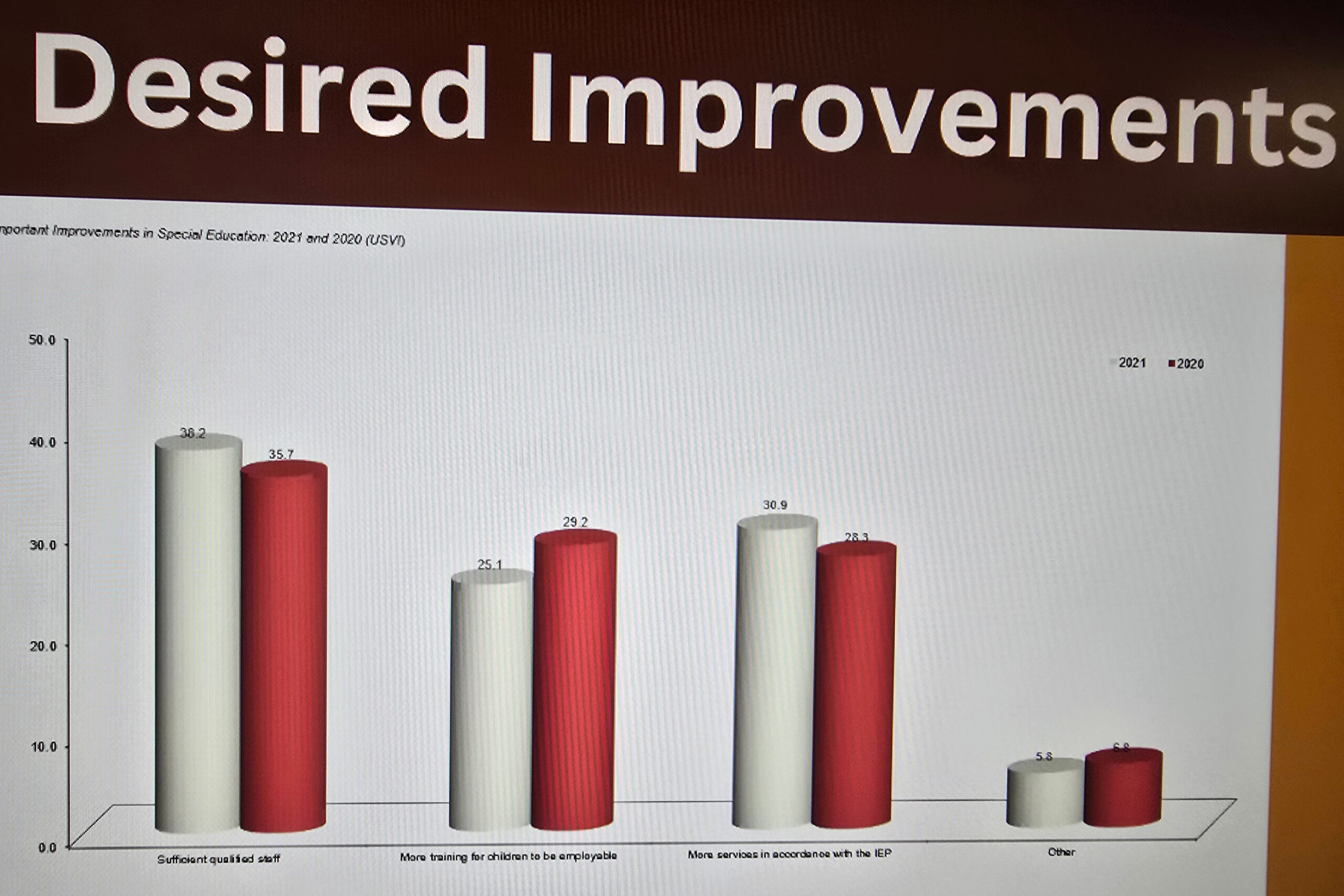
A survey of Virgin Islands parents and guardians with children who have special needs underscored the need for communication and outreach about available programs while highlighting some of the positive impacts of the territory’s special education services.
The findings were shared during a virtual, public presentation of a parental satisfaction survey conducted by the University of the Virgin Islands Eastern Caribbean Center for the V.I. Education Department State Office of Special Education. Eastern Caribbean Center Director Marissa Johnson Rogers told The Source that the center has been conducting the survey for 17 years. The findings presented on Monday night pertained to the 2021-2022 school year, which Rogers attributed to a delay caused by the COVID-19 pandemic.
Surveyors contacted the households of 787 students using a list provided to them by the State Special Education Office. The study included 13 types of disabilities: intellectual disabilities; hearing impairments; speech and language impairments; visual impairments; emotional disturbance; orthopedic impairments; other health impairments; specific learning disabilities; deaf-blindness; multiple disabilities; autism; and traumatic brain injuries.
Respondents were asked to indicate their levels of satisfaction in a range of areas, from the impact of special education services on their child to their experience with school administrators, teachers and staff.
Rogers said the latest findings didn’t contain much in the way of surprises for the researchers.
People who took the survey were more likely to agree that the school system’s special education services helped their child with speech issues and social skills. Conversely, parents and guardians were less likely to agree that the services helped their child develop organization and planning skills or with health and medical issues. Respondents generally agreed that in-person learning is preferable to virtual instruction.
Respondents were also more likely to agree that available services can be shared more effectively and annual meetings to discuss special education programs have been unhelpful or uninformative. Parents and guardians were least likely to indicate satisfaction with the availability of information about services.
One virtual attendee on Monday evening, Rebecca Russell, highlighted the need for designated Special Education Parent Teacher Associations, or SEPTAs, within schools or school districts. Russell told The Source on Monday night that she is from St. Thomas but lived on St. Croix for more than two decades — and was part of the Parent Teacher Association for the duration. The need for specialized PTAs to discuss sensitive subjects is important to her, she said, because her son has Down syndrome.
“Our people are afraid, and then some — most — of our people are so preoccupied with trying to pay the rent, and trying to pay the mortgage, keep food on the table, that these things just slip through the hands, and through the cracks,” she said. “It’s really important. Why? Because there’s sensitive matters that our arena needs to speak about, and only another parent who has a child or a loved one that has someone with special needs will be able to understand that.”
Russell acknowledged that most school PTAs already have a full agenda, and issues affecting students with special needs may not be pressing for most parents and guardians.
“But see, this is why … the schools that house the special education classes [should] have a SEPTA that’s separate and aside from the general population,” she said. Just like how you have the mainstream education and you have special education. We should have the same thing.”