

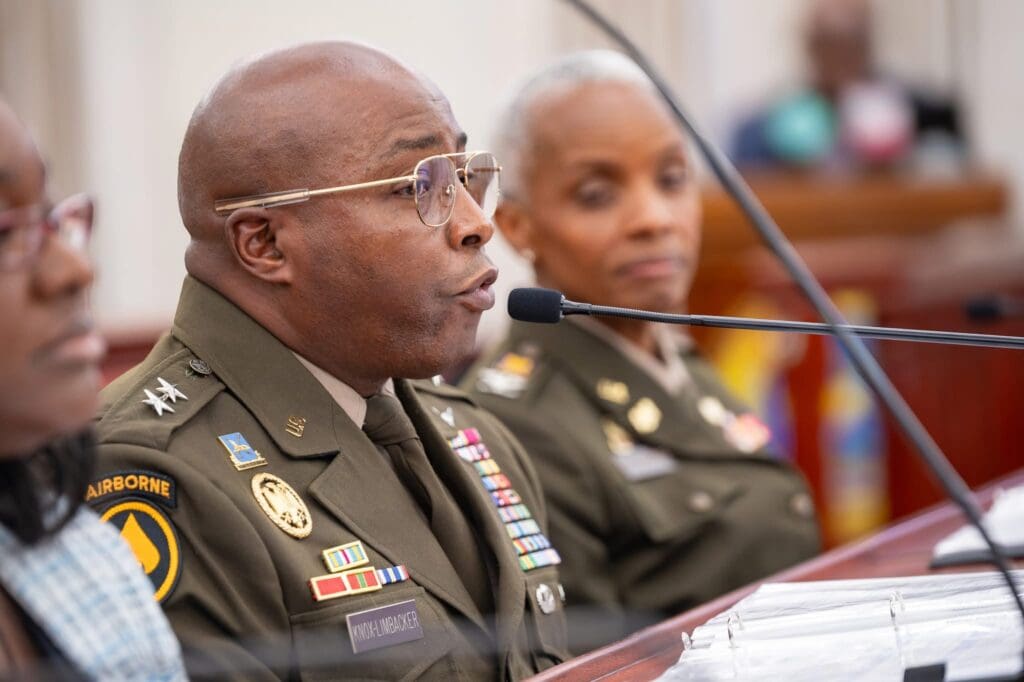
The head of the Virgin Islands National Guard Tuesday laid bare a series of critical concerns during testimony before the Senate Budget, Appropriations, and Finance Committee — from delayed payments to soldiers on duty, to the loss of the territory’s aviation assets and long-standing budget execution failures that threaten operations.
At the core of the hearing was VING’s fiscal year 2026 budget request: $3,243,939 from the General Fund, paired with $39.1 million in projected federal support. The federal share remains 12 times larger, and while it funds the bulk of operations, Adjutant General Kodjo Knox-Limbacker told lawmakers the local government’s portion is crucial for programs that directly serve residents.
That includes $982,242 for the Youth About Face and Forward March program, $150,000 for the V.I. National Guard Pension Fund, and $2.9 million to support core operations and territorial readiness. But Knox-Limbacker warned that the problem isn’t just what’s in the budget — it’s the lack of consistent access to funds that are already approved.
“Every year since I’ve been here, we’ve not been able to execute the money we were allocated and approved to have,” he said, citing delayed disbursements — including this year’s fourth quarter allotment — that impact security and maintenance requirements, among other things.
One of the most immediate concerns, he added, is how the territory funds Territorial Active Duty. These are often short-term mobilizations — such as crowd control during Carnival — when local agencies, like the V.I. Police Department, call on National Guard troops to assist. But while the agencies provide “funding lines” to cover the costs, the lines are often empty.
“When the funding line hits, there’s no money,” Knox-Limbacker said. “We’re left waiting for reimbursement, which can take significant time.” The delays have had real consequences. During this year’s St. Thomas Carnival, he said, soldiers declined to volunteer after not being paid for their service during the St. Croix festivities.
“I will not call my soldiers somewhere where they will not be paid,” Knox-Limbacker said. “And I will not ask them to volunteer.”
He urged lawmakers to establish a dedicated fund, calling it a “final solution set” to a long-standing problem that previous proposals failed to fix. Sen. Novelle Francis said the Senate had already met Monday night to draft legislation addressing the issue. Meanwhile, Sen. Kurt Vialet noted that just over $1 million in the Tourism Advertising Revolving Fund has also been earmarked for TAD and said he would follow up with VIPD to determine whether those funds are being used exclusively by the department.
Another issue raised was the loss of the territory’s aviation unit, once composed of two smaller helicopters and fully trained flight personnel. The story told Tuesday, in response to questions from Sen. Avery Lewis about the opportunities available for students interested in piloting, was personal for Knox-Limbacker, who explained that it was the reason he returned to the Virgin Islands in 2018. By then, the unit had already been dismantled; the aircraft reassigned and the personnel dispersed. Still, he said, the Guard was able to move the remaining team to Michigan, where they reached readiness level one and were successfully deployed to the U.S. Southwest border to support Homeland Security missions.
“We build our budgets based on forecasts and try to stay within those limits,” he said. “But what happens is, when agencies exceed their own overtime or spending projections, the money has to come from somewhere. And often it comes from us — agencies that are staying within a balanced budget.”
He added, “We don’t have a revenue problem in the Virgin Islands. We have a spending problem. And until that’s addressed, it’s going to continue to impact those of us doing things by the book — vendors don’t get paid on time, and services are delayed.”