

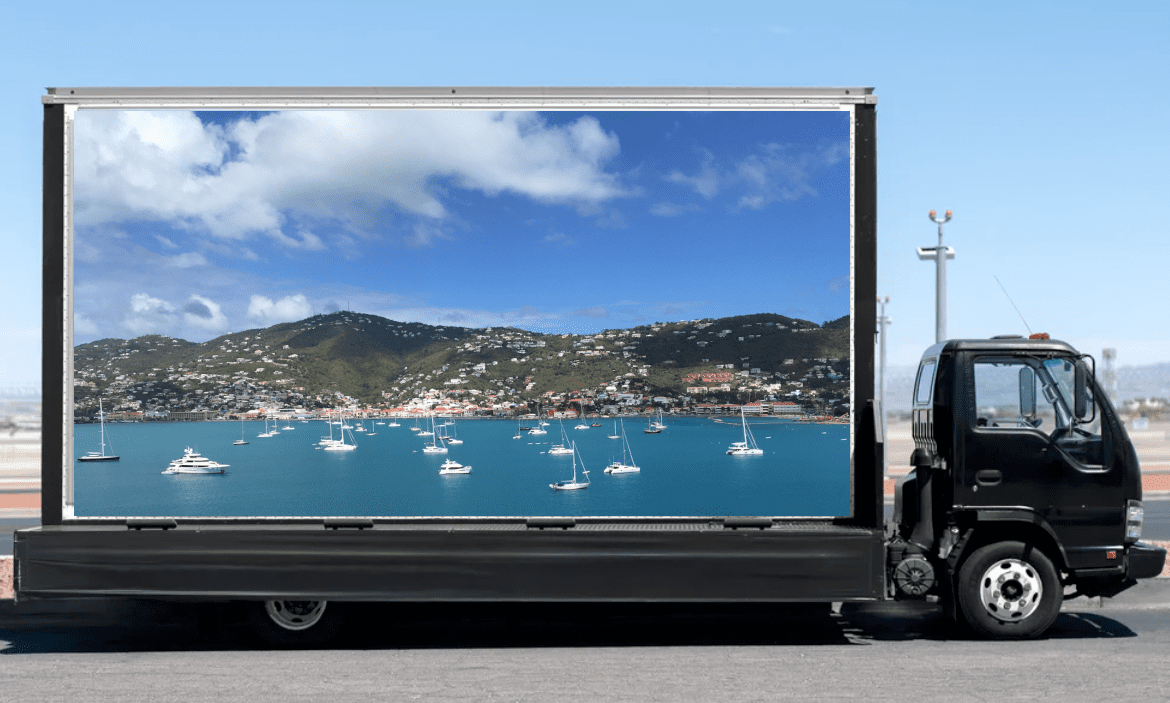
Virgin Islanders answered a call for comment on a giant digital billboard proposed to sit along the Weymouth Rhymer Highway — sending the Public Works Department more than 300 messages against the plan, said Commissioner Derek Gabriel, who has denied the permit.
Gabriel had said he was personally against the billboard proposed by a private company as it would dramatically change the nature of the landscape but wanted to gauge community sentiment as well. He sent out a request for public comment the first week of May, with a May 26 deadline.
The public poll results were overwhelmingly against the 10-foot-by-30-foot light-up billboard atop an enormous pillar near the Edith L. Williams Academy High School, roughly halfway between the turnouts for Cost U. Less and PriceSmart in central St. Thomas.
Some commenters were concerned that billboards can be legally tricky and certainly costly to remove once erected.
“Most really were concerned about aesthetics,” he said Thursday. “The last thing I want is for it to be an adversarial situation,” he had said earlier.
The denial did not prohibit the would-be billboard builders from revising and resubmitting their proposal, Gabriel said. Each permit application is considered on its own merit and Public Works officials plan to meet with the billboard company in coming days.
Gabriel did not say which company was behind the digital billboard proposal but one company, St. Thomas-based RockVision Media, sells advertising on digital billboards in Mandela Circle, at the Red Hook Terminal, and at the Tortola Dock in Charlotte Amalie.
The company boasts “seamless” relationships with the Division of Festivals, the University of the Virgin Islands, and marketers associated with the Virgin Islands Police Department and other organizations. The company’s website lists planned expansions.
RockVision’s website was also overt in leveraging the Virgin Islands’ natural beauty as a contrast to its signage. The website features prominent images of Fort Christian, Yacht Haven, the Virgin Islands Legislature, Charlotte Amalie Harbor, Main Street, the WICO dock, and other St. Thomas landmarks.
According to the website, RockVision is the “ … premier destination for cutting-edge billboard solutions in the captivating landscapes of the U.S. Virgin Islands. As the forefront leader in innovative outdoor advertising, we blend technology with creativity to bring your brand to life against the backdrop of our stunning island vistas.”
The proposed billboard was not the only signage issue up for debate in the territory.
Recent changes to laws governing public signs complicate the issue, Gabriel said, and opened the door to an era of free-for-all roadside signage.
Two weeks ago, the 36th Legislature overrode Gov. Albert Bryan Jr.’s veto of a bill from Sen. Marvin Blyden that lifted many restrictions on roadside signs.
The new law exempts temporary noncommercial signs, defined as “concerning an election, candidate, political committee, ballot question, referendum, public question, civic matter, religious message, ideological message, charitable message, community event, or other noncommercial expression.”
Blyden’s measure was not a bill of its own but an amendment tacked on to an unrelated proposal, meaning debate and public comment were limited.
Gabriel said the language of the new law was somewhat ambiguous. For example, would it apply to a for-profit company selling sign space for a noncommercial message.
The law also does not define temporary, only saying it must be taken down within 14 days of the event advertised. If the sign is permanent — like a large digital sign — but the message on it is temporary, is it permanent or temporary? Or what if a large digital sign is on a truck or trailer that can move? And if the event never arrives — like the ever popular message “Repent, the end is near” — what is to keep the territory from being littered with such signage?
Public Works officials were trying to discern the new law’s implications.
“We are still analyzing the overall impact but it essentially gives people the authority to erect signage wherever they want with our fees or approvals once it isn’t a for-profit cause. That’s going to cause real issues,” he said.
When vetoing the amendment, Bryan had said, “road signs can be an ugly impediment to our territory’s natural beauty and fines or fees are necessary to maintain order for the erection and removal of such signs in a timely manner.”
The most recent digital billboard proposal came just as a two-year moratorium on such signage was ending.
Laws about what signs are allowed and public opinion about them are not new issues.
In 2017, a private company proposed floating billboards in Charlotte Amalie Harbor. In 2018, then-Gov. Kenneth Mapp signed a law strictly limiting digital signs.