

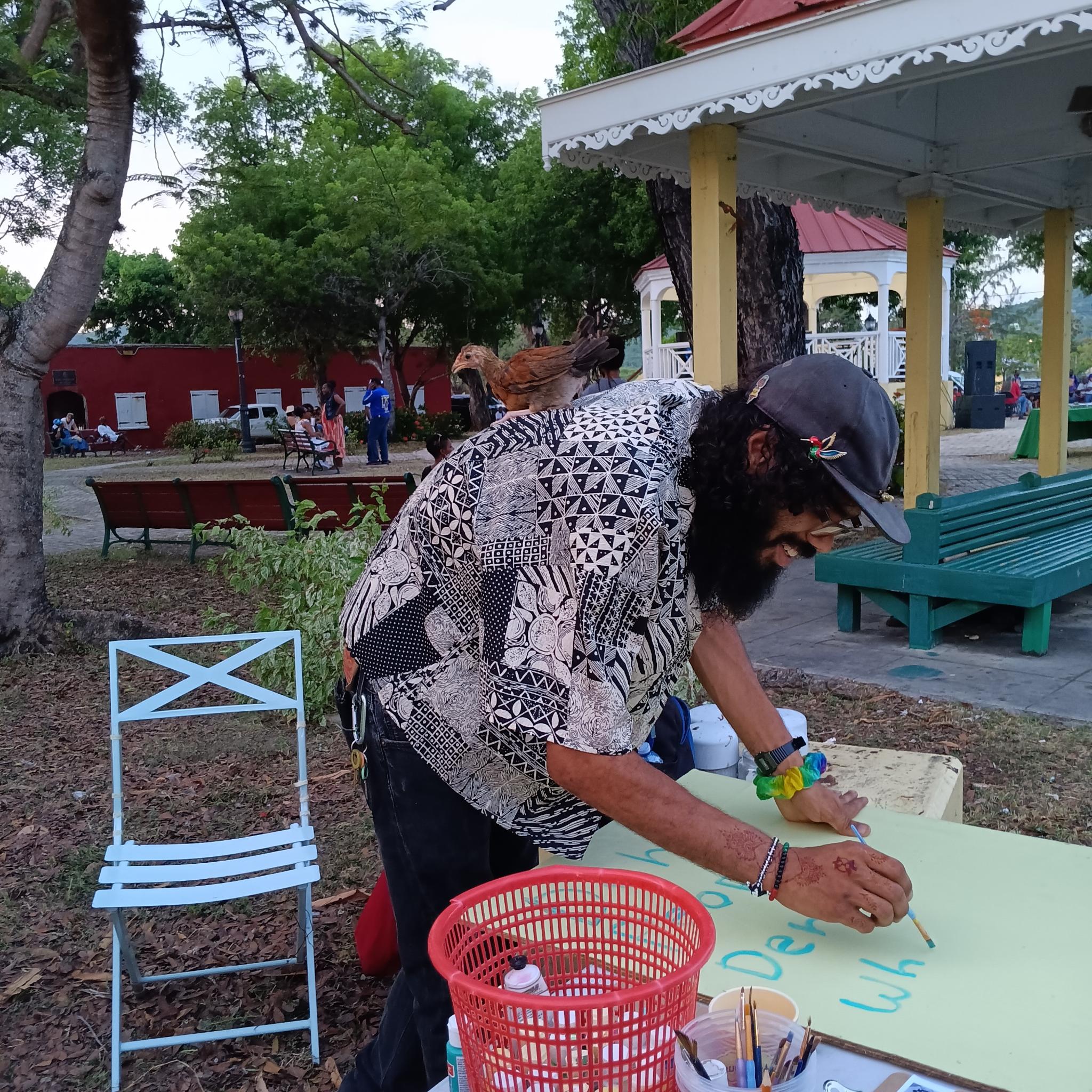
A new online project invites Virgin Islanders to re-explore and rethink “Ourstory” through archival records, Indigenous timelines, and historical storytelling, with the hope of fostering a deeper understanding of the territory’s past.
Launched by community organizer and decolonial researcher Dese Maynard, Liberation Gardens is an online educational platform dedicated to sharing cultural activities, archival materials and discussions surrounding the Virgin Islands’ past, from the very first plants and animals to the Indigenous communities that lived here for millennia to the more recent waves of migration.
For Maynard, the project is about more than preserving our stories. They describe Liberation Gardens as part of a larger effort to encourage what they call the “decolonization” of the Virgin Islands through education, community engagement and decolonial analysis.
“Full decolonization is a process that I’m unsure I will live to see in full fruition. Yet, I am only watering a seed planted long ago,” Maynard said.
They believe understanding our homeland’s stories requires looking beyond familiar narratives and examining how colonial systems have shaped modern life.
“I would say the largest issue I often recognize is a disconnection from our responsibilities to each other and our environment,” Maynard said.
According to Maynard, the idea for Liberation Gardens emerged after returning home to the Virgin Islands in 2022 following several years on the U.S. West Coast, where they lived and worked alongside Indigenous-led community organizations. Those experiences demonstrated how communities could preserve cultural traditions that contributed to and maintained strong relationships with the natural environment.
Shortly after returning home, Maynard’s mother, Jo Zepp, died by suicide following years of chronic illness. They describe the loss as a deeply personal turning point that reinforced their desire to help build stronger, more connected communities.
“While that has been a wound that has taken a lot out of me, it also was a catalyst to build communities where elders are connected, valued, and health care is a right,” Maynard said.
Although Liberation Gardens has gained limited visibility through Facebook, Maynard said the project extends well beyond social media.
“This work is done every day offline,” Maynard said.
They noted that local elders, members of the Rastafarian community, inspirational young people and other community members have helped sustain the initiative.
They described social media as a modern public square where Virgin Islanders can reconnect with our stories while engaging in discussions about culture, identity and ecological preservation.
Maynard said their intended audience is broad.
“My primary audience for Liberation Gardens is all the people of the Virgin Islands. I believe that our stories are powerful, tragic, and full of lessons that, if we examine and learn from them, would have us living in the paradise others think we do,” says Maynard.
They write poetry and have recently published another growing project. Maynard recently released “Waves of Invasion & Waves of Migration: Precolonial Indigenous Timeline of Cruz,” the first publication in a larger historical series examining the island of Cruz’s different waves of people that have come together to make the modern Crucian.
Future works will explore Indigenous resistance during European colonization and include a biomythographical fiction series centered on the hero Augustus of Concordia. Augustus was one of the people involved in and executed following the 1848 emancipation movement on St. Croix.
Looking ahead, Maynard said they plan to continue expanding Liberation Gardens through additional research, publications and community engagement.
“This, the fictional ancestral background of Augustus of Concordia, has been an amazing piece to research and work on. I am very excited to share more as it comes together,” Maynard said.
Those interested in following the project can find Liberation Gardens on Facebook, Patreon, and Instagram, where Maynard regularly shares cultural documents, educational resources, updates on upcoming publications, and other decolonial work being done throughout the Caribbean and the Global South.