

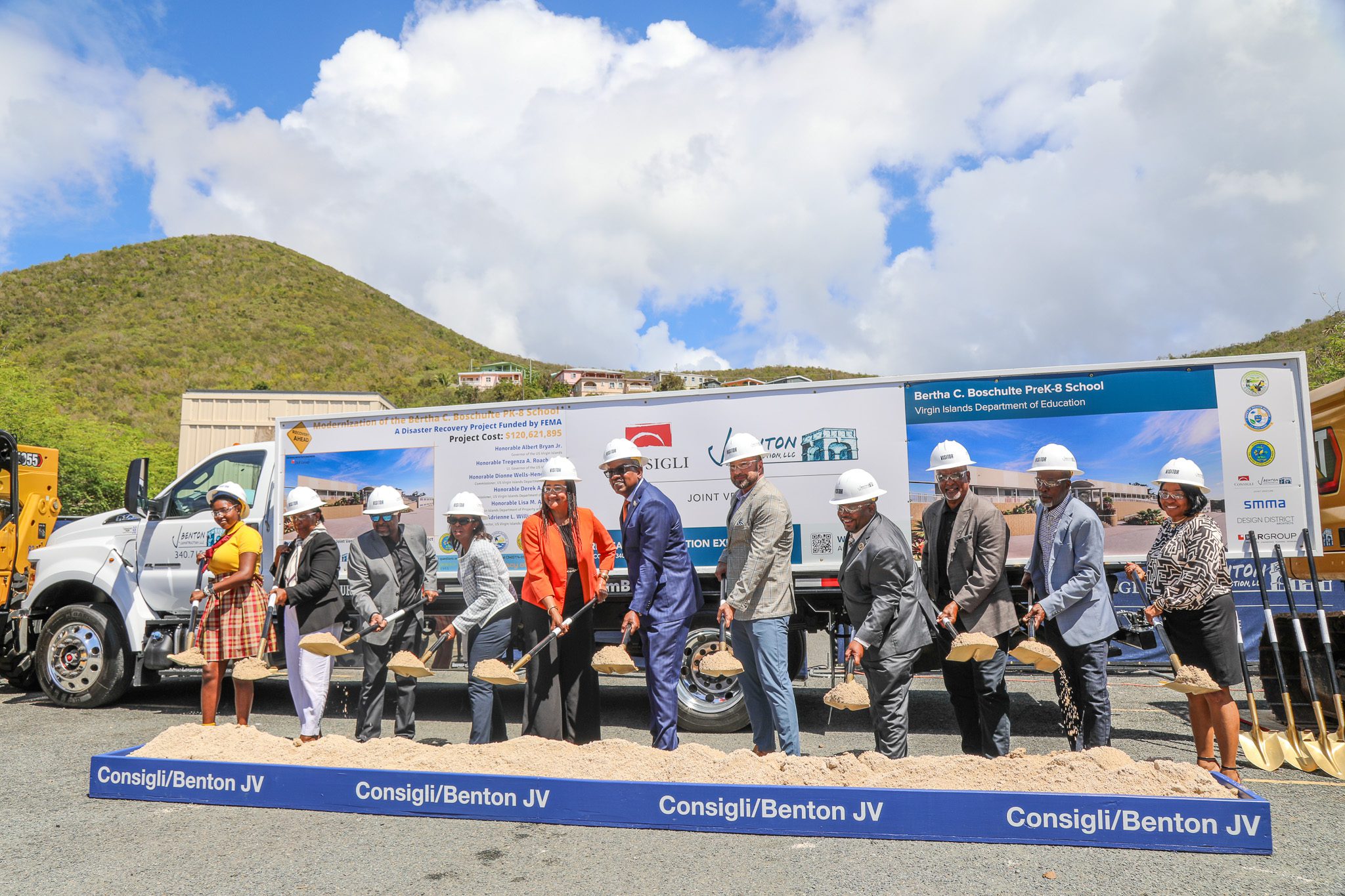
The government of the Virgin Islands has broken ground on a $120.6 million modernization project at Bertha C. Boschulte Middle School — a long-awaited step forward for a campus that, until recently, had become a clear example of how strained school conditions have been across the territory.
Those conditions have been well documented. In October, teachers did not report for duty, forcing an early dismissal over concerns about mold, heat, leaks, and failing air conditioning systems. Weeks later, during a walk-through of the campus, Senate President Milton Potter described classrooms where buckets caught water dripping from ceiling vents, with doors and windows propped open just to keep air circulating. “We definitely can’t function like this,” Potter said at the time, calling for urgent action and greater accountability between agencies responsible for school maintenance.
By January, the school shifted to a shortened schedule, with classes ending at midday as conditions persisted. Principal Terrence Corbett said at the groundbreaking ceremony that it’s only within the past two weeks that BCB has returned to a full day, following targeted repairs by the Bureau of School Construction and Maintenance and J. Benton Construction, working in partnership with Consigli. In the interim, classroom and building doors remained open throughout the day to help circulate air, even as crews began replacing aging units and stabilizing conditions across campus.
Now, that stopgap work is transitioning into a broader rebuild. The project, led by the Education Department in partnership with the Consigli/Benton Joint Venture and the Office of Disaster Recovery, will overhaul the existing 14-building campus — replacing aging systems, upgrading ventilation and chilled-water infrastructure, and reworking classroom and shared spaces to meet current building standards. Plans also include improved circulation across campus and more durable materials aimed at reducing the kind of maintenance issues that have plagued the school for years.
Contractor James Benton said crews have already begun early-phase work on site under a limited, early-release scope, including removing and replacing outdated air conditioning units. He said the project is now moving through additional approvals, with full mobilization expected by the start of the next school year. In the months ahead, Benton said residents should expect to see increased activity on campus, with materials arriving and crews expanding work across multiple areas.
Because the school remains in use, Benton said construction will be carried out in phases — taking buildings offline one at a time and coordinating closely with the Department of Education to minimize disruption. That approach, he noted, adds complexity and can slow progress, but is necessary to keep the campus operational. He added that while some delays are always expected in projects of this scale, the goal is to avoid anything significant enough to derail progress as work ramps up.
But even as construction begins, officials are clear about the scale — and the pressure — of the recovery effort. Office of Disaster Recovery Director Adrienne Williams-Octalien said the territory is managing roughly $4 billion in school-related projects, but acknowledged the pace has not kept up with the need. The territory, she said, should be moving closer to $1 billion a year in construction spending to stay on track for a 2035 completion timeline — a gap that underscores how much work remains.
Education Commissioner Dionne Wells-Hedrington called the groundbreaking “a good day for the BCB family,” pointing to years of planning and persistent facility issues, while Gov. Albert Bryan Jr. said the moment reflects a shift from planning into execution, even as the territory faces ongoing constraints in labor, infrastructure, and capacity.