

With sea surface temperatures reaching a scalding 91.4 degrees Fahrenheit during summer and autumn, 2024 may be the most difficult on record for coral in territorial waters, researchers and government officials said Wednesday.
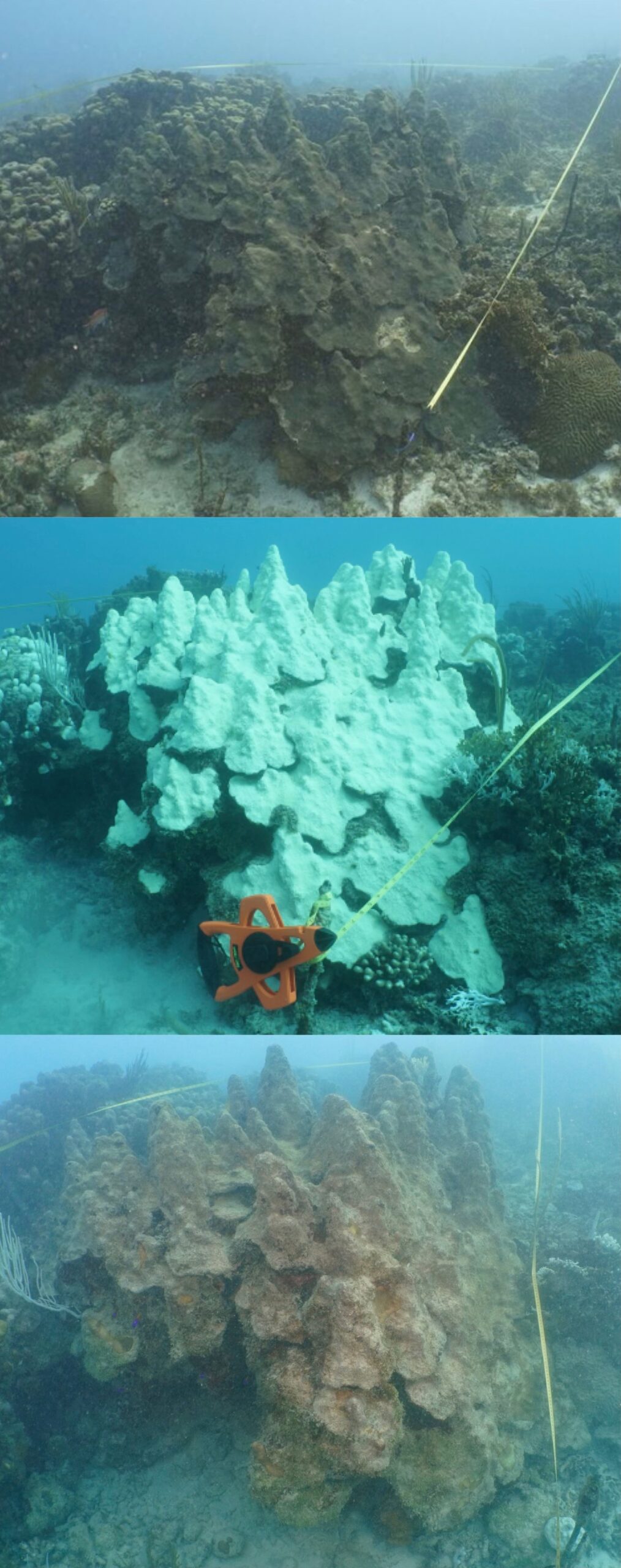
Virgin Islands coral are unlikely to survive such abnormally high sea temperatures, which led to unprecedented mass bleaching, said Department of Planning and Natural Resources Commissioner Jean-Pierre Oriol. In some areas, 100 percent of coral being monitored died.
Cooler winter sea temperatures may help return the vital undersea reef builders to their natural, healthy, vibrant color, but they will remain weak and struggling, said Coral Disturbance Response Coordinator Courtney Tierney in a written statement from DPNR.
“As we transition from the heat of summer and fall, water temperatures are decreasing, which is positive news for coral,” Tierney said. “They are weakened from the stressful bleaching and are now more vulnerable to disease and other threats.”
Some of those threats can be addressed locally while others require generally elusive global cooperation, said Tyler Smith, a professor at the University of the Virgin Islands Center for Marine and Environmental Studies.
“The Caribbean is really bad, and the last two years have seen unprecedented warming throughout the Caribbean Basin, including up into Florida and the Gulf of Mexico. We’ve just seen mass bleaching throughout the entire region in both years. So, 2023 was really bad, the worst it’s ever been. 2024 was worse. So we’ve entered this cycle. We don’t know if this is going to continue,” Smith said. “We’re noticing warming temperatures over time. They’re going up in a linear way. And then the rate of marine heat waves where we have these anomalously warm temperatures at the warmest time of year that can cause these core bleaching events are also increasing the frequency. And so it looks like it’s a trend just going in that direction.”
Coral, he said, are an early warning indicator species. If they die, something else may be not far behind. Like the canary in the coal mine warning miners of poison gases, coral health is a predictor of overall environmental fitness.
In October 2006, Smith told The Source the Virgin Islands’ coral — which is vital to the tourism industry, as well as for fish habitat and storm surge protection — was at its lowest levels ever recorded. He and other researchers said up to 30 percent of the world’s coral reefs had died since the 1950s and another 30 percent were severely damaged. The scientists estimated by 2031, as much as 60 percent of the world’s coral could be dead.
Exactly how that amount was measured was difficult to quantize, he said Wednesday morning but reiterated much of the threat to coral came from rapidly warming sea temperatures caused by carbon dioxide in the atmosphere. Hot water can cause coral to starve and die.
While Virgin Islanders have little impact on global greenhouse gas emissions and potential international efforts to curb them, Smith said there are things people in the territory can do to help.
Like elsewhere in the world, USVI coral can be damaged and even killed by toxic chemicals like petroleum products, clouds of sediment from improperly secured construction sites, and the probing hands of curious snorkelers and scuba divers, Smith said.
Coral and the reefs they build provide three services vital to the territory, he said.
Coral reefs create natural storm-surge protection. Millions of years of reef buildup allow for the placid waters of Christiansted Harbor. No amount of man-made artificial reef could compete with what’s there now, Smith said, especially given nature did it for free.
Secondly, healthy coral are beautiful. Photos of vibrant Virgin Islands coral reefs helped draw visitors from around the world to the territory in the mid-20th Century and helped create the tourism-based economy in place today.
Coral are also behind the territory’s picture-postcard white-sand beaches. A breakdown of coral skeletons and the limestone carrying algae on coral systems washes ashore, he said. Without renewal from living reefs, the beaches may be in trouble.
Those reefs are also important fish habitats. Parrot fish, spiny lobsters, and other colorful undersea life take shelter in the coral skeletons and symbiotically clean the coral of algae and other debris. While beautiful in themselves, the fish are an important cultural marker, food source, and point of pride for Virgin Islanders, Smith said.
Overfishing can devastate coral reefs, he said, but careful use of fisheries can rehabilitate even nearly extinct species.
“A really good example of that in the Virgin Islands is the Nassau grouper. And this is a very large grouper species. They’re delicious. They’re also kind of dumb in a way that they could get caught very easily. You know, they’ll turn sideways to you if you’re a spear fisherman and just kind of present their body. They like to go into fish traps. They can be somewhat easy to catch. Well, these fish were here in the thousands and maybe the hundreds of thousands 50, 60, 70 years ago,” he said.
When fishermen started targeting their spawning habits, the Nassau grouper population dropped dramatically to the point of near extinction.
Local and federal laws protecting the fish have helped it come back from the brink, he said.
“This is very exciting because we thought they were almost extinct from the Virgin Islands. That population has been growing. And in the last few counts of the last few years, it’s over a thousand fish,” Smith said.
These success stories help offset the doom and gloom of the dire state of coral reefs, he said, while serving as an example of what can be achieved through concerted efforts.
“We need to come together on climate change. Fish, we actually can really control,” he said. “You can actually control the amount of fish in this system, by the actions. And so if we think long term, we can have vibrant fisheries in the Virgin Islands. And by balancing the needs of the people who are catching the fish and use that to sustain their livelihood, and the needs of the ecosystem that need those fish to perform functions, and also the population of those individual species of fish that need to replenish themselves, to carry on through time.”
Coral health requires a much larger effort but one with precedent. Dangerous holes in the Earth’s stratospheric ozone layer were repaired by banning or largely reducing emissions of chemicals like chlorine and bromine.
There are novel new ideas to help coral, such as vitamin supplements. But real change will require limiting fossil fuel use, which will decrease the amount of carbon dioxide absorbed by the ocean.
“And even if we stopped emitting carbon dioxide right now as humanity, just the system itself will still be warming for another twenty plus years just because of the carbon that’s already been released. So even if we are able to control it now, we still have this lag time where it’s not gonna kick in. But that means we hate to do it now. I mean, that’s the, you know, the warning cry for humanity is that we need to do it now,” Smith said.
There’s another reason people should care about coral, he said, and it has nothing to do with tourist dollars, the food chain, or protecting against hurricanes. There’s a beauty in respecting the sanctity of life.
“There’s a spiritual aspect, or the emotional aspect, of having a healthy ecosystem and seeing, you know, vibrant communities how they should be,” Smith said. “That’s the one where I got most involved in marine science because I was so interested in this beautiful system that had to integrate relationships among the organisms. And so that’s what spurred me to become an ecologist. So that’s important to me. But I think other people take almost a, you know, something that’s deep within humanity in terms of looking at nature and seeing that it’s functioning properly and then it’s undamaged and you think things are able to, you know, carry on, like they had done in the past.”