

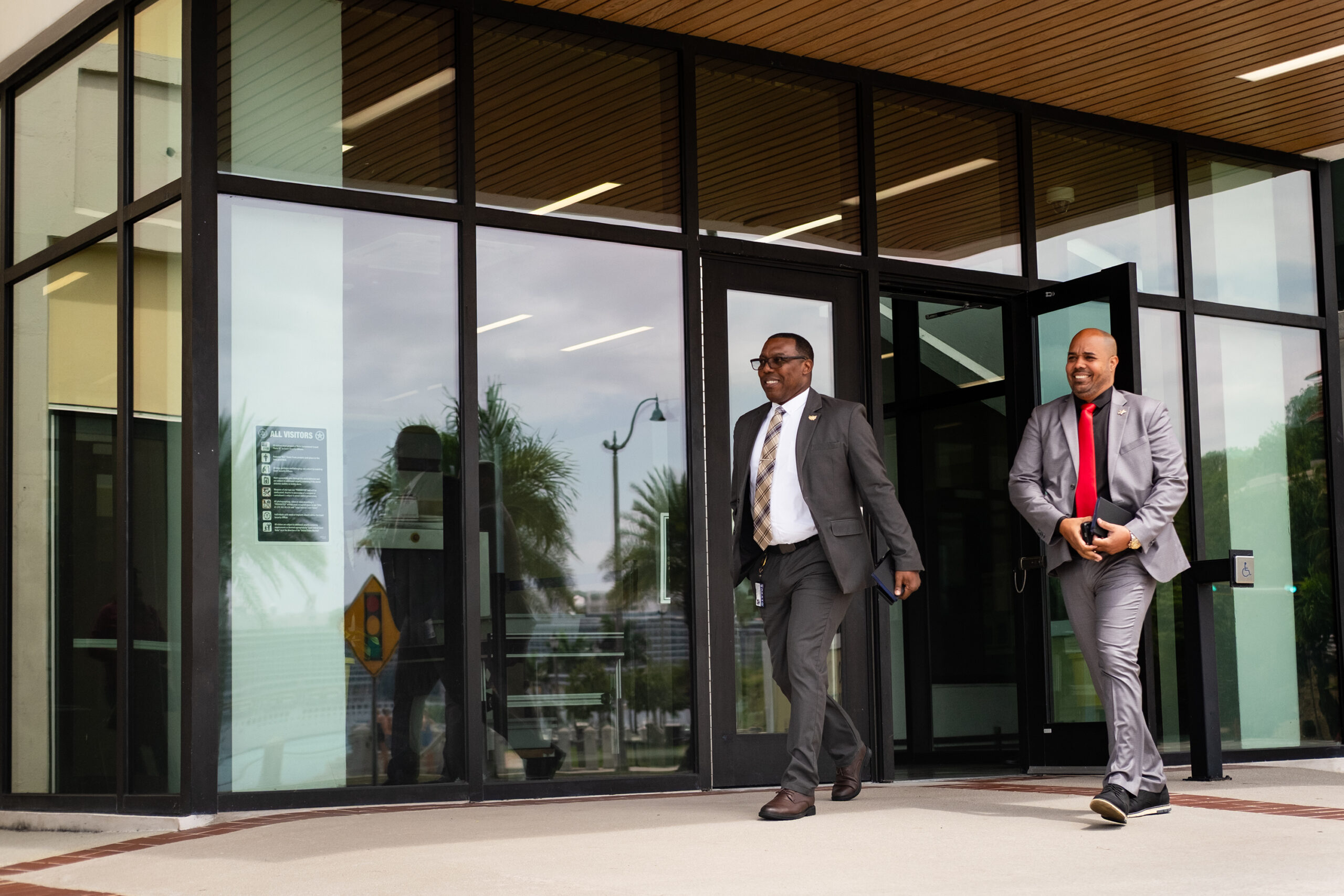
The V.I. Police Department is in substantial compliance with all provisions of a federal consent decree, but work remains before the department can emerge from nearly two decades of federal oversight.
“Don’t ease up off the gas,” U.S. District Court Chief Judge Robert Molloy cautioned during an evidentiary hearing Thursday. “Full throttle.”
Molloy granted the territory’s request to terminate oversight of provisions related to VIPD’s handling of citizen complaints following two years of sustained compliance. The request was supported by the U.S. Justice Department and the independent monitor, Sydney Roberts, in a quarterly report submitted to the court last week.
Much of the hearing involved testimony and questions about the department’s use of force investigations, which Molloy noted had been a “thorn in the side” of VIPD for years. The department previously attained full substantial compliance in 2019 but stumbled at the finish line amid what the Justice Department described at the time as “instances in which officers deployed Tasers against individuals who did not pose a threat to the safety of officers or others, and VIPD’s supervisors and command staff did not recognize or address these unreasonable uses of force.”
In the most recent monitoring report, Roberts noted that use of force incidents were “thoroughly investigated, contained descriptive narratives of the facts, appropriately reported and/or identified the force used, uncovered investigative deficiencies, where applicable, and corrected before closure.”
“More than three-quarters of the department’s UOF investigations were completed in accordance with policy, and for those that were not, most reflected some level of accountability for the investigator responsible,” the report added.
According to testimony given Thursday, the department has five open investigations into Level 1 uses of force, which involve an officer using deadly force. A status report VIPD filed in U.S. District Court Tuesday notes that one of those cases is awaiting a Force Review Board hearing and the remaining four “are either under review, being investigated, or… have been referred to the V.I. Attorney General for prosecutorial opinion.”
At least one of those cases refers to the July 17 killing of Alejandro Torres III, who was shot by police in the LBJ Gardens neighborhood on St. Croix. VIPD spokesperson Glen Dratte told the Source last week that the case is still under active investigation but did not respond to questions about whether the officers involved have returned to active service. Neither did VIPD Public Information Officer Glen Dratte provide an update on the Source’s long outstanding public records request for body-worn camera footage of the incident.
VIPD’s body-worn camera policy states that “Copies of BWC video files for release pursuant to a public records request or as authorized by the Commissioner or designee, shall be redacted, as required by law and Department procedures, prior to release.” A separate section titled “Non-Departmental Requests” states that public records requests “shall be accepted and processed, in accordance with the provisions of federal and territorial law and forwarded to the Project Administrator.”
Yet another section gives investigators who are “conducting criminal or internal investigations discretion to “Advise the Project Administrator or System Administrator to restrict public disclosure of the BWC file in criminal or internal investigations, as necessary” and to “Notify the System Administrator to remove the access restriction when the criminal/internal investigation is closed,” but the Virgin Islands Code defines “public document” as “any public record, regardless of format or purpose, supported in whole or in part by public funds” including “printed or audio-visual forms of communication and their accompanying technology.” Exceptions to public access include medical records, trade secrets, and “Peace officers’ investigative reports, except where disclosure is authorized elsewhere.”
Use of force investigations are typically opaque. VIPD’s policy requires that supervisors respond to the scene and investigate any use of force incident, and the department’s Internal Affairs Bureau is required to conduct an administrative investigation into any incident involving serious physical injury or death. The government’s collective bargaining agreement with the department includes a provision stating that “The employer shall not publish in any news media or for public consumption the names of employees covered by this Agreement who have been disciplined under internal disciplinary proceedings.”
The CBA may also give employees broad cover by setting a 50-day statute of limitations on filing internal disciplinary charges.
Deputy Commissioner Jason Marsh, who heads the department’s Professional Standards Division, testified Thursday that lower-tier use of force reviews are supposed to take up to 120 days to clear and Level 1 incidents up to 180 days, per VIPD policy. In practice, Internal Affairs Director Vivianne Newton testified, the investigations can take longer while the bureau waits for things like medical reports and chemical tests.
The workings and timelines of internal Level 1 investigations can be glimpsed in a V.I. Licensing and Consumer Affairs Department document filed in V.I. Superior Court last week.
Dated May 2025, the document outlines the department’s decision to fire an enforcement officer, Chelston Richardson, who was on loan to the V.I. Police Department. In October 2022, Richardson triggered a Force Investigation Team investigation when he “discharged his department-issued H&K UMP 40 submachine gun at a moving vehicle,” according to the DLCA. The Force Review Board determined that the shooting was unjustified 19 months later, in May 2024, and forwarded their findings to DLCA two months after that.
Richardson contested the firing and asserted that he was in immediate physical danger when he fired at the car, which sped away after officers asked its driver to exit.
According to the DLCA’s review of body camera footage captured by another officer, J’Moy Francis, “At no point was the driver driving directly towards Richardson. The video showed that Richardson had walked into the roadway when he fired the shots. Based on the direction of the shots fired by Richardson, they were fired in the direction of another VIPD Officer and a stopped white vehicle located across from where the initially stopped vehicle was located.”
DLCA’s description of the incident contradicts what officers initially reported in a sworn affidavit when they arrested the driver and recommended charges of attempted murder, first- and third-degree assault, reckless endangerment and other offenses. A later affidavit from VIPD’s watch commander noted that it was Richardson and Francis who opened fire on the fleeing vehicle, and most of the charges were dropped.
Prosecutors later asked to dismiss the case altogether because VIPD failed to turn body camera footage over to the defendant, and a judge prohibited them from using the outstanding footage at trial.
“The People will be unable to prove their case beyond a reasonable doubt at this time,” Assistant Attorney General Eugene James Connor Jr. wrote.