

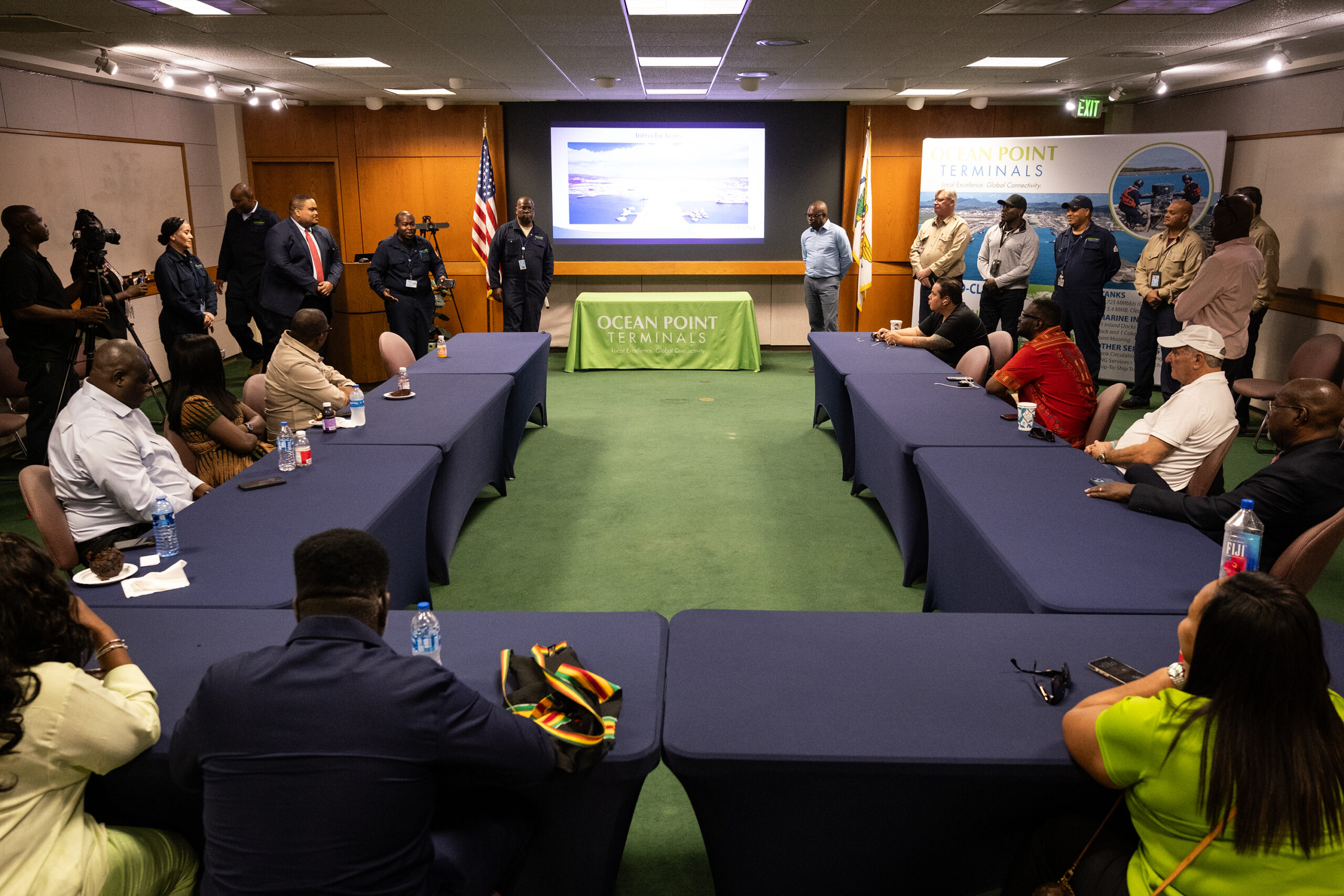
The Virgin Islands government’s courtship of foreign business relationships and investment continued Wednesday as visiting officials from Ghana and the African energy sector visited St. Croix’s south shore for tours of Ocean Point Terminals and Port Hamilton Refining and Transportation.
The back-to-back tours came one day after Gov. Albert Bryan Jr. and Maame Efuo Houadjeto, chief executive of the Ghana Tourism Authority, signed a memorandum of understanding between the Ghanaian and U.S. Virgin Islands governments during a “USVI-Africa Mini Summit” held at the Westin Beach Resort on St. Thomas and two months after Virgin Islands officials visited Ghana in what Bryan called a project “to connect Ghana to the Western Hemisphere” by strengthening cultural and economic ties. The territory could also become connected to the continent in a more literal sense. Delegate to Congress Stacey Plaskett reintroduced legislation in March requesting a feasibility assessment for the “DiasporaLink” — a trans-Atlantic undersea fiber optic cable connecting the United States’ east coast to Ghana and Nigeria which would pass through the USVI.
Wednesday’s tour was attended by Houadjeto and other tourism officials, Access Bank Ghana Executive Director James Bruce, representatives from PWP Energy Partners, Nigeria-based International Sustainable Energy and Construction and others. Local representatives included V.I. Labor Commissioner Gary Molloy and Kevin Rodriguez, Bryan’s deputy chief of staff and chair of the V.I. Economic Development Authority board.
Rodriguez called this week’s visit a “spinoff” of the government’s trade mission in November and pointed to opportunities for Ghana to ship raw goods like cocoa, shea butter and textiles to the territory where they can be developed by Virgin Islanders for export to the United States. Connecting with Ghana’s energy sector, he added, could put the Virgin Islands in a position where it no longer has to source fuel from Puerto Rico — potentially leading to savings at the pump, he said.
Rodriguez said they’ve been keeping federal agencies like the U.S. State Department in the loop.
“Whatever we need to do, we’re gonna do it,” he said, adding that officials began their Ghana tour with a visit to the U.S. Embassy, who had “eyes on us” throughout their time there.
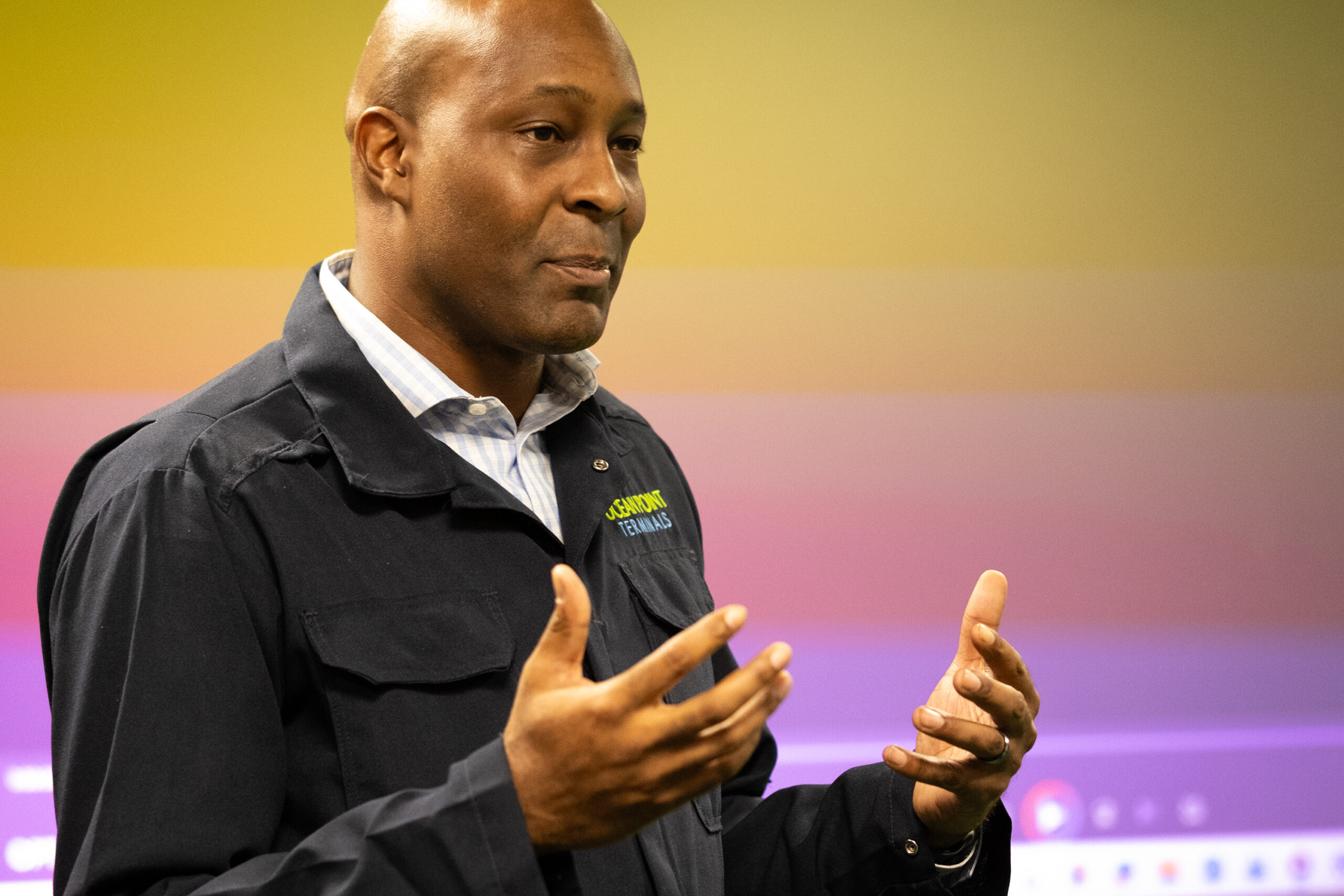
Tour attendees heard first from Ocean Point’s Chief Operating Officer, Jeff Charles, who explained that the fuel hub and marine facility, which can store up to 34 million barrels of crude and petroleum products across 167 tanks, handles logistics for multiple customers. The facility can store and blend oil and fuel, and break bulk into smaller shipments to accommodate smaller regional ports.
“We’re very busy, and we’re doing it very quietly,” Charles said. Throughout his presentation, Charles stressed Ocean Point’s ability to adapt to fit the needs of its customers, whether that means adding a hot oil heater for one client or retrofitting one of its 11 docks to accommodate Puerto Rico’s intake of liquefied natural gas. Asked about renewable energy services, he said: “if I can’t do it today, I can probably do it tomorrow.”
Attendees next visited with leadership from the Port Hamilton refinery — which members of the media were not invited to attend because it involved potentially proprietary information — before touring that part of the facility.
The dual presentations and tours fell on the same day Secretary of State Marco Rubio told the Senate Foreign Relations Committee that following Armed Forces’ removal of Venezuela’s president, Nicolas Maduro, and his wife, Cilia Flores, earlier this month, the United States will allow the country to sell tens of millions of barrels of crude oil while temporarily maintaining oversight of the revenues through the U.S. Treasury Department. The revenues will be used to support basic government services in the country, he said.
While that could present an opportunity for the U.S. Virgin Islands, Bryan scarcely mentioned the refinery during his final State of the Territory address Monday night. He mentioned the refinery eight times during his 2025 address, in which he called for a safe restart and noted that it could generate as much as $400 million annually — $45 million of which would flow into government coffers — and bring more than 400 jobs to St. Croix. This year, both mentions of the refinery were brief references to the impact of its closure.
After Bryan’s speech, Delegate to Congress Stacey Plaskett noted that “there are a lot of Gulf refineries that have been operating that also refine Venezuelan crude.”
“So while we are looking at every opportunity, we’ve got to continue diversification and ensuring that that space, while it may have refining or topping…that it’s also looking at other utilization of the space that’s there, and… pushing us forward, so that we’re looking at other forms of energy as well,” she said.