

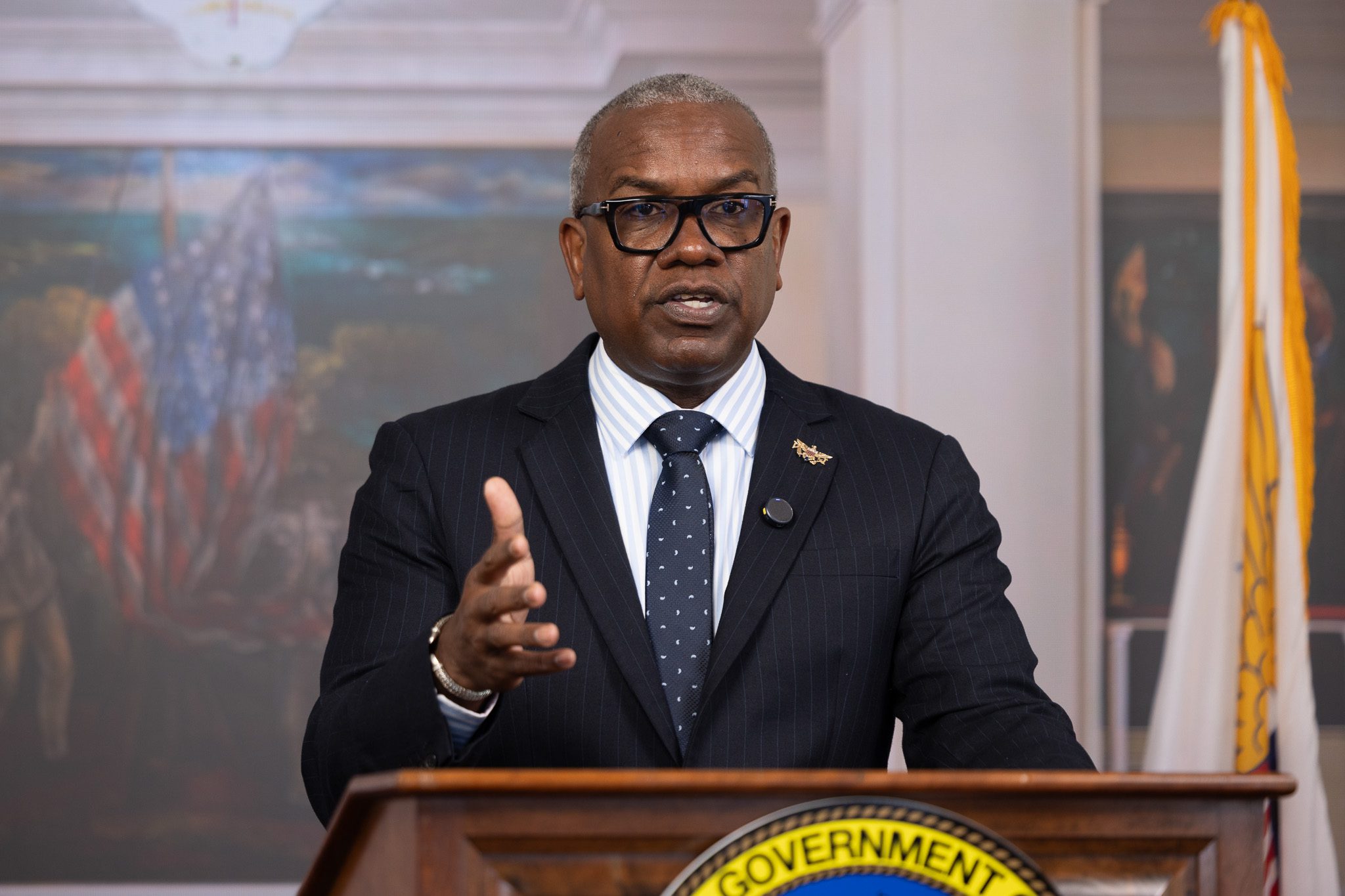
While residents on St. Thomas and St. John continue to grapple with unreliable power, an optimistic Gov. Albert Bryan Jr. said during a press briefing Tuesday that the territory’s recovery projects are “on track,” and he urged the next administration not to “get any bright ideas about changing this course.”
“It’s all there — it’s all paid for,” he said. “Like, don’t rock the cradle.”
Virgin Islanders have become increasingly frustrated with pervasive outages and rotation schedules, particularly on St. Thomas and St. John. While both of the territory’s power plants are slated for FEMA-funded replacement, WAPA chief executive Karl Knight said earlier this month that temporary generators — which will carry the load on St. Thomas during the Randolph Harley plant’s overhaul — will be installed approximately 12 months after their date of purchase. On Tuesday, Bryan appeared to offer a more optimistic timeline.
“Any temporary generator is four to six months away,” he said. “Right now we’re having a little problem with two of the Wartsilas down there — we try and fix them, you know…. It’s not like you can go and buy a Honda generator, plug it into your house. It’s way more complicated than that. We’re gonna get it ironed out.”
The territory’s last major generator procurement did not go smoothly. Four Wartsila units arrived in the territory in 2021 and collected dust for years until they were finally commissioned in early 2025. The generators were heralded for their purported ability to cut costs by running either on diesel fuel or cheaper liquefied petroleum gas, but they quickly experienced what one WAPA official called a “catastrophic failure” when the utility attempted to run the generators on LPG.
V.I. Public Services Commission Chair David Hughes called the engines “experimental” during a recent PSC hearing and said they “are clearly not working out very well.”
“They were probably an ill-advised purchase by WAPA,” he said. “There is no one running this engine anywhere that I am aware of because they have not sold a single other one to a sole entity.”
When pressed by a reporter Tuesday about the utility’s track record — including its disastrous engagement with European energy supplier Vitol, its loss of more than $2 million to email scammers, and its ongoing issues with the Wartsilas — Bryan said it wasn’t about bad decision-making but rather “the failure for us to stay focused.”
“You got to stay the course on these problems because they’re big problems. They don’t solve in a night,” he said. “When we talk about temporary power for WAPA? Six months, best case scenario…. You think I want to be talking about WAPA all the time? I don’t want to be talking about WAPA. I want to be talking about other things that are happening positive around the place, but it takes so long to get these things implemented. Unless everything going well, there’s always some little snafu.”
Nearly 10 years since hurricanes Irma and Maria, the territory has yet to complete many of its major disaster recovery projects. On Tuesday, Bryan said most of them weren’t feasible until the Biden administration increased its cost share to 95 percent for most projects and 98 percent for critical infrastructure projects.
“And that’s how we can finally get these large projects like the schools and the hospitals going, because now we have the funding to be able to do it,” he said. ‘It’s freed up hundreds of millions of dollars.”
The larger concern for hospitals may be less about new facilities and more about the growing number of uninsured patients and the rising costs of providing uncompensated care. Luis Hospital estimated that it would provide nearly $39 million in uncompensated care in 2026 during a Senate Finance Committee hearing last summer, and Schneider projected more than $36 million. Frederiksted Healthcare expects to absorb $10 million in uncompensated care costs next year, and the St. Thomas East End Medical Center Corporation recently told lawmakers that more than a third of the care it provides generates little or no revenue.
Bryan said Tuesday that he’s continuing to urge the Legislature to issue a referendum.
“Are we willing to pay one percent of our salaries towards health care, towards the homelessness, towards the mental illness, towards all the people who abandon their loved ones in the hospital — and we have to take care of them — toward all the people in behavioral health that we gotta take care of? Something’s gotta give, folks,” he said. “The money’s got to come from somewhere.”
Bryan said later that Virgin Islanders “can’t keep complaining about the problem if the Legislature ain’t even willing to put… the referendum on a ballot to let the people vote on it.”
Tuesday’s briefing came a day after key stakeholders in another major infrastructure project, the public-private rebuild of the territory’s airports, once again raised doubts about the projects’ economic viability and the V.I. Port Authority’s financial transparency. In an open letter to Bryan and VIPA Director Ava Penn, representatives from seven airlines said the territory’s airports “risk becoming less competitive than comparable airports in the U.S. and Caribbean.”
“Don’t let the airlines fool you,” Bryan said Tuesday. “They’re just repeating their burden because they don’t want to pay at all.”