

Introducing Business Matters, a new feature from the Source staff created specifically for local businesses. Our goal is to explore issues that impact business success, from branding and marketing to broader trends shaping both brick-and-mortar and online commerce.
Confusing. Scary. Useless. Irrelevant. Game-changing.
Pick one: that’s how differently AI is being described now.
If AI systems are being adopted and being used by businesses more and more, there’s still no clear consensus about their value – especially for small businesses that lack the deep pockets for trial-and-error.
Fortunately, sound guides and recommendations are beginning to emerge.
A recent article from the University of Rhode Island’s Small Business Development Center points out that the key to capitalizing on AI lies in using AI to “speed up execution, not replace human decision-making.”
That is, AI works as a tool: you use it. It doesn’t use you – or replace you!
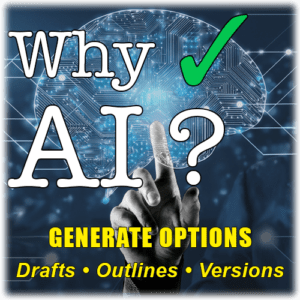 Where AI Works Effectively for Your Business
Not surprisingly, AI excels at handling routine often tedious sales, marketing and communications tasks.
For example, AI can be used to produce first drafts and outlines of all kinds of print and electronic communication.
It’s also adept at generating multiple versions of headlines and body content, even visuals, as well as repurposing content for varying formats.
For example, with a prompt, you can have an AI program serve up five, ten or more variations on headlines for ads or blog posts or sales copy – something that might take hours even for your experienced and knowledgeable team.
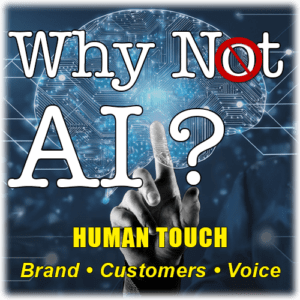 Where AI Must Be Managed
Just as important as understanding where AI can be an effective tool in your business is the awareness of where it won’t help.
In many critical areas, you and your team should maintain “oversight” of AI generated content – just as you would work product created or proposed by any outside contractor.
Some of this content represents the heart and soul of your business. For example, the Small Business Development Center specifies the following as tasks where human oversight remains paramount:
— Brand voice
— Messaging priorities
— Offer developments
— Customer understanding
— Fact checking
Note how all of these areas involve judgment and special understanding of human dynamics and relationships that may remain elusive blind spots to even the best AI systems.
AI can clearly assist in developing more effective business tactics – and it pays to take advantage of these capabilities.
But the fact remains, “AI helps teams using it move faster, but strategy remains human-led.”
Full article: