

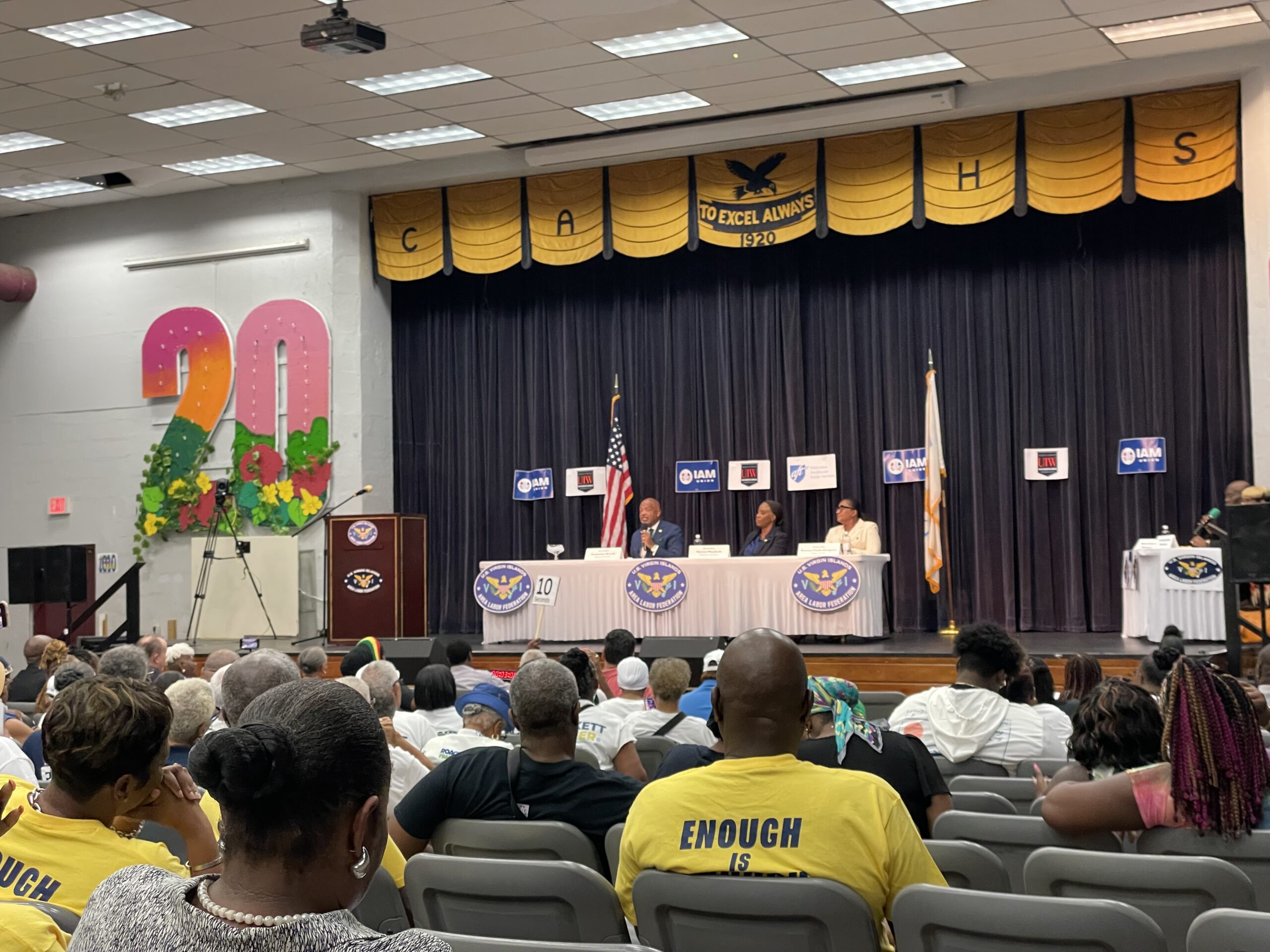
The U.S. Virgin Islands Area Labor Federation hosted the first gubernatorial debate of the 2026 election cycle Friday at the Charlotte Amalie High School auditorium. The debate featured Lt. Gov. Tregenza Roach, Delegate to Congress Stacey Plaskett and former Sen. Donna Frett-Gregory, who are seeking the Democratic nomination for governor in the Aug. 1 primary.
The debate was moderated by Moleto Smith Jr., director of the V.I. Law Enforcement Planning Commission, and Emily Carter, a career educator at the Education Department. Candidates took turns answering questions and were given 90 seconds each. When it was not a candidate’s turn to answer, they were given 45 seconds to rebut.
Over the course of two hours, candidates answered prepared questions on collective bargaining, health care, government accountability, and economic development. Smith began the debate with a question for Roach.
“In your first 100 days [as governor], name one concrete, measurable commitment you will make to public school administrators and organized labor, something we can hold you to,” he said.
Roach committed to staffing the Office of Collective Bargaining and supporting union contract negotiations.
“I would staff up the office of collective bargaining, because I believe that is a tremendous need. They need more attorneys … I will also seek, in the first 100 days, legislative support for funding to pay negotiated raises, so that when people sit at the bargaining table, they’re not bargaining in a vacuum,” he said.
In a short rebuttal, Frett-Gregory touched on what would become a recurring theme of the night’s discussion: Roach’s connection to the outgoing administration.
“What prevents you from ensuring that we get back to the table and move forward these union negotiations now?” she asked.
Roach responded by stressing that the chief negotiator “serves at the pleasure of the governor and follows his directives.”
While all three candidates agreed that the Virgin Islands Water and Power Authority is in dire need of reform, they disagreed on the immediate path forward. Frett-Gregory proposed seeking a public-private partnership within her first 100 days.
“Until WAPA is regenerated with the 4.7 billion [dollars] that I was able to receive for the Virgin Islands, how are you going to attract a private sector company to come in and do a generation program?” Plaskett questioned.
Citing complaints from residents about government responsiveness, Carter posed the following question to Frett-Gregory:
“What specific measures would you put in place to hold your appointees accountable, ensuring that the basic problems faced by residents and their neighborhoods are addressed in a timely manner?”
Frett-Gregory proposed an accountability system within the Office of the Governor, as well as a mobile application that would allow residents to report grievances like potholes and flickery street lights.
“If you are on the road, and you run into a streetlight issue, you are able to make a text on that app to ensure that you are able to get your streetlight fixed,” she said. “Accountability matters, and transparency matters, and that’s the direction that we need to move in this territory at this time,” she continued.
While Plaskett appreciated the idea, she argued that “an app is not going to solve the problem.”
“I think an app is a good first step. We all know that we’ve been able to tell various offices when there have been issues and nothing is done. I think the real issue is, do we have the personnel, do we have the support, do we have the funding to be able to actually put on the ground to get things done in a timely fashion,” she said.
On the issue of economic development, all three candidates agreed that more transparency is necessary with respect to EDC benefits, which are tax incentives granted to businesses that meet certain requirements for contribution to the territorial economy.
“I agree with Senator Frett-Gregory that a dashboard is eminently necessary for Virgin Islanders to be able to see what they are getting from the companies that are here,” Plaskett said.
Roach criticized EDC rules that allow companies to hire workers from elsewhere and count them as V.I. residents after one year.
“That does not grow resident employment. That is a thing that I would change,” he said.
Roach also proposed reopening the Limetree Bay Refinery and encouraging development on St. Croix’s South Shore as strategies to diversify the V.I. economy.
The final two questions were posed to all three candidates, with each given a full 90 seconds to answer. The first focused on ensuring that labor standards and union regulations are upheld, while the second focused on health care.
“I think there needs to be an open door to the governor, and in my administration, one of the things that I would first institute is a biannual meeting of the Labor Council with the office of the governor, where they are sitting at the table and expressing issues that they have across labor unions with the governor herself … That should be done with nonprofits, with our faith-based community, with youth, [there should be] regularly scheduled meetings so that the governor can hear directly from the people that are affected,” Plaskett said.
After each candidate answered the final questions, they were given three minutes to make a closing statement. Frett-Gregory emphasized the role of young Virgin islanders in building the territory’s future.
“I’m running for governor because it’s time for results for our people, not for a select few here in this territory. We talked about workforce development, and we talked about young people. It is time that we put our young people first in this territory,” Frett-Gregory said.
Plaskett addressed comments about being born outside of the territory, and stressed her political record.
“I was raised by fighting people on St. Croix who believed that [these islands] can be better, but more than a fighter, I’m a worker, and I will stand by my record. I’m not going to take just the good and not take the bad. I’m willing to say that I’ve been a part of work that has been transformational, but my issue is that you have not, and I have not seen and felt it on the ground, and I want to be a part of ensuring that that’s what’s happening,” Plaskett said.
With his final three minutes, Roach again aimed to distance himself from Gov. Albert Bryan Jr. and questioned Plaskett’s experience.
“You’re ready to run the government of the Virgin Islands when the most you probably run is an office of maybe 10 persons,” he said to Plaskett. “Four thousand, at the Department of Justice,” she quipped back.
“There’s only one governor at a time. The Organic Act of the Virgin Islands, as you both know, gives the governor a superior power to any governor in the United States. In fact every appointment document, every paper document, every contract that has to be signed is signed by the governor. So it is, it is improper for us to be in this forum, and focused on the failures of [this] government,” Roach continued.
The full debate is available for online playback via YouTube at this link