

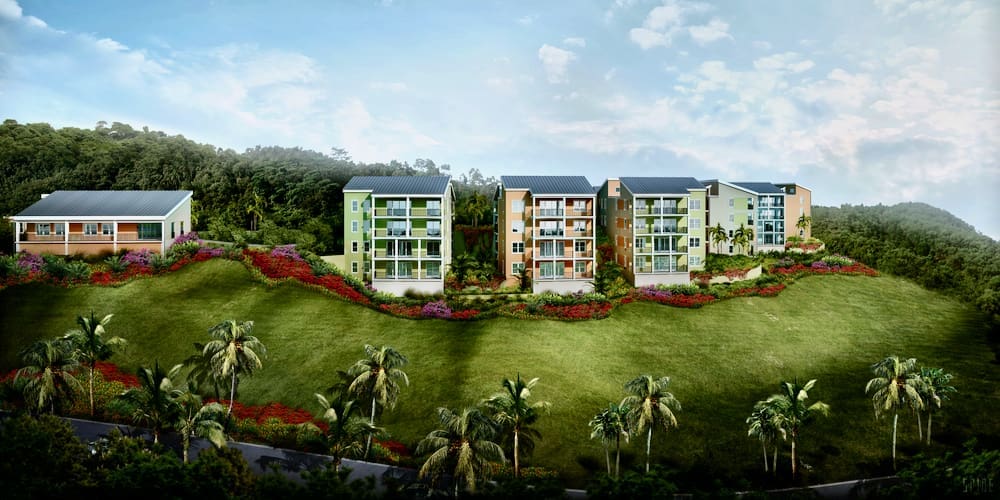
Seven years after hurricanes destroyed the already-rickety Tutu High Rise and Donoe Apartments, promises to quickly and efficiently rebuild the public housing remain years behind schedule and startlingly over budget, according to testimony at the Senate Monday.
In January 2021, the Virgin Islands Housing Authority, contractors, and management companies estimated building 84 apartments in 14 buildings on 10.6 acres would cost $57.7 million and be completed by December 2022. With work less than 40 percent complete, construction was stalled and at least a year behind schedule in September 2022 and remained so.
Fears about soil contamination from the nearby solar farm also obliterated by the storms were addressed years ago.
Dwayne Alexander, executive director of the Virgin Islands Housing Authority for just seven months, told the Committee on Housing, Transportation and Telecommunications that the long-stagnant project required an additional $46 million. He didn’t say why work had stopped and not restarted.
“We are currently in the process of completing the environmental remediation work, which is anticipated to be finalized by mid-November,” Alexander said.
If the money were approved and allocated by federal authorities, work could resume as early as 2025, with a potential completion date in December 2026, he said.
Alexander said other projects, some languishing well behind schedule, were still in the works. Sen. Dwayne DeGraff said the authority’s $200 million budget to complete the projects was the equivalent of “pocket change” given the enormous scope of work.
Redevelopment of the Estate Tutu North Senior housing involves constructing a new five-story building with 60 accessible apartments in Annas Retreat. Demolition of the office building currently on the site was scheduled for December and expected to take at least six months, Alexander said.
“Designed with a preference for senior residents, we are targeting financial closing for this project in the second quarter of next year. The estimated completion date for construction is December 2027,” he said.
Financing rehabilitation of the 106 apartments in D. Hamilton Jackson Terrace was expected to close by mid-November, with an estimated construction completion date in December 2026, Alexander said. The schedule for revitalizing the Alphonso Gerard Complex, also known as Bassin Triangle, was less clear, requiring additional contract agreements, he said.
Work redeveloping Tutu North and the Lucinda Millin Home were stalled, he said.
“These projects are still on hold at this time as we continue to evaluate the feasibility in moving forward based on cost and available financing,” Alexander said.
Some rehabilitation projects have been completed and other new projects were on the way, he said.
Work revitalizing the Walter I. M. Hodge’s 20 buildings and community center was completed Sept. 9, Alexander said. Only landscaping and touchups remain to be done for the 248-unit facility. The site currently has 122 units leased, and 126 units are vacant and ready to be leased, he said.
Construction of nearly 100 new units at Stoney Ground would help the elderly to age in place with support services provided onsite.
“The first phase encompasses 98 units distributed across four buildings. The primary objective of this initial phase is to offer replacement housing for the residents of the Wilford Pedro Home, also known as the Whim Gardens community. We are currently awaiting environmental approval and acquisition authorization from the U.S. Department of Housing and Urban Development to proceed with the purchase of the property,” Alexander said.
The Housing Authority manages 2,536 public housing units spread across 21 developments. Alexander said the authority was on track to be at 96 percent of capacity by year’s end.
He said the authority was redoubling efforts to make repairs to aging or storm-damaged units.
“Over the same time in 2024, the team has opened 7,781 work orders, an increase of over 2,600 worker orders compared to last year. This surge is not merely in quantity, it reflects our commitment to enhancing our operational efficiency and responsiveness to our residents’ needs. We also saw a remarkable improvement in our closure rate, with 6,674 work orders closed, almost 2,000 more than the previous year,” Alexander said.
He said the authority was also working to help their residents better their financial situations. The Resident Wellness and Empowerment program sought to empower residents by promoting opportunities for economic mobility and self-sufficiency through targeted programming and community partnerships. The objectives include household wellness assessments, workforce development, financial management education, and establishing resident councils.
“To date, we have established and registered six resident councils,” Alexander said. “These councils will play a vital role in fostering communication, representation, and resident participation in key decisions that impact their communities.”
The authority was also checking in on residents who may be in danger of not being able to make rent.
As of Aug. 31, Alexander said, they had identified 569 families in positions of concern. There were 180 vulnerable families, relying heavily on subsidies and 106 families with one consistent income but reliant on subsidies. There were 283 families reliant on subsidies despite having one or more incomes.
Homeless advocates from the Methodist Training and Outreach Center, the Virgin Islands Continuum of Care Council on Homelessness, Catholic Charities, the Human Services Department, and others spoke on difficulty caring for people in greatest need.
Dan Derima, chairman of the Continuum of Care Council, said 252 people were unsheltered in the territory. Averil George, Human Services commissioner, put the number at 207, down from 314 in 2019.
Derima said facilities were not adequate for the assistance needed, no matter the number.
“These people are living in a place not fit for human habitation, such as abandoned buildings, parks, and our ballfields. Some are generally in unpleasant situations, for example, ex-prisoners recently released, some facing family disputes, or having no family on island. We also have those people faced with eviction for delinquency or non-payments and overcrowded living conditions. This situation does not speak well of the territory and how they treat their own, the less fortunate constituents,” he said.