

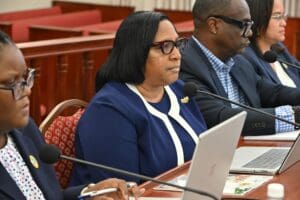
The hearing began on a positive note Thursday, with several senators acknowledging the V.I. Department of Property and Procurement’s ongoing efforts to modernize its operations.
Commissioner Lisa Maria Alejandro and her leadership team were commended for implementing standard operating procedures across various divisions, which have been instrumental in streamlining procurement processes and establishing a strong foundation of knowledge among employees.
Sen. Novelle Francis highlighted the importance of these advancements, stating, “The department has made significant strides in modernizing its operations. These efforts are crucial in ensuring that our procurement processes are not only efficient but also transparent and accountable.”
Sen. Kenneth L. Gittens echoed this sentiment, noting, “The steps taken by the DPP to enhance their processes and embrace new technologies are commendable. It shows a forward-thinking approach that is necessary for our government to function effectively in the modern era.”
The department’s efforts to introduce technological innovations were also recognized. The implementation of the Enterprise Resource Planning (ERP) system and the GVI Buy platform were particularly noted for their role in enhancing vendor management and improving procurement processes. These systems have allowed the department to better track and manage procurement activities, reducing inefficiencies and ensuring that vendors are better supported.
Despite praise for modernization efforts, the DPP’s budget became a focal point of concern during the hearing. The Senate questioned the sustainability of the department’s current financial model, particularly its reliance on legislative appropriations to fund operations. The DPP’s fiscal year 2025 budget request totaled $20,850,998, including $17,350,998 in appropriated funds and $3,500,000 in non-appropriated funds. However, senators expressed doubts about whether this budget would be sufficient to cover all operational needs, especially given the significant cuts in areas like supplies.
Sen. Donna A. Frett-Gregory was particularly critical of the department’s budgeting for supplies, which saw a sharp reduction from $895,000 in FY 2023 to just $132,681 in FY 2025. She questioned how the department could operate effectively with such limited resources for essential supplies.
Alejandro acknowledged the challenge, explaining that the department has been forced to work within tight constraints, often reappropriating funds from other areas to cover shortfalls.
In addition to budgetary concerns, the hearing revealed significant flaws in the department’s operations, particularly regarding staffing and the ability to manage its vast portfolio of government properties effectively. The department currently has 78 employees, with 10 vacancies that are critical to its operations. These vacancies include key positions in the fiscal and procurement divisions, which are vital to the department’s ability to manage contracts and collect revenues.
Gittens raised concerns about the department’s ability to fill these positions, noting that the vacancies are impacting the department’s efficiency. “How can we expect the department to function at full capacity when there are so many unfilled positions? This is something that needs urgent attention,” Gittens argued.
The department’s leadership admitted that recruitment has been a challenge, partly due to budget constraints and the difficulty in finding qualified candidates willing to work for the offered salaries. “We are actively recruiting, but the competition for skilled workers is intense, and our budget limitations make it difficult to offer competitive salaries,” said Assistant Commissioner Vincent Richards. The DPP has approximately $600,000 in outstanding balances, which it has struggled to collect due to understaffing in the fiscal division.
Sen. Javan James pointed out the lack of detailed financial data regarding the funds generated by the department’s various programs. The department was unable to provide precise figures during the hearing, leading to calls for more robust data collection and reporting practices.
“We need transparency in how these funds are managed. Without detailed reporting, it’s impossible for us to fully understand where the money is going and how effectively it’s being used,” James emphasized.
In response, Alejandro assured the Senate that the department is working on improving its data collection processes.
“We recognize the need for better data and are committed to providing more detailed and accurate reporting in the future,” Alejandro responded.
Despite the challenges, the DPP has laid out several strategic initiatives aimed at improving its operations in the coming years. The department plans to continue modernizing its IT infrastructure, which is expected to enhance efficiency and transparency.
Frett-Gregory highlighted the importance of these initiatives, stating, “Modernizing our IT systems is crucial for improving efficiency and transparency. The DPP’s efforts in this area are a step in the right direction, and we must ensure they have the support needed to see these projects through.”
However, the success of these initiatives will largely depend on the department’s ability to secure adequate funding and fill its critical staffing vacancies. The department has requested legislative support for its proposed changes to Title 31 of the Virgin Islands Code, which are aimed at increasing efficiencies in the delivery of goods and services and the management of government properties.
The department’s asset management efforts were highlighted as a critical component of its operations. The DPP is responsible for managing all government-owned fixed assets, including real estate and vehicles. During the hearing, the department was commended for its successful implementation of policies and procedures aimed at improving asset management. This includes revising outdated forms and taking steps towards self-management, which are expected to lead to more efficient use of government assets.
Senators acknowledged the department’s role in facilitating strategic real property acquisitions for agencies like the Departments of Education and Human Services, valued at over $10 million, to support government property development.
The DPP’s embrace of technological innovations, including the exploration of AI to automate tasks and improve efficiency, was praised during the hearing. AI is expected to free employees for more complex work and enhance client services with 24/7 support. This forward-thinking approach was seen as essential for maintaining operational effectiveness and keeping the department at the forefront of technological advancements.
Francis added, “Incorporating AI into the department’s operations is a bold move that shows the DPP is serious about staying ahead of the curve. This kind of innovation is exactly what we need to keep our government efficient and responsive.”