

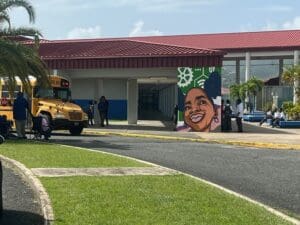
The contractor who installed the ceiling fan that fell on a St. Croix Educational Complex student has been suspended from future work, Education Department officials said Monday as parents and legislators decried decrepit conditions in the territory’s schools.
K&J Services, owned by William Trinidad, took down all of the 17 ceiling fans it installed across a dozen SCEC classrooms after one sent a student to the hospital Thursday, just one month into the school year, Education officials told the Senate Committee on Education and Workforce Development.
K&J Services had been working government contracts for many years, said Yancy Milligan the St. Croix director of maintenance.
“His expertise is being questioned,” Milligan said. “We’re going to take all his work out this afternoon and suspend him from doing any further work until further investigation.”
Milligan confirmed the heavy fans had been attached to existing ceiling structures. Sen. Franklin Johnson said he’d seen a video of the fans wobbling.
The department would not use the same metal-blade type fans again, said Craig Benjamin, executive director of the newly created Bureau of School Construction and Maintenance. Portable air conditioners would be installed in classrooms left without fans because of the incident, he said.
The student, who received 30 stitches, was eager to return to school but had not because his wounds were still too raw, newly-hired St. Croix Superintendent Sharlene Belton-Gonzalez said. The student’s classmates protested the rundown schools with signs urging administrators to take the matter seriously.
Committee Chair Sen. Marise James took the unusual step of swearing in each Education Department testifier, reminding them they could face perjury charges for failing to tell the truth.
“Today’s a day for honesty,” James said. “Let’s put it like this, fans don’t just fall from the ceiling just like that. There had to have been signs.”
A week into the school year, Tropical Storm Ernesto toppled trees onto school roofs, exposing water leaks and electrical failures in the territory’s embattled education infrastructure, but acute and systemic flaws to the facilities are decades old and worsening, frustrated parents said.
Parent-teacher association officials railed against reopening the schools Aug. 5 in what they called deplorable conditions where mold, insects, and other hazards joined a long list of concerns about inadequate staffing and supplies.
In the Pearl B. Larsen Elementary School, students had to hold broken bathroom stall doors shut for each other — and guess how much toilet tissue they’d need because tissue dispensers were located outside the stalls, PTA officials said. The music room’s rickety bandstand and ceiling were so bad that music classes were moved to the library or computer lab where, like in many of the territory’s schools, internet connectivity was so slow that teachers and students would simply take work home for faster connections.
Janice Jones, president of the Alfredo Andrews Elementary School’s Parent Teacher Organization, said the school was short on desks, had roof leaks, overheating, termite infestations, and more.

“We are deeply disgusted regarding the current state of our school’s restrooms. It has come to my attention that the conditions are deplorable, with brown water in the toilets and rust on the sink handles, which is not only unsightly but also poses a health risk to our students,” Jones said. “Alfredo Andrews Elementary School was once a great school.”
She now asks the department to “make Alfredo Andrews good again.”
Dionne Wells-Hedrington, commissioner of the V.I. Education Department, said decades of underfunding and deferred maintenance could take $44 million or more over many years to fix. But senators said they’d already approved $12.5 million for 2024 school repairs, so lack of funding was not a valid excuse.
Wells-Hedrington said both federal and local funds were in various stages of “the pipeline” to being obligated.
Benjamin, who started in July, said repairs and routine maintenance were a daunting task that would “take a lot of money.”
Senate President Novelle Francis Jr. said he hoped there would be a state of emergency declared.
“What the hell is the problem,” Francis exclaimed. “Why are we here talking about this when there are fans falling down out of the schools.”
Power fluctuations during the storm damaged several air conditioners and electrical boards, blew compressors, and caused malfunctioning capacitors, which exacerbated maintenance challenges. Flooding in modular classrooms, as well as some regular classrooms, led to mildew and mold, creating health concerns that required immediate remediation to ensure a safe learning environment, Benjamin said.
Stefan Jürgen, the St. Thomas-St. John insular superintendent, acknowledged the schools were in rough shape, but said he thought they were ready to reopen. Belton-Gonzalez, his St. Croix counterpart, said she thought the start of school should have been delayed until significant infrastructure problems could be addressed.
Failing air conditioning units, mold, leaks, termite infestations, staffing shortages, power outages, gaps in curriculum planning, safety issues like missing fencing and cameras, and the snail’s-pace internet all adversely affected learning, they said.
Sen. Diane Capehart called for a comprehensive assessment of all school facilities, determining which are worst off.
“Some of these schools been there from the beginning of time and we keep putting Band-Aids on them,” Capehart said.
Maqueda Noorhasssan, president of the Ricardo Richards Elementary PTA, complained of a lack of transparency from Education officials. Videos purporting to show the state of the schools were mostly fluff, Noorhasssan said, or tailored to show completed projects and not areas of continued concern.
“In my opinion, there is a lack of proof of transparency that indicates prior and current problems were addressed. For example, the classrooms, bathrooms, leaking roofs — especially the flood zone schools — gymnasiums, and libraries. As to date, no images, air/water quality testing reports, and/or mold remediation reports have been released to the public for the school year 2024-2025,” she said. “It is unacceptable and unfortunate that on the first week of school at Eulalie Rivera School, some students were sent home due to an unsafe and non-conducive environment for the students and teachers.”
Abdul Ali, chair of the St. Croix Public School Parent Coalition, said accountability and updates on repairs were vital, but so was a way forward both administratively and personally.
“I don’t want this all to be about the maintenance issue, which is important, but we also need some maintenance of the mind,” Ali said. “Right now we’re all in pain. We need to come up with some kind of design that helps us all move forward.”
He emphasized the issues at the school should be seen by parents, administrators, and students as the kind of obstacles a person encounters in life, and are a chance for all to learn.
“Get the healing process moving in a kind of way that there is an understanding that we’re just going through life. These things have happened to other people in some kind of way,” he said.
One unexpected concern arose as an aside in the hearing when Capehart read the text of Act 8717, section 102, which created the Bureau of School Construction and Maintenance. It required the executive director be an engineer or architect licensed in the Virgin Islands. Benjamin acknowledged he did not have a degree in either and was not licensed as an engineer or architect anywhere.
In his defense, Benjamin read the requirements for the position given to him when he applied, which did not outline the need for a license. The advertisement Benjamin had seen was created by Gov. Albert Bryan Jr.’s office, Education officials said.
James said she’d spent years trying to get students to read. Now, she said, she was asking officers of the Virgin Islands government to do the same.
“Reading matters,” she said.