

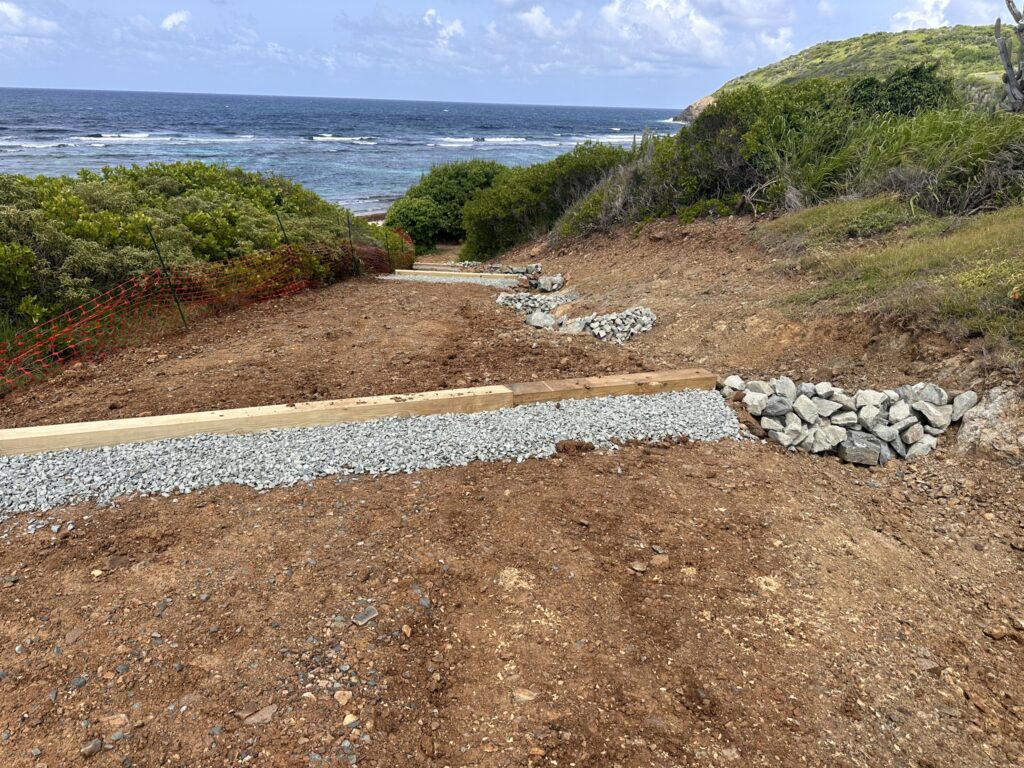
The Territorial Comprehensive Outdoor Recreation Plan (TCORP) will chart the future of outdoor spaces on St. Croix, St. Thomas, and St. John from 2026 to 2036. Developed by the Virgin Islands Department of Planning and Natural Resources in partnership with the Horsley Witten Group (HWG), the federally mandated plan will identify priority projects and ensure the territory remains eligible for Land and Water Conservation Fund (LWCF) grants.
HWG has an established history of work in the Virgin Islands, from helping to shape the Comprehensive Land and Water Use Plan approved by the Legislature in December 2024 to leading large-scale mangrove wetland restoration efforts. A press release shared by HWG, an environmental consulting firm working with DPNR, provided details about how the TCORP plan will benefit the USVI.
“This federally mandated plan is a requirement for the territory to remain eligible for funding from the LWCF, which approves over $2 million in outdoor recreation investments to be available to the U.S. Virgin Islands,” the HWG press release stated. “The plan will serve as a roadmap for outdoor recreation development over the next 10 years, identifying infrastructure needs and community priorities through a comprehensive evaluation of recreation sites and extensive public engagement,” the press release said.
The Horsley Witten Group will conduct a territory-wide inventory of existing recreational facilities across the Virgin Islands, including parks, sports fields, hiking trails, and waterfronts. The effort will also assess accessibility, signage, and overall site conditions to help guide improvements and ensure resources are used effectively, according to the release.
“The TCORP process is about building a vision for accessible, inclusive, and resilient outdoor recreational spaces,” said Craig Pereira, senior planner at the Horsley Witten Group. “We’ll be looking at every element: ADA compliance, facility condition, community use, and cultural significance to ensure public funds are utilized to best effect.”
The Significance of the TCORP Plan
The Source contacted Pereira for more details on Horsley Witten Group’s role in the project, and he highlighted the importance of having an approved TCORP.
“Once the Virgin Islands has a current TCORP in place and it is approved by both the National Park Service and the Land and Water Conservation Fund — which we hope will happen by late 2026 — the territory will be eligible to apply for outdoor recreation improvements through its annual allocation every year,” Pereira said.
“If a state or territory has a Territorial Comprehensive Outdoor Recreation Plan that is active and approved by NPS, it can apply for funds for outdoor recreation improvements. So, it’s essentially a funding mechanism,” he added.
As part of the plan, HWG will conduct a comprehensive inventory of outdoor recreation facilities across the territory, visiting each site to evaluate amenities, equipment conditions, parking, circulation, and Americans with Disabilities Act (ADA) accessibility.
“We are going to create a new database or inventory of all of the outdoor recreation sites on the three main islands of St. Thomas, St. Croix, and St. John,” Pereira said. “We’ll be doing an assessment of what each location offers, whether it’s a softball field, baseball field, playground, or other amenities, as well as the condition of the facilities, the flow of parking and traffic, and whether ADA-accessible features are in place.”
Pereira added that the work will focus on existing recreational spaces but also identify underserved neighborhoods where new facilities could be built. “It might be a specific area or neighborhood that’s underserved without our recreation amenities, and that’s where the TCORP comes into play, because they’ll be able to use funds in order to purchase property and to build out those sites,” he said.
Kristina “Kitty” Edwards, director of Territorial Parks & Protected Areas with the DPNR, also shared how the initiative will benefit the USVI.
“This program will absolutely help us to build a Territorial Parks System that the people of the Virgin Islands can enjoy and be proud of,” Edwards explained. “Funding is hard, and having consistent non-competitive money coming into the territory is a huge benefit. For the Division of Territorial Parks & Protected Areas, this program provides an opportunity to take conservation lands and make them interactive.
“We can build multi-use trails that will bring people into the natural areas that make our home so special, we can take properties and develop areas where individuals can spend a day participating in different activities, and we can make places where people can create their own activities,” she said.
Partnerships and Public Engagement
For Edwards, ensuring that the plan reflects local needs and culture is crucial, and it starts with collaboration.
“When looking at what to do with each of the recreational properties, we have to remember that the land dictates its use, so a project has to make sense environmentally. But the impact to the community depends on making sure that we are taking existing use and making it better. If there’s a property in the National Park System where families have spent generations learning to swim, camping, and having birthday parties, then the final plan for that property will be aligned for just that purpose,” Edwards said.
“My team is made up of Virgin Islanders, and we take the creation of the park system very seriously,” Edwards affirmed.
With LWCF support available annually, Edwards said her team will ensure the benefits reach all islands.
“Each island has so much opportunity for projects under the LWCF program,” Edwards said. “I think that we are going to see great improvements in outdoor recreation and opportunities for getting outside and enjoying our natural spaces. There are existing parks managed by multiple agencies that are going to benefit from this program, and the team is excited to see what each community feels is important to focus on,” Edwards stated. “We are also excited to build new opportunities as properties are added to the park system.”
Edwards shared what she hopes will occur throughout the TCORP’s 10-year horizon, which will track recreation trends to guide long-term decisions.
“Eventually, I hope it will generate interest and attention to outdoor recreation facilities,” Edwards explained. “We’ll be able to identify where those undisturbed areas are and if it’s a playground that is needed within a certain radius of a residential area. You know, it’s really all about what the trends are right now and what the trends are going to be in the next five to 10 years.”
Pereira noted that an interactive project website that will soon become available will help gather feedback before site visits begin.
Regarding a vision for the USVI community, Edwards is very enthusiastic, and the mission is clear: “What we are doing is all about the people of the Virgin Islands,” Edwards stated. “In our division I constantly remind the team that ‘VI Parks for VI People,’ and we are making this for us!” she concluded.