

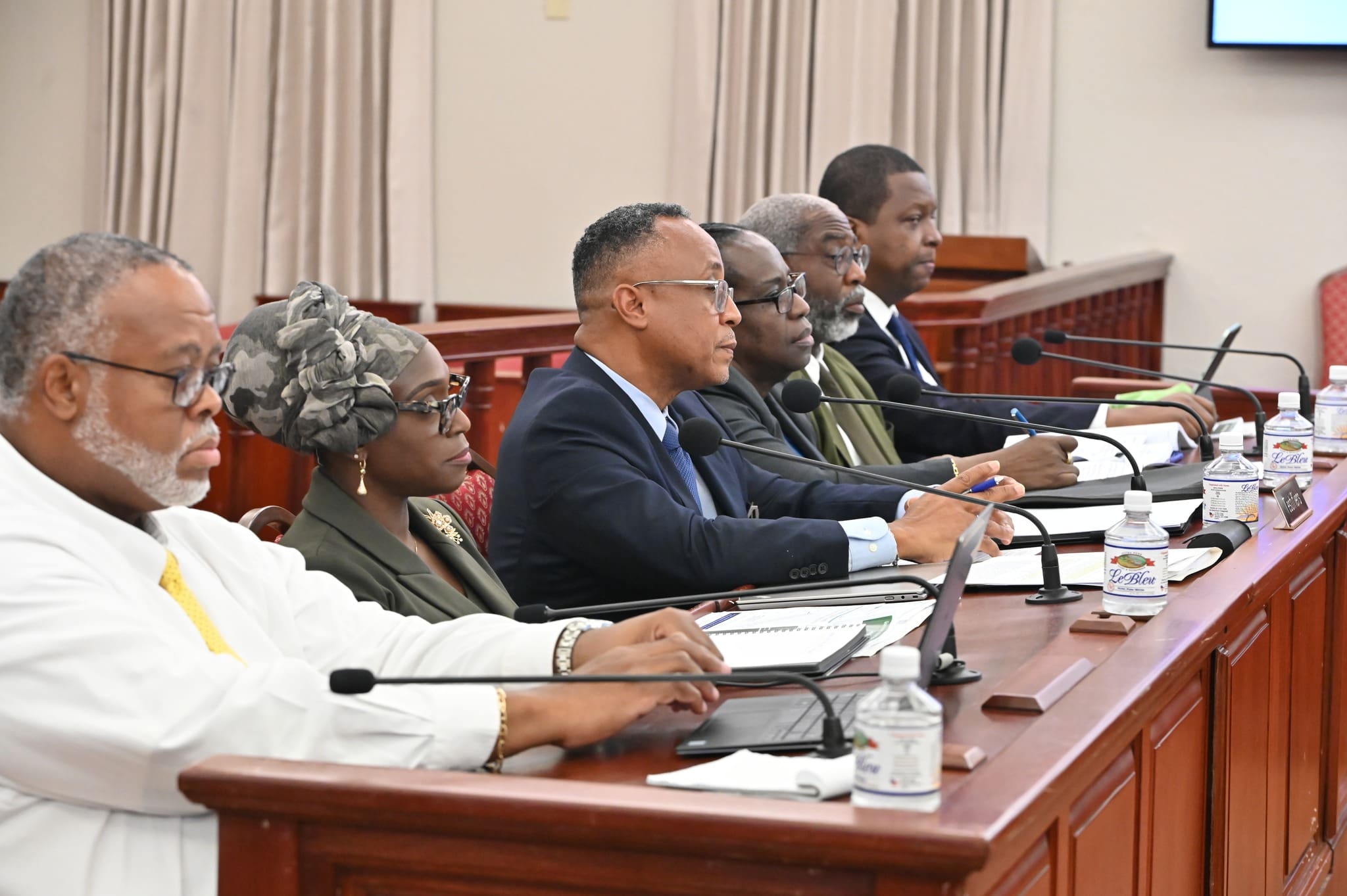
Angel Dawson, administrator of the Government Employees’ Retirement System, gave the Committee on Budget, Appropriations and Finance on Tuesday what he called “a glimmer of light in the midst of what has been a gloomy budget season.”
In his annual overview of the system, he discussed investment performance, saying that the market value of assets increased from $400 million on Sept. 30, 2022, to $455 million on Sept. 30, 2023. He added, “Thus far in fiscal year 2024, the market value of assets has increased by another $69 million from $455 million on Sept. 30, 2023, to $524 million on July 31, 2024.”
The system did have a shortfall of $34 million because instead of receiving the $158 million federal Matching Fund cover-over rate, it received $124 million because the rate was $10.50 per proof gallon of rum produced in the U.S. instead of $13.25, on which the rescue plan was based.
Under the territory’s Revised Organic Act, any excise tax collected on USVI-manufactured rum imported into the mainland United States is transferred to or “covered over” to the USVI. The V.I. government submits an advance estimate of rum excise taxes to the Interior Department’s Office of Insular Affairs on an annual basis so that a payment can be made by September of each fiscal year.
Any adjustments are calculated and paid based upon amounts advanced from rum excise taxes derived from the USVI and actual receipts collected by the federal government, according to the release. The fiscal year 2024 advance payment to the USVI government was calculated using the $10.50 per proof gallon rate, as provided for under current law.
The federal Bipartisan Budget Act of 2018 raised the per-gallon rate to $13.25 for five years following the twin Category 5 hurricanes of September 2017, but that expired at the end of December 2021, and subsequent efforts by V.I. government officials to restore the higher rate have failed.
Meanwhile, during Tuesday’s meeting, Sen. Ray Fonseca congratulated Dawson on re-establishing the government employees’ loan program and noted that 8 percent was a good return for the system.
Sens. Javan James and Donna Frett-Gregory questioned a three-percent increase that GERS was considering for government employer contributions to the retirement system. Frett-Gregory told Dawson that he was asking for $13 million (the three-percent increase in contributions) while the government is facing revenue challenges.
Sen. Franklin Johnson asked whether the system keeps the government contribution when an employee opts out. Dawson answered yes, but added that it does little to alleviate the $3.5 billion debt hole the system dug. He said the hole was dug because of the “sins of our fathers and mothers.”
Dawson said the system was authorized to increase employer contributions from 23.5 percent to 26.5 percent effective Jan. 1, 2025, and the board intended to do so.
He testified that on Aug. 15, the GERS paid benefits to 8,770 retirees and beneficiaries. He also testified that from Oct. 1, 2023, through Aug. 15, 278 retirees were added to the payroll, and during that same period, 268 deceased retirees were removed from the payroll.
Sen. Marvin Blyden said those figures show that GERS is a driving force in the territory’s economy.
Sens. Frett-Gregory, Javan James, Marvin Blyden, Dwayne DeGraff, Samuel Carriόn, Novelle Francis, Alma Francis Heyliger, Kenneth Gittens, Carla Joseph, and Johnson attended the meeting.