

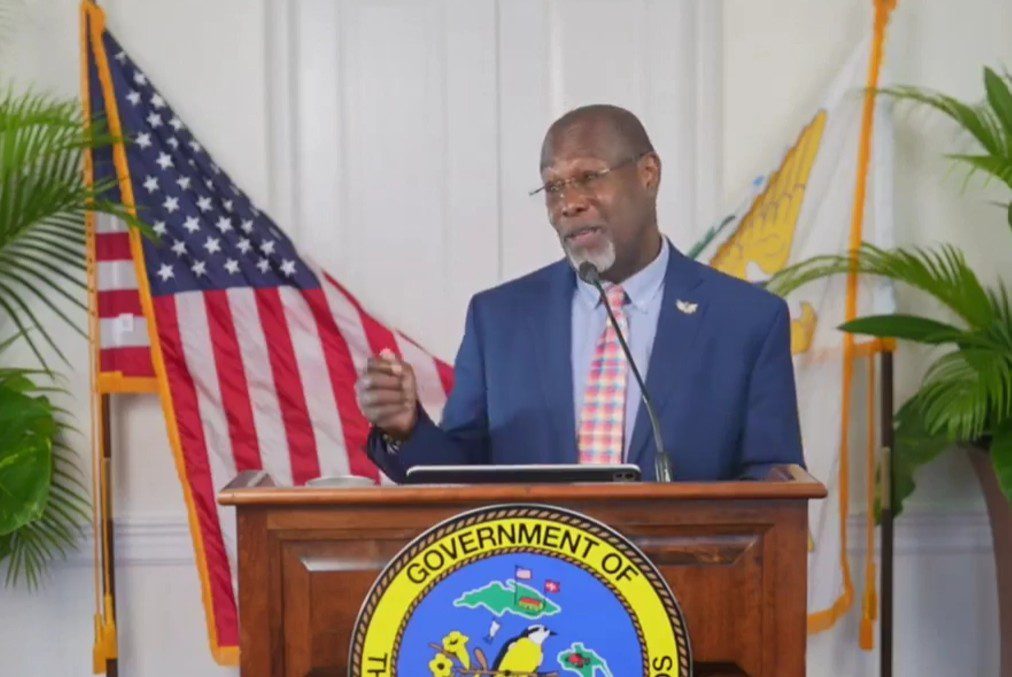
Gov. Albert Bryan Jr. spent much of Monday’s Government House press briefing addressing the ongoing power outages afflicting residents and businesses on St. Thomas and St. John, but he and V.I. Labor Commissioner Gary Molloy also took time to announce that the territory’s Unemployment Insurance Trust Fund is “back in the black” for the first time in 15 years.
Bryan noted that “in a small part, I created this problem because when I was commissioner of Labor we had the ‘Great Recession.’ We were under so much pressure, we borrowed like $80 million from the federal government, and because of that, we’ve been paying extra taxes.”
Molloy took to the podium to announce that the fund held a net positive balance of more than $4 million as of March 20.
“To put this in perspective, as recently as 2022 the Virgin Islands carried nearly $100 million in federal debt tied to the unemployment insurance system. This debt accumulated over time as a result of major economic shocks,” he said. Those include the Great Recession of 2008, Hovensa’s closure in 2012, hurricanes Irma and Maria in 2017 and the COVID-19 pandemic in 2020, “all of which placed significant strain on the economy and workforce.”
In 2016, former V.I. Attorney General Claude Walker and former Labor Commissioner Catherine Hendry announced that more than 3,000 of the territory’s businesses collectively owed upward of $32 million in contributions to the fund. Hendry said at the time that the fund contained $1.7 million but needed an approximately $8 million reserve to serve Virgin Islands workers. The joint statement prompted Bryan to respond in a lengthy op-ed published in local media outlets.
“The Legislature systematically began to lower the tax rate, eliminate penalties and increase the amount that was being paid out to unemployed individuals. This helped to decrease the tax fund, but it still would not go down significantly,” he wrote at the time. “The Legislature finally eliminated the tax rate by lowering it to zero in 2001. This meant that for more than 10 years, businesses did not have to pay any local Unemployment Tax.”
“It was only after much research and deliberation that we went to the Legislature in 2012 and got them to raise that minimum tax rate to 1.5 percent,” he added.
Molloy went before the 33rd Legislature in 2019 with proposed legislation that based employers’ tax rate on their payroll and contributions into the system instead of a flat rate and said the change was necessary to bring the territory into compliance with federal law.
“The results are clear,” he said during Monday’s briefing. “We have moved from deficit to surplus, from borrowing to stability, and from uncertainty to confidence. So what does this mean for you, the people of the Virgin Islands? First, it means greater economic stability — a solvent trust fund ensures that we can support workers during periods of unemployment without relying on federal emergency borrowing.
“Second, it means relief for employers,” he said. “As we approach full repayment of the federal loan, employers will begin transitioning back to standard federal unemployment tax rates, rather than the higher penalty rates associated with the outstanding debt. Third, it reflects stronger fiscal stewardship for the territory.”
Molloy said the Labor Department is on track to make its final loan payment in May.
On Monday, Bryan also announced his nomination of V.I. Internal Revenue Director Joel Lee to chair the V.I. Casino Control Commission and a recent effort to collect the stories of Virgin Islands residents and business owners who have been impacted by the Trump administration’s elimination of the “de minimis” exemption for packages from outside the U.S. Customs Zone.
“All we need is an execution by the president and the White House, and we’re just putting that together and sending that on,” he said, adding that he didn’t know offhand how many responses Government House had received. “You know, I thought for them to request it was kind of crazy anyway, but we just do what is requested to show the change on that.”
Bryan noted that he intends to follow up on the issue during a visit to Washington, D.C., scheduled for June.