

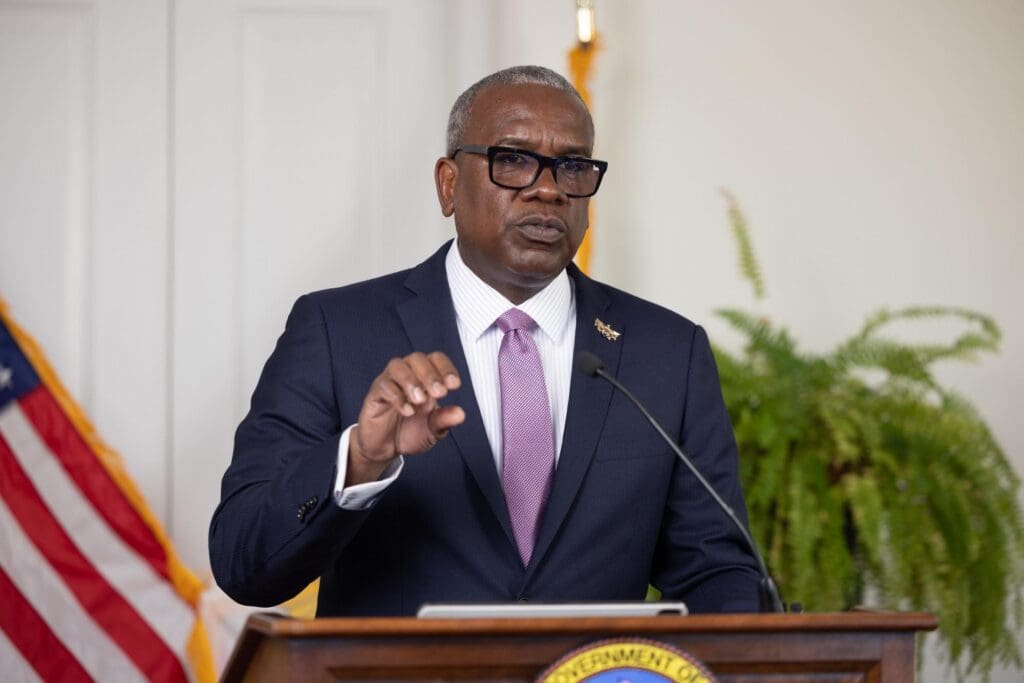
Gov. Albert Bryan Jr. pushed back Friday afternoon after the Senate voted down one of his key proposals and removed two others from the special session agenda, calling lawmakers’ actions “preservation of perks” and accusing them of placing self-interest above the public good.
The Senate’s morning session opened with the removal of two bills — Bill No. 36-0124, which sought to allow government employees to retain their jobs while running for elected office, and Bill No. 36-0125, which aimed to prohibit sitting lawmakers from receiving a legislative salary and retirement annuity simultaneously. Both were reassigned to their committees of jurisdiction after Sen. Kurt Vialet cited the Legislature’s preemption rule, with one measure sponsored by Sen. Alma Francis Heyliger and the other by Sen. Marise James.
In a blistering statement issued by Government House Friday afternoon, Bryan said senators had “quietly removed” the bills to avoid public debate and accountability.
“That choice shields legislators from public accountability and puts self-interest ahead of critical change,” he said. “This is not leadership. It is preservation of perks.”
Bryan’s office argued that the employee election bill would eliminate the requirement for government workers to take six months of unpaid leave before running for office, making public service more accessible to working-class residents who cannot afford to forgo pay or health insurance. The reform, he said, would level the playing field for Virgin Islanders “who cannot sacrifice pay or insurance to serve.”
The governor also reiterated that Bill No. 36-0125 was designed to end “double dipping” by current and former senators — prohibiting them from collecting a legislative salary while simultaneously drawing retirement benefits from the same system. Such practices, he said, “drain GERS and undermine integrity,” and are incompatible with the Legislature’s earlier stated commitment to pension reform.
Bryan further warned that with a 3% employer contribution hike to the Government Employees’ Retirement System set to take effect on Oct. 1 — at a cost of roughly $12 million to $14 million annually — the cost of inaction would be borne by jobs, public services, or taxpayers. He contrasted this local inaction with what he called “a win for stability” at the federal level: a permanent extension of the $13.25 rum cover-over rate that will help support pension funding, schools, and core services.
The failed effort to advance either bill was followed by a lengthy and contentious hearing on Bill No. 36-0126, a measure that proposed creating a five-member special legislative committee to explore whether a self-funded group health and dental insurance model could reduce premium costs for the government and its employees.
That proposal, too, was met with resistance — particularly for its exclusion of the Government Employees Service Commission Board, the body legally tasked with managing the government’s insurance plan. Board Chair Beverly Joseph said much of the analysis the administration claimed it needed had already been completed by the board’s consultant, and warned that transitioning to a self-funded model without a financial safety net could jeopardize both the government’s fiscal health and employee coverage.
With six senators still waiting to speak and a scheduled power outage hitting the St. Thomas Senate chambers, members voted to waive the remainder of the debate. The final vote: 13-0 against.
In his response, the governor called the Legislature’s rejection of the health insurance bill “shortsighted,” adding, “We must act decisively to reduce health care costs while maintaining quality coverage, and we remain ready to work collaboratively to achieve that goal.”