

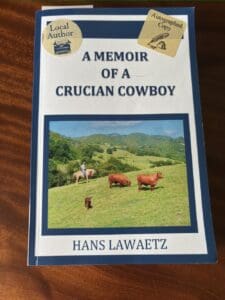
“A Memoir of a Crucian Cowboy” by Hans Lawaetz is not an easy read. It took three years to write, and he has included many facts, events, and memories.
The 89-year-old cowboy not only rode the range but, following in his family’s footsteps, helped develop a breed of cattle, raised a family, and administered several national and community organizations.
Lawaetz has included various stories of his adventurous life. His experiences reflect basic Crucian strength. Each chapter tells of the people of the island during those days and their focus on conservation, athleticism, and agriculture.
Lawaetz is the third generation to farm the West end of the island. The first to settle on the island was Pastor Herman Lawaetz in 1889, who served as pastor of the Lord God of Sabaoth Lutheran Church in Christiansted.
Herman Lawaetz’s cousin, Carl, relocated to St. Croix in 1896 to farm 450 acres in the Western part of the island. Hans Lawaetz’s father Frits, was the third of seven children born to Carl and his wife.
“I wrote the book to get out the history of Senepol cattle,” he said.
Bromley Nethropp was the first to begin breeding Senepol cattle when he crossed a Bos Red Poll from England with a Bos Taurus N’dama, originally from Senegal, West Africa, in 1918. The two breeds are known for good milk, good beef, and being heat- and disease-resistant.
Years later, Frits Lawaetz and his partner purchased a herd of Nelthropp cattle and continued to work for years toward having the name Senepol trademarked. The breed was registered in 1949, and some said it was “the best looking breed.”
After Hans Lawaetz graduated from college, he served in the U.S. Air Force for five years and then returned to St. Croix to work at Annaly Farms. He eventually took over and managed the business, which eventually included a meat market that is still in existence.
Hans Lawaetz devoted decades to the Virgin Islands Olympic Committee. In 1966, the territory was given permission to participate, on a trial basis, in the 1966 Central American and Caribbean Games. Because participants did so well, the Virgin Islands was granted full membership in the International Olympic Committee. Hans Lawaetz served as president for 16 years and 20 years as secretary general. His fundraising for the Olympics included a fruitful day where he visited Lawrence Rockefeller and Leon Hess on the same day and received $15,000 in donations from both. A highlight of his time was watching his daughter Jodie carrying the V.I. flag and leading the Virgin Islands delegation in the 1984 Los Angeles Games.
The other organizations Hans Lawaetz was actively involved with included the V.I. Conservation District, Good Hope School, Country Day School, and the St. Croix Horse Show Association.
Some of his travels to places such as Colombia, Brazil, Paraguay, Mexico, and Guatemala, where he went to talk about cattle and the Senepol Breed Association, are recounted in his book.
Overall, Hans Lawaetz’s 329-page book is a thorough read of history and shares recollections of the Caribbean region, especially St. Croix.