

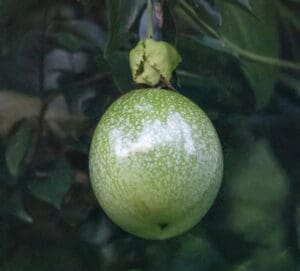
Some years the passion fruit flowers all dry up on the vine, but this year we are grateful for a yard filled with ripening fruit. The passion fruits aren’t ready to eat until they turn pale yellow and drop off the vine, so we will have to be patient. My husband and I did share a ripe one last week, and it was delicious. I love the sweet smell of the pulp as much as the taste, and carefully save some of the seeds for planting more.
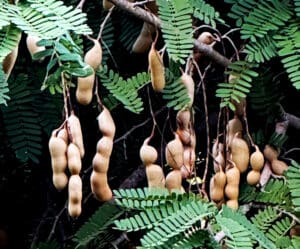
The tamarind tree is also filled with fruit. Inside the pods, the pulp is a little bit sweet and usually quite a bit tangy. Unfortunately many of the pods are a bit too high to reach. Also we have to be careful about approaching the tree because the vicious Jack Spaniard wasps like to make nests on the undersides of the branches, and don’t like to be disturbed.
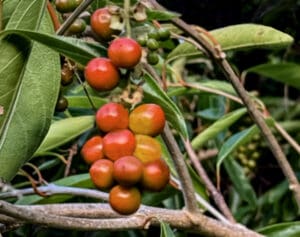
A fiddlewood tree offers orange berry-like fruits, as well as new flowers like tiny white stars. However the fruits don’t taste very good to me, and I leave them for the birds.
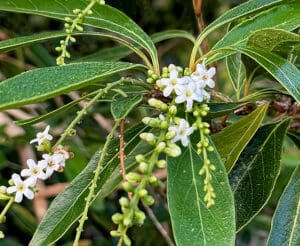
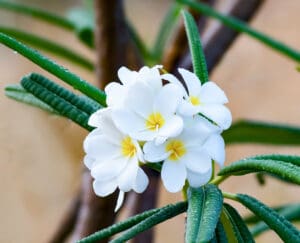
A frangipani tree is full of flowers, a feast for our eyes. Later the leaves might become fodder for the striped frangipani caterpillars that turn into big, gray pseudosphinx moths, but for now the tree is beautifully intact.
The most unusual gift from the rain this fall was a patch of weird mushrooms down on the ground. They caught my eye as I got out of the car, and seemed to be staring up at me.
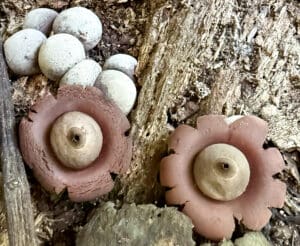
They turned out to be ‘earthstars’, a type of ‘stomach fungus’. They develop underground and then come to the surface when there is a lot of rain. They show up first as round white orbs, which contain sacs full of billions of tiny spores in their round bellies.
The orbs are fruiting bodies connected to an underground network of mycelium filaments. When they are up on the surface and rain hits an orb, the outer layer splits opens and curls back around the spore sac, lifting it up above the leaf litter on the ground. Forceful rain can then cause the spores to get pushed out of the sac’s center hole and dispersed on the wind.
I read that some types of earthstars are considered to be delicious, like mushrooms, when they are young. But they looked a bit scary to me.
Still I was happy to see something totally new and amazing, thanks to the rain.
—–
Gail Karlsson is the author of a new photo booklet Looking for Birds On St. John, as well as two other books about nature in the Virgin Islands – The Wild Life in an Island House, and a guide book Learning About Trees and Plants – A Project of the Unitarian Universalist Fellowship of St. John. Follow her on Instagram @gailkarlsson and at gvkarlsson.blogspot.com.