

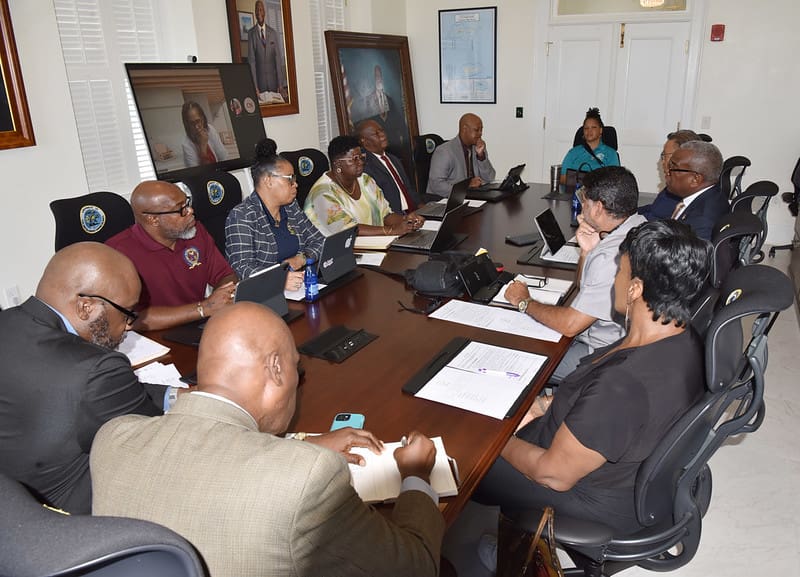
Gov. Albert Bryan Jr. convened the first meeting of the Virgin Islands Council on Human Trafficking last Wednesday, focusing on developing victim services, raising public awareness and coordinating training for government employees who may come into contact with victims or perpetrators of trafficking.
Human trafficking, defined as the recruitment or transport of individuals through force or deception for labor or sexual exploitation, has been identified as an issue in the Virgin Islands. “It seems distant, but right here in the Virgin Islands, it happens every day,” Bryan said in a press release sent over the weekend.
During Monday’s weekly press briefing, Bryan further detailed that the council will operate with about a $15 million budget funded by the settlement the territory reached with JPMorgan Chase over the bank’s ties to disgraced former financier Jeffrey Epstein. Bryan confirmed Monday that the money does not need to be budgeted by the Legislature as it has already been allocated for this purpose, though moving forward, the council is expected to submit an annual spending plan to the Office of Management and Budget and the Finance Department for approval.
Bryan noted Monday that while the law establishing the council has been on the books for decades, it had become inactive and was recently reassembled. He emphasized that the council would allocate funds for public awareness campaigns, training programs, and direct support for trafficking victims. The council will also work to ensure that resources are available to protect victims, particularly undocumented individuals, from deportation under federal mandates.
During the press briefing, Bryan also outlined several tangible milestones achieved during the first meeting and emphasized the importance of understanding the broader scope of trafficking beyond just sex work. He highlighted that the initial focus was on assembling the council members and appointing the chair and vice-chair, a foundational step, he said, that was crucial for setting the stage for future work.
During the meeting, Bryan said he participated in an information session that expanded his perspective on trafficking, noting that while many associate trafficking primarily with sex work, it can involve various forms of exploitation; the council’s efforts are specifically geared toward supporting victims, including those who may not have been initially recognized as such.
The council also discussed the need for adequate sheltering services, recognizing that as public education on trafficking increases, more victims may come forward. Bryan stressed that victims who turn themselves in are protected under federal mandates and will not face deportation. Additionally, he emphasized the need for resources to help identify victims and provide long-term support, acknowledging that it can take six months to a year for a victim to regain independence.
Bryan also mentioned plans for a future conference to further explore the issue of trafficking, including the specific challenges faced by children involved in these situations.
In this weekend’s news release, Council Chair and Deputy V.I. Attorney General Ian Clement described human trafficking as a serious issue that the territory needs to address with urgency. “The Virgin Islands Council on Human Trafficking aims to provide resources for victims, training for responders, and community awareness,” Clement said.
The council’s next steps include developing a budget and beginning outreach efforts to educate the public about the signs of trafficking and the resources available for victims, Bryan said.