

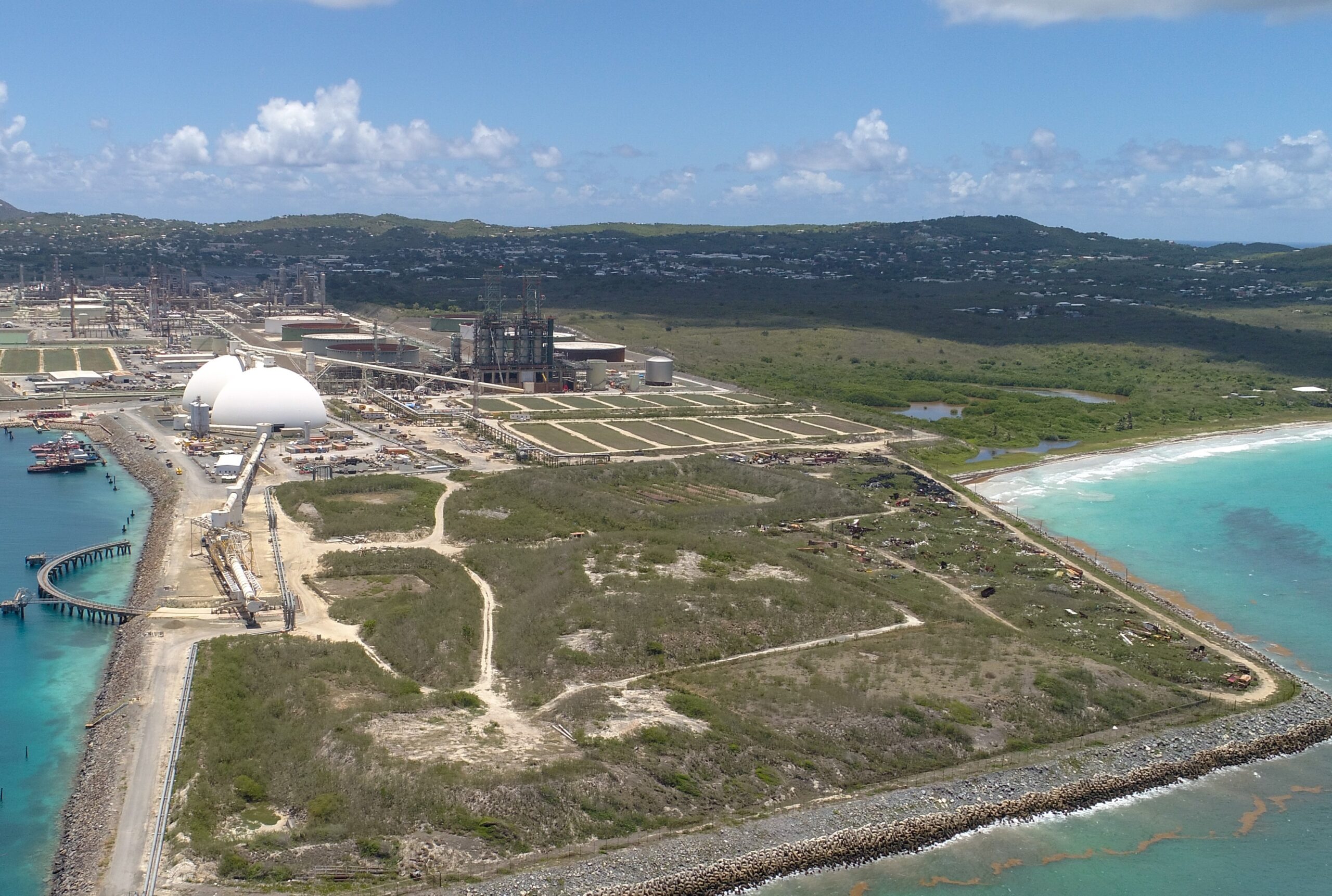
The owners of one of the Western Hemisphere’s largest oil refineries have entered an agreement to build a wind turbine and solar power field along St. Croix’s south shore, refinery officials said Friday.
Port Hamilton Refining and Transportation signed a letter of intent with Davis, California-based Wind Harvest to build a renewable-energy and battery-storage project on the refinery’s coke dock peninsula.
The plan calls for Wind Harvest to develop a hybrid renewable-energy system with up to six megawatts of vertical-axis wind turbines, paired with six megawatts of solar generation and integrated battery energy storage.
The system would provide reliable, on-site power to support refinery operations while reducing emissions and improving redundancy for critical systems, refinery officials said in a press release.
Wind Harvest CEO Kevin Wolf cofounded the company 20 years ago and never dreamed he’d be partnering with an oil refinery.
“Not expected. I know they are trying to do a variety of low-carbon fuels and things like that but the world needs our technology,” Wolf said.
Developing the company’s eight patented technologies — including those that make the turbines hurricane resistant — required testing in Denmark, Texas, and elsewhere, and cost a lot of money. The more projects Wind Harvest can get up and running, the easier time it will have convincing banks that it’s a worthy investment, he said.
“It’s damn expensive and it takes a long time,” Wolf said.
Hybrid wind, solar, and battery storage projects are a growing trend in industrial energy systems, particularly in island and remote environments, where energy resilience, fuel cost reduction, and grid stability are key operational priorities, refinery officials said in a written statement
“This project has the potential to deliver meaningful value to Port Hamilton,” Port Hamilton Director David Johnson said. “Accessing locally generated renewable energy at a lower cost than conventional fuel-based generation improves long-term operating economics while strengthening energy resilience. It is a practical solution aligned with our operational and infrastructure objectives.”
The site itself is one of the windiest on St. Croix but has mounds of hosing, concrete and steel put there over nearly 70 years of oil refining, Wolf said. His company is also exploring adding a wind turbine at the island’s Leatherback Brewery.
Wind Harvest’s vertical-axis wind turbines are engineered for complex wind conditions, designed to operate in high-wind and hurricane-prone environments. The turbines’ compact design — just 60 to 90 feet tall — support deployment in industrial and coastal settings where conventional turbine configurations may be less suitable, Wolf said. The turbines have a hexagonal base and the turbine blades connect at two points, not one.
“Trade wind regions such as the Caribbean require durable and cost-effective renewable energy solutions,” he said. “Our technology is designed specifically for these conditions, offering a resilient approach to renewable power generation in challenging environments.”
The turbines also operate at a lower 50-kilowatt level, which helps in windy regions, he said.
The project was in the early development and data-gathering phase Friday. Near-term efforts were focused on advancing site development activities, resource assessment, and positioning the project to qualify for applicable federal investment tax incentives. Installation was projected for completion in 2028.