

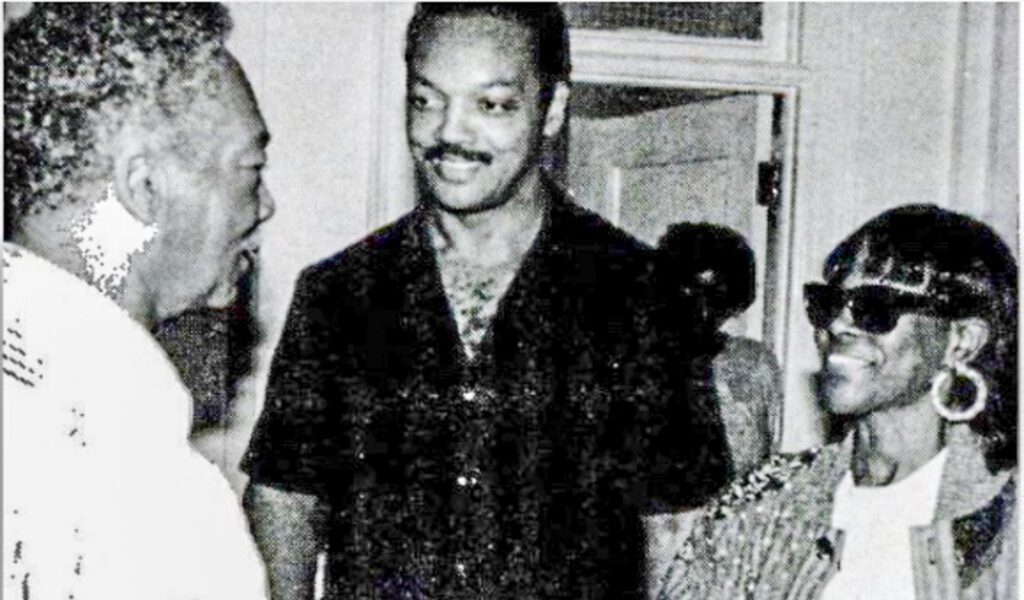
When Rev. Jesse L. Jackson Sr. ran for president in 1984, Donna Christensen was not watching from afar. She was in it.
“I chaired Jesse’s campaign in the Virgin Islands,” Christensen told the Source Tuesday. “I was a Jesse delegate to both conventions — 1984 and 1988.”
Jackson, the civil rights leader and two-time Democratic presidential candidate, died Tuesday at age 84, according to national reports and statements from his family. His death closes the chapter on one of the most consequential political and moral voices of the late 20th century — a man whose presidential campaigns reshaped the Democratic Party and whose work through Operation PUSH and the Rainbow/PUSH Coalition expanded the political imagination of what was possible in America.
For Christensen, Jackson was not simply a national figure. He was someone she worked alongside during a formative political moment.
As a member of the Democratic National Committee beginning in 1984, Christensen aligned herself with Jackson’s insurgent presidential campaign — a campaign that centered Black and brown communities, working families, and those long excluded from power. In 1984, Jackson became only the second African American to seek the Democratic nomination for president. Four years later, in 1988, he mounted an even stronger bid, winning 11 contests and earning more than 7 million votes nationwide.
“He opened the path for us to have a President Obama in our lifetime,” Christensen said. “It might have taken longer had we not had not only Jesse, but also Shirley Chisholm before him.”
Born in Greenville, South Carolina, in 1941, Jackson rose to prominence as a close associate of Dr. Martin Luther King Jr. and was present at the Lorraine Motel in Memphis the day before King’s assassination in 1968. In 1971, he founded Operation PUSH (People United to Save Humanity), aimed at economic empowerment and corporate accountability. In 1984, he established the National Rainbow Coalition, a multiracial political movement that emphasized voting rights, labor rights, and economic justice.
His message of coalition politics resonated in the Virgin Islands, where questions of political status and representation have long shaped public life, according to Christensen and local leaders.
Christensen recalled that during the 1984 Democratic National Convention, she was scheduled to speak on behalf of Jackson’s campaign. She and Puerto Rico’s delegation had crafted remarks centered on self-determination for the territories. She made it backstage, waiting to go on, before being told her speech would not be delivered.
“The word ‘self-determination’ was seen in the context of Israel and Palestine, and they did not want those two words uttered,” she said.
She never gave the speech.
Four years later, in 1988, she found herself again navigating internal party tensions as the territory’s delegate vote strength became a point of dispute in a convention largely aligned behind the eventual nominee.
Yet Jackson’s connection to the Virgin Islands extended beyond party politics.
After Hurricane Hugo devastated the territory in 1989, national media reports often portrayed chaos and disorder in its aftermath. Christensen, then serving within Democratic Party leadership circles, reached out and urged that Jackson come to the Virgin Islands.
“He went to St. Thomas first and then to St. Croix,” she said. “His presence was reassuring to a lot of people.”
At a moment when many residents felt mischaracterized and marginalized, she believed his presence would carry weight.
“He was a spokesperson for the Black community,” she said. “I felt that his presence would be acknowledged by the community and bring some comfort.”
Local leaders echoed that sentiment Tuesday.
Sen. Marvin A. Blyden said Jackson inspired him as a young man during the 1984 and 1988 presidential campaigns and credited him with centering Black and brown communities, women and working families in the national political vision. Blyden noted Jackson’s early work alongside Dr. King, his role in the Selma to Montgomery march, and his later leadership through Operation PUSH and the Rainbow Coalition, adding that Jackson’s inclusive vision “still speaks powerfully to us in the Virgin Islands.”
Senate President Milton E. Potter described Jackson as “a servant leader in the truest sense” and said his life carried special meaning in the Virgin Islands, where residents understand what it means to be marginalized within the nation they call home. Jackson’s Rainbow Coalition, Potter said in a press release, proved that a coalition of conscience could change the course of American history.
In a statement Tuesday, the Democratic Party of the Virgin Islands likewise described Jackson as “a towering figure in American history and a global symbol of civil rights, justice, and democratic participation,” crediting his leadership with strengthening democracy and expanding representation for communities long denied a voice.
Christensen last saw Jackson in 2019, when he was honored by the University of the District of Columbia. In recent years, as his health declined, many who followed his career understood that his public appearances were becoming fewer.
Still, she spoke of him without hesitation.
“Jesse is a legend,” she said. “And legends never die.”
Asked whether there is someone today who carries the same national moral authority Jackson once did, she paused.
“It may take more than one person,” she said. “Until that person emerges, each and every one of us in between has to carry on his work.”