


Representatives from multiple labor unions protested outside the Legislature Monday night as Gov. Albert Bryan Jr. delivered his final State of the Territory Address, citing years of unaddressed grievances, expired contracts, and unsafe working conditions. Union leaders said the government has repeatedly failed to negotiate wages, honor collective bargaining agreements, or address concerns about workplace safety.
Union leaders said they were initially permitted to protest closer to the Legislature building but were ordered days before the event to relocate farther down the road toward Vendors Plaza. They described the change as unnecessary and perhaps unlawful.
John Vigueras, an international special representative for the International Association of Machinists, said, “We had negotiated in front of the building, and they pushed us all the way over here. Now they cut down the traffic, so we have zero impact. This is a way of silencing us. This is not working with us. This is working against us.”

Vigueras said police told union leaders the relocation was required by law, but that explanation was later disputed by lawmakers. “I’ve been in constant contact with Senator Franklin Johnson,” Vigueras said. “He told me himself there’s no law that stipulates that.”
Multiple union representatives noted that in previous years, protesters had been allowed to stand much closer to the Legislature building.
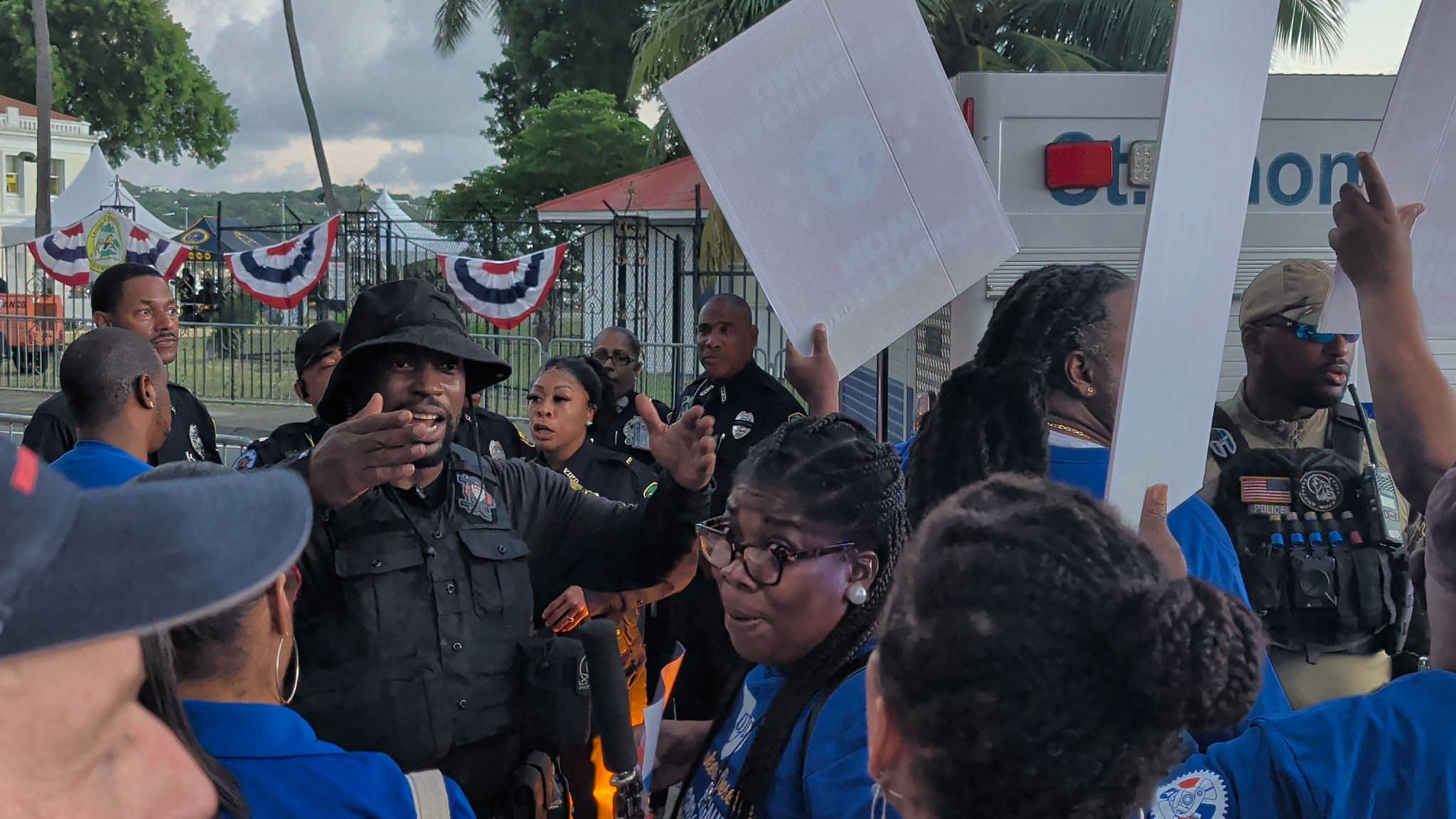
Beyond the dispute over the protest site, union leaders said the demonstration reflected deeper, long-running tensions between workers and the government. Representatives from education, waste management, health care and public service unions said the protest was driven by expired contracts, stalled negotiations, unsafe infrastructure, and what they described as the current administration’s anti-labor stance.
“The common adversary is the government,” Vigueras said. “They don’t want to negotiate with us. They don’t want to respect the contracts. They don’t want to pay progression rates.”
Several union officials said collective bargaining agreements have lapsed for years, preventing workers from receiving progression pay and leaving grievances and arbitration cases unresolved. Others cited unsafe or unhealthy working conditions, including mold in schools and government buildings, staffing shortages, and persistent backlogs at labor boards and arbitration panels, which they said reflect broader neglect of public-sector workers.
Union leaders said the government has repeatedly ignored agreements negotiated with workers, leaving employees without promised protections or pay increases. “They do not respect our CBA, they don’t respect our members, and it’s really a problem for us when our leaders don’t respect us or our CBA,” said Carver Farrow, president of the Education Administrators Association on St. Thomas and St. John. A collective bargaining agreement, or CBA, is a legally binding contract between a union and an employer that sets wages, benefits, and working conditions.
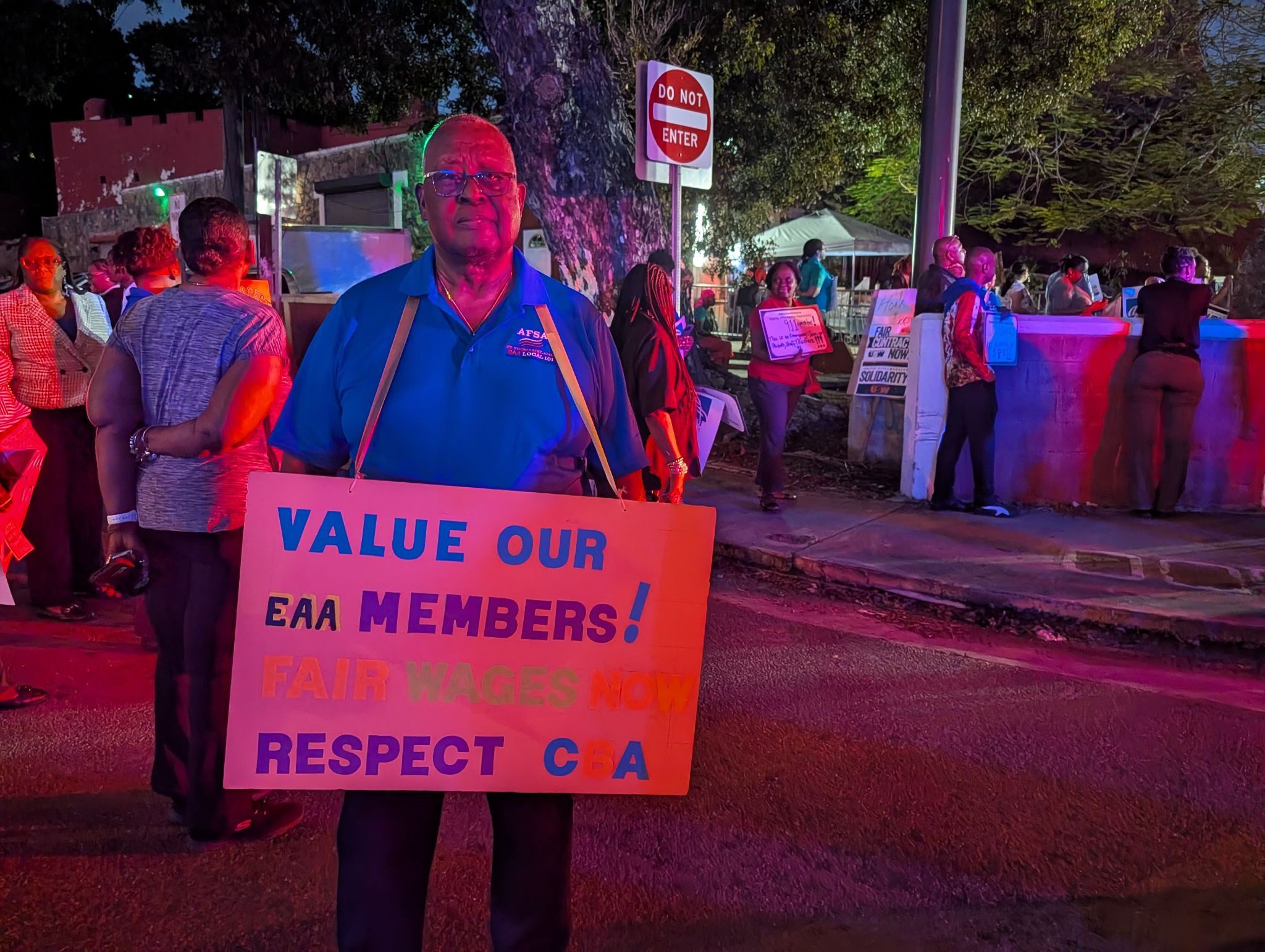
Farrow, and other labor leaders, said grievances are piling up at the Public Employees’ Relations Board, the agency that handles labor disputes for public-sector workers, and in arbitration, leaving hundreds of cases unresolved.
“PERB has over 100 cases … If I have a grievance, I expect it to be settled in a reasonable amount of time,” said Farrow “If you go to arbitration, there’s over 300 cases in arbitration. When are those cases going to be heard? These are the type things that we just can’t stomach anymore. We need some action. We need the governor to do something. We need our senators to look into these things for the working class.”
John Merchant, general counsel to a seafarers union, said, “There’s just been this atrophy of the mechanisms that we have to peacefully resolve our disputes, the bargaining table, the arbitration, the public employee board. So without that, all we have to do is to speak with our feet and our signs.”
Teachers and administrators said deteriorating school buildings and air quality are making staff and students sick. “Our schools are not healthy for teachers and students,” said Leontyne Jones, president of the St. Thomas-St. John Federation of Teachers, Local 1825. “We have mold issues. We have CO2 issues in some of the schools …. I don’t want my people to get sick and then have these chronic health issues.”
Linda Edmead-Glesford, second vice president of Local 1825, said those problems are visible in classrooms every day. “Just today, one of my co-workers, she had to open her door … because the mold was giving both her and the students a headache,” she said. “The mold is in the lights in the classroom. The mold is in the wall … People are getting sick constantly. The students are getting sick constantly. We need to be heard.”
Union leaders said they are responding by coordinating more closely across sectors and planning for a sustained campaign. Vigueras said local unions have formed an Area Labor Federation, allowing them to pool resources and present a united front.
“We created what’s called an Area Labor Federation that’s been sanctioned by the American Federation of Labor, the AFL-CIO,” he said. “These are all unions working together for the same common issues.”
Several labor leaders said their unity will extend to the ballot box, with unions now planning to act as a single voting bloc in upcoming elections. Farrow emphasized the impact this coordinated effort could have: “What we are planning on doing is working together from this point on, and we are going to vote in a bloc. We are going to be a major player in who the next governor is going to be. We’re going to be a major player on which senators get in there.”
Linda Edmead-Glesford added, “I am totally in agreement with all the unions coming together, because that’s unity, strength, and when everybody comes together, then action takes place.” Jacqueline Dickenson, vice president of the United Industrial Workers of the Virgin Islands–Service Employees International Union, urged voters to support labor-friendly candidates: “Election is coming this year, and we need for you to get out and vote, vote union friendly. We need people inside there who are going to work for us.”
Jones concluded the remarks, stressing that this is only the beginning: “This is just the first step. We are going to keep doing this until we see a change. We have power in numbers. We can vote these people out of office.”