

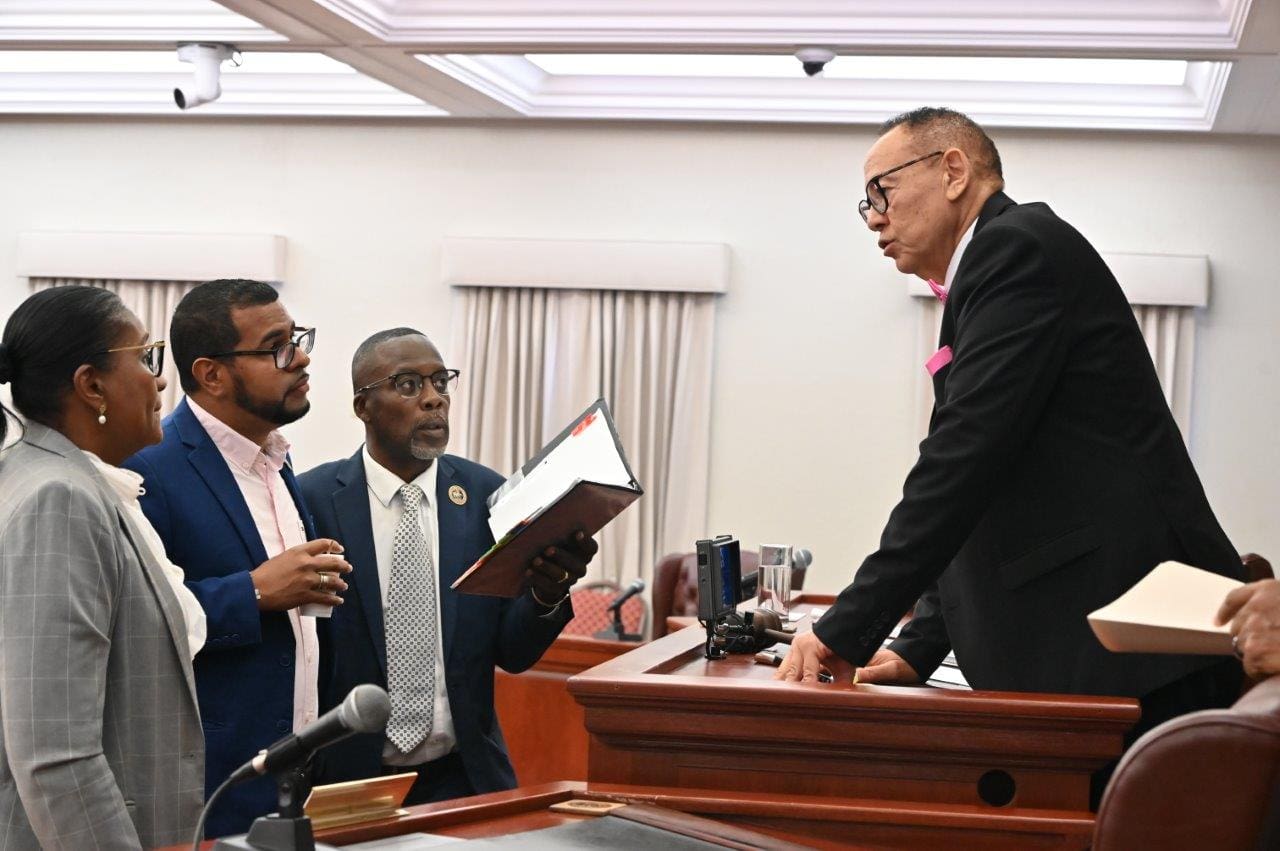
The Health, Hospitals, and Human Services Committee tackled pressing issues in health care access, regulatory reforms, and medical waste management on Friday. Led by Sen. Ray Fonseca, the committee approved three pivotal bills, each aimed at addressing long-standing gaps in the territory’s health care infrastructure.
The first measure, Bill No. 35-0254, proposed by Sen. Diane Capehart, seeks to establish the Audiology and Speech-Language Pathology Interstate Compact. This agreement allows audiologists and speech-language pathologists in good standing to practice across member states under a compact privilege, a provision equivalent to a license. Assistant Commissioner Rueben Molloy of the Virgin Islands Health Department emphasized the compact’s potential to improve access to care for residents, particularly children and stroke survivors.
“The compact offers a practical solution to addressing our limited pool of audiologists currently just three across the territory, while ensuring consistent standards of care,” Molloy said. He noted that the compact privileges are expected to be operational by late summer 2025, giving the territory time to align its infrastructure with the compact’s requirements. As Molloy pointed out, “This isn’t just about increasing numbers. It’s about ensuring that every Virgin Islander has access to timely, specialized care without the need to leave home.”
However, the Virgin Islands must establish a dedicated board to comply with the compact requirements, which mandate appointing two delegates to its governing commission.
Thirty-four states have already enacted similar legislation. The Virgin Islands stands to become the first U.S. territory to join the compact. Proponents of the bill hope the measure will not only address current shortages the Virgin Islands face but also attract a larger pool of professionals to meet future health care demands.
Horace Graham, assistant commissioner of the Virgin Islands Licensing and Consumer Affairs Department, provided testimony addressing the regulatory implications of the proposed Audiology and Speech-Language Pathology Interstate Compact. Speaking on behalf of DLCA Commissioner H. Nathalie Hodge, Graham emphasized the importance of the DLCA maintaining authority over the issuance and regulation of business licenses for individuals and entities operating within the Virgin Islands.
In his testimony, Graham highlighted a significant aspect of the compact: while it facilitates the interstate practice of audiology and speech-language pathology through a unified licensing system, it does not explicitly waive the requirement for practitioners to obtain a local business license to operate within the territory. This provision ensures that professionals practicing under the compact’s “privilege” must still adhere to local business regulations, preserving the Virgin Islands’ ability to oversee and manage business operations effectively.
“The compact establishes uniform standards for licensure, ensuring all member states adhere to a consistent level of regulation and oversight,” Graham stated. However, he raised concerns about the need for clear guidelines to prevent conflicts between the compact’s regulatory framework and local licensing requirements. Specifically, Graham underlined that while the compact streamlines professional licensure, it does not exempt practitioners from the procedural and tax obligations associated with acquiring a business license in the Virgin Islands.
Graham also pointed out that this dual-layered approach preserves the integrity of the Virgin Islands’ regulatory system, ensuring that businesses operate transparently and within established legal frameworks.
The second piece of business, Bill No. 35-0295, sponsored by Sen. Donna Frett-Gregory, proposes the establishment of a Prescription Drug Monitoring Program (PDMP) to combat opioid misuse and ensure safe prescription drug practices. Testifiers highlighted the benefits of the program, including improved patient safety and the prevention of drug misuse through an electronic database tracking controlled substances.
Troy de Chabert-Shuster, state director for AARP, emphasized the importance of this initiative by stating, “A PDMP will save lives by identifying at-risk patients and ensuring safe prescribing practices. It’s a proven public health tool that our territory desperately needs.” He highlighted the alarming prevalence of prescription drug abuse in the United States, noting that over 16 million Americans reportedly misused prescription drugs in 2023. “The Virgin Islands faces similar risks,” de Chabert-Shuster added. Stressing that without proper intervention, practices such as doctor shopping and overprescribing would continue to strain the health care system.
Despite widespread support, concerns were raised over missed opportunities for federal funding. Sen. Marvin Blyden criticized the Health Department for failing to apply for a federal grant under the Harold Rogers Prescription Drug Monitoring Program, which could have alleviated funding challenges.
The third bill presented, Bill No. 35-0408, seeks to create a regulated medical waste management plan to ensure the safe disposal of hazardous materials. Testimony underscored the environmental and health risks posed by the current lack of a clear policy.
“Medical waste requires careful disposal and containment before collection and consolidation for treatment,” Frett-Gregory stated. “We must ensure our health care infrastructure is equipped to handle medical waste responsibly, especially as we rebuild hospitals and medical facilities across the territory.”
Experts testified that medical waste, though a small percentage of overall waste generated, carries significant risks. It includes dangerous microorganisms, toxic substances, and radioactive materials that, if mishandled, can jeopardize public health and environmental safety. The Centers for Disease Control and Prevention has long advocated for regulated waste management plans as a best practice for health care facilities, reinforcing the need for policy updates in the Virgin Islands.
Jean-Pierre Oriol, commissioner of the Department of Planning and Natural Resources, expressed support for the proposed bill but recommended removing the management plan component. Oriol argued that the DPNR does not oversee medical waste directly, and the responsibility for managing such materials should lie with health care providers and waste disposal specialists. Despite this, he acknowledged the necessity of updating the Virgin Islands Code to include provisions for regulated medical waste.
While the measure received widespread support, Fonseca raised concerns about the government’s readiness to implement the proposed regulations. Fonseca criticized the lack of a comprehensive plan and coordination between departments, noting that DPNR did not send a representative to testify in person, which highlighted potential gaps in collaboration.
Despite these challenges, the bill moves forward along with the other two bills to the Rules and Judiciary Committee for further deliberation.
Sens. Ray Fonseca, Marvin A. Blyden, Diane T. Capehart, Samuel Carrion, Donna A. Frett-Gregory, and Marise C. James were present at the meeting.