

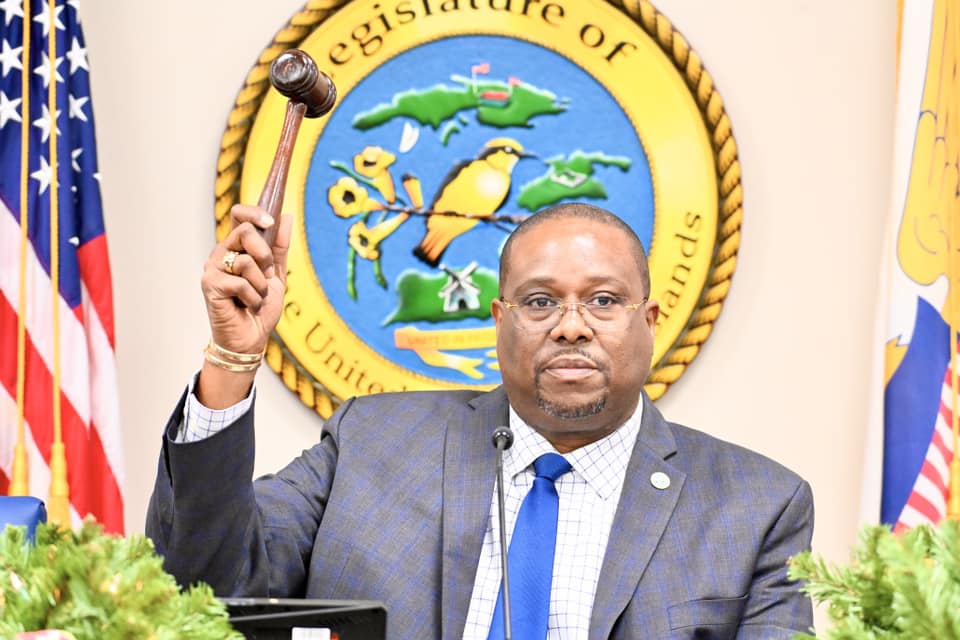
On Wednesday the Homeland Security, Justice and Public Safety Committee addressed several public safety measures, with particular focus on ghost guns and traffic safety regulations.
The committee, chaired by Sen. Kenneth L. Gittens, heard compelling testimony from Criminal Chief H. Timothy Perry of the Virgin Islands Justice Department regarding Bill No. 35-0419, dubbed the “Virgin Islands Firearm Serial Number Regulation Act.” Perry characterized the legislation as the “Closing the Ghost Gun Loophole Act,” addressing a growing concern in both the territory and nationwide.
Ghost guns, as Perry explained, are firearms manufactured without serial numbers, making them untraceable by law enforcement. Unlike traditional firearms, which have been required by federal law since 1968 to bear serial numbers, ghost guns are intentionally produced as component parts that can be assembled into fully functional weapons while evading existing regulations.
The urgency of this legislation was underscored by alarming statistics presented during the hearing. According to the Brady Campaign to Prevent Gun Violence, law enforcement agencies nationwide witnessed an astronomical increase of over 1,000 percent in ghost gun recoveries between 2016 and 2021. The numbers jumped from 1,758 ghost guns in 2016 to more than 19,000 in 2021, with these weapons being implicated in approximately 700 homicides or attempted homicides.
“These ghost guns fire the same bullets as a legal firearm, they are just as deadly,” Perry testified. “But these guns are specifically marketed to would-be criminals, as untraceable guns. And, increasingly, as throughout the United States, ghost guns are showing up here, now, on the streets of the Virgin Islands.”
The proposed legislation would join similar measures enacted by other jurisdictions. As Perry noted, “We join 16 other states and numerous localities in getting laws on the books to regulate or ban ghost guns.” He provided specific examples of recent legislation, including Hawaii’s January 2022 law that “makes it illegal to possess a firearm receiver that has not been provided a serial number that may be registered” and Maryland’s June 2022 Senate Bill 387, which “requires a firearm to be imprinted … with a serial number.”
The threat of ghost guns has gained national attention. Perry referenced a recent incident reported by National Public Radio involving “the gunman in New York City, who murdered the CEO of United Healthcare in cold blood and led the nation on a manhunt, he was carrying a ghost gun.” According to federal authorities, “less than one percent of ghost guns are traceable back to their original purchaser.”
Based on his direct experience in law enforcement, Perry emphasized the local impact by stating, “I prosecute gun crime. I work with the families of victims of gun crime. And, I work with our brave police officers, the men and women who show up, at 2 a.m. at Round the Field, after a shooting.” He described the legislation as “a common sense fix to close a loophole in the law, to hold criminals accountable and to make our community safer.”
As Perry concluded in his testimony, “There is no downside to this bill. This bill does not foreclose, in any way, the right of any man or woman in this Territory, to acquire and license a legal firearm. This is exactly the way democracy is supposed to work, A lawmaker, sees a community need, and crafts a fix.”
In addition to the ghost gun legislation, the committee also considered measures related to traffic safety and vehicle regulation. Bill No. 35-0409, sponsored by Sen. Samuel Carrión, addressed critical gaps in the territory’s vehicle titling system. The legislation aims to amend the definition of salvage vehicle purchaser and junk vehicle purchaser, requiring mandatory reporting to the Motor Vehicles Bureau.
Barbara Jackson McIntosh, director of the Motor Vehicles Bureau, provided testimony highlighting the current challenges faced by the territory. The Virgin Islands currently does not share vehicle certificate of title information with other states and territories, creating vulnerabilities in the system. According to McIntosh, this has led to an increase in “title washing,” where vehicles with salvage or junk titles are fraudulently rebranded as roadworthy.
The committee also considered Bill No. 35-0417, which proposed increasing penalties for traffic violations and establishing a Virgin Islands Police Department impound lot. However, this bill was held in committee due to the absence of key testimony from traffic enforcement representatives and a lack of comprehensive statistical data.
Statistics presented during the hearing revealed significant challenges in vehicle registration and insurance compliance. For the 2023 fiscal year, unpaid registration fees totaled approximately $2.4 million. The problem extends beyond registration issues. The Motor Vehicles Bureau reported 2,094 unregistered vehicles in October 2024 alone, representing approximately $183,000 in unpaid fees. In November, the number increased to 2,303 unregistered vehicles. Of particular concern was the number of uninsured vehicles, with 567 vehicles listed as uninsured in October and 508 in November.
“We share this information monthly with the police department and the Office of Highway Safety,” McIntosh told the committee, highlighting the available data that could inform enforcement efforts.
Sen. Franklin D. Johnson, expressing disappointment at the absence of traffic commanders, questioned the department’s basic enforcement capabilities. “Why doesn’t the department have radar guns right now to be able to find folks for speeding?” Johnson asked, noting that speeding contributes to many accidents.
Daphne O’Neal the director of V.I. Highway and Safety Office acknowledged that while some radar guns exist, maintenance issues and funding constraints have limited their deployment. When asked about citation statistics, she could not provide specific numbers but indicated they could be obtained from department records.
The proposed legislation aims to address these challenges through several mechanisms, including increased penalties for traffic violations and the establishment of official police impound lots in the St. Thomas and St. Croix districts. Gittens, the bill’s sponsor, argued that current fines are insufficient to deter violations.
“You know that you’re gonna have a traffic violation and paying $25 or for $35 for a traffic violation — I mean, we have even offices here within the body that could tell you some of the French words that you get when you write somebody a ticket, and they tell you hurry up right there so and so ticket is only $25,” Gittens said.
Looking ahead, McIntosh announced plans to implement new technological solutions to address compliance issues. The Motor Vehicles Bureau is working with software developers to automate the cancellation of registrations for uninsured and unregistered vehicles, replacing the current manual process that struggles to keep pace with violations.
“Enforcement is key,” noted Sen. Dwayne M. DeGraff, a former police officer with 26 years of service. “What I look at is there’s no one here to tell us what kind of tickets have been dispersed for the year. Now it seems as if we could be raising the fees to impose on the law-abiding public and to deter versus getting out and doing the work.”