

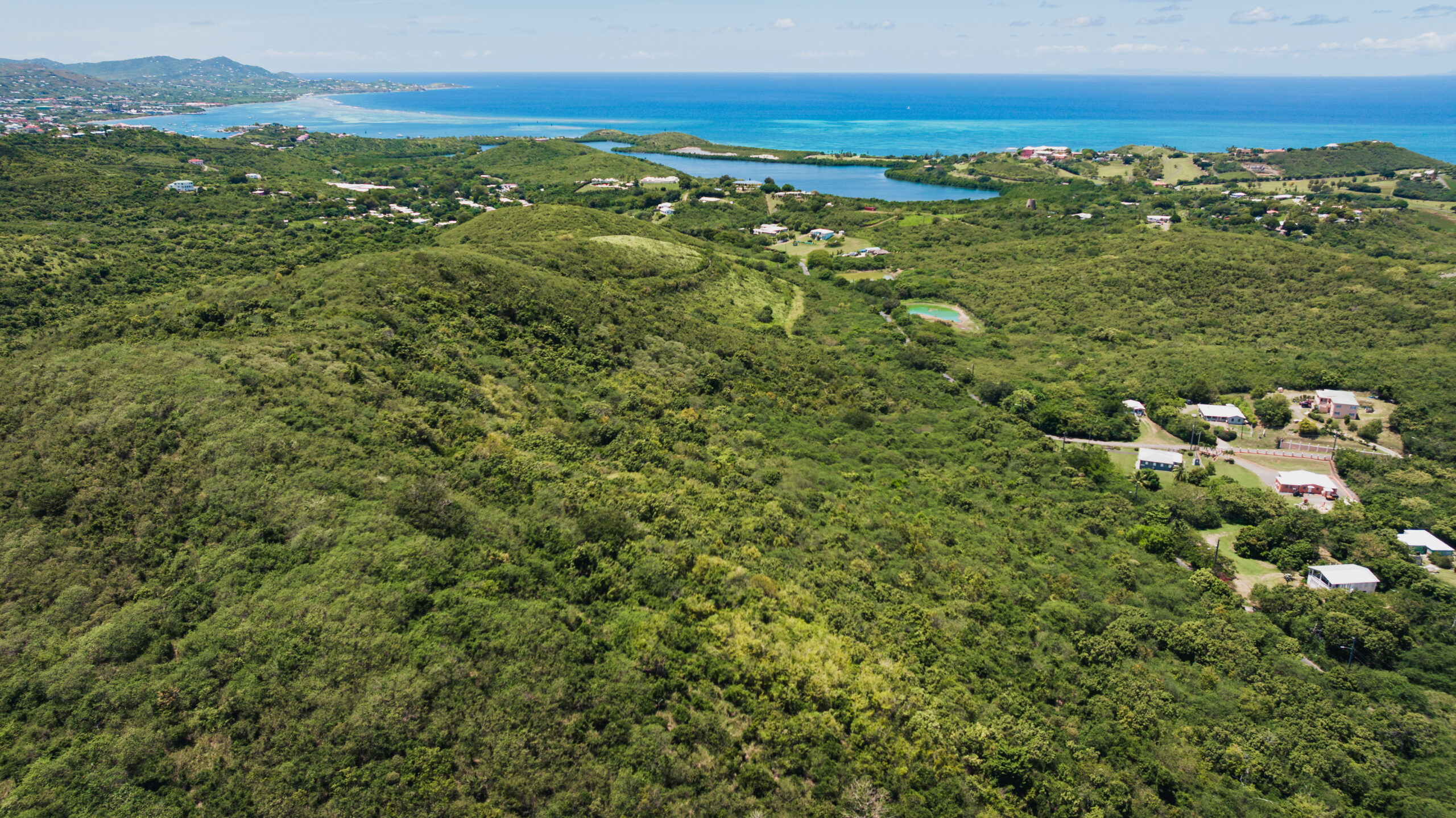
Fifty-three more acres of undeveloped land on St. Croix’s southeastern shoreline will be preserved for current and future Virgin Islanders to enjoy, the VI Department of Planning and Natural Resources and its Territorial Parks and Protected Areas division announced this week.
The land acquisition was funded through a $69 million Climate Resilience Regional Challenge grant administered by the National Oceanic and Atmospheric Administration, which covers activity across watershed and coastal improvement plans, climate-resilient land conservation and park development, and education and workforce development. The Lowry Hill site purchase on St. Croix follows the government’s $17.5 million purchase of 2,469 acres in the Maroon Ridge and Annaly Bay area and its $5.6 million acquisition of 140 acres overlooking Perseverance Bay on St. Thomas.
Environmentalist and educator Olasee Davis noted that the preservation of sites like Lowry Hill, which connects to the Great Pond watershed, can have significant downstream effects for local fishermen and others. TPPA Director Kristina “Kitty” Edwards told the Source Friday that the grant also covers the management plans for the sites they’ve acquired. That’s important, she said, “because we are spending this money to bring properties into our management and we want to make sure that they are managed properly in perpetuity.”
“So we will be working with a contractor to develop park unit management plans, looking at usage zones, doing public input, researching the history of all of these properties,” she said.
Of the overall effort to build out a territorial park system, Edwards said her division’s motto is “VI parks for VI people.”
“If we take care of ourselves first and make an amazing park system for us, it’s going to be amazing for everybody,” she said, adding that the work is about protecting not just the land, but also culture and history. “‘Culture’ is right up until today. And so that is looking at past uses, current uses, future uses — where we are really looking holistically at how we as Virgin Islanders use our land and want to use our land in the future.”