

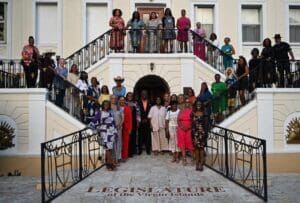
Against the historic backdrop of Kamala Harris’s U.S. presidential run, dozens of female elected officials from across the nation gathered on St. Thomas for a landmark conference, symbolizing the rising influence of women in leadership.
Host Sen. Donna Frett-Gregory highlighted, in particular, the significance of being able to collaborate with colleagues and learning from their experiences to address common challenges. The National Organization of Black Election Legislative Women’s Conference, now in its 39th year, focuses on health equity, economic opportunities, and social justice, emphasizing underserved communities.
“As women, as elected leaders, we get up every day, do all the things we have to do at home with our families, and still work hard to serve our communities,” Frett-Gregory said.
Sen. Marise James, co-host of the conference, similarly underscored the importance of offering such a platform for dialogue – one that essentially serves as a think tank that can help shape public policy.
“It’s essential to come up with solutions and suggestions on how we can improve the quality of life for residents,” James said, emphasizing the urgent health care crisis in the territory. With the recent withdrawal of Pafford Medical Services, access to quality healthcare has become even more critical. “If you don’t have access to quality health care, you aren’t really treated like others in the states,” she added, highlighting her focus on health equity during the conference.
The group spent time together on Tuesday and Wednesday touring the Legislature and speaking to the press, with Georgia Senator and N.O.B.E.L President Tonya Anderson expressing the group’s excitement about their upcoming visit to the University of the Virgin Islands to view the campus and discuss increasing opportunities for girls and women in technology. “We are in a partnership to make sure that every woman from N.O.B.E.L. is supported from Iowa to L.A. to Utah to Ft. Lauderdale-Miami,” Anderson said.
Speaking to the Source, Anderson also highlighted the importance of focusing on wellness and policies around wellness.
“It’s our responsibility to stand for Black and Brown people, so they can have that equity and justice in education, economics, and empowerment,” she said. The conference sessions in the days ahead would address the need for broader access to health care for communities of color in the U.S., discussing issues such as maternal mortality, breast cancer, and sickle cell disease. Anderson emphasized the need to involve community partners and local health care providers in addressing these critical issues.
Anderson also spoke with anticipation as the Democratic National Convention in Chicago looms. A first-time convention delegate, Anderson said she and other N.O.B.E.L. members are looking forward to the appearance of Vice President Harris, the party’s presidential nominee.
Because the group is non-partisan there will be no official role for N.O.B.E.L. to play at the convention, she said. But those members who qualify and have been chosen to serve as delegates will perform their duties there.
“We’ve been doing the work, but now our lens is focused and we can’t be distracted,” she said. This election only helps to carry our message when we’re looking at the future of leadership – and we’re looking at this candidate as a catalyst to help push the policy agenda.”
Also attending Wednesday was Tennessee State Representative Antonio Parkinson who said he traveled to St. Thomas for the conference.
“We want to make sure we are in a position of support for all of these wonderfully talented women and their policies that are coming forth,” Parkinson said.
And, throughout the day, that message of women leading and supporting each other globally greatly resonated among the group.
“Holding a conference like this allows us to collaborate around what we want to see as women globally,” Frett-Gregory said. “While we do have differences, our differences make us unique, and through discussions on critical issues and a united effort to promote equity and justice, we can create lasting positive change for all of our communities and beyond.”