

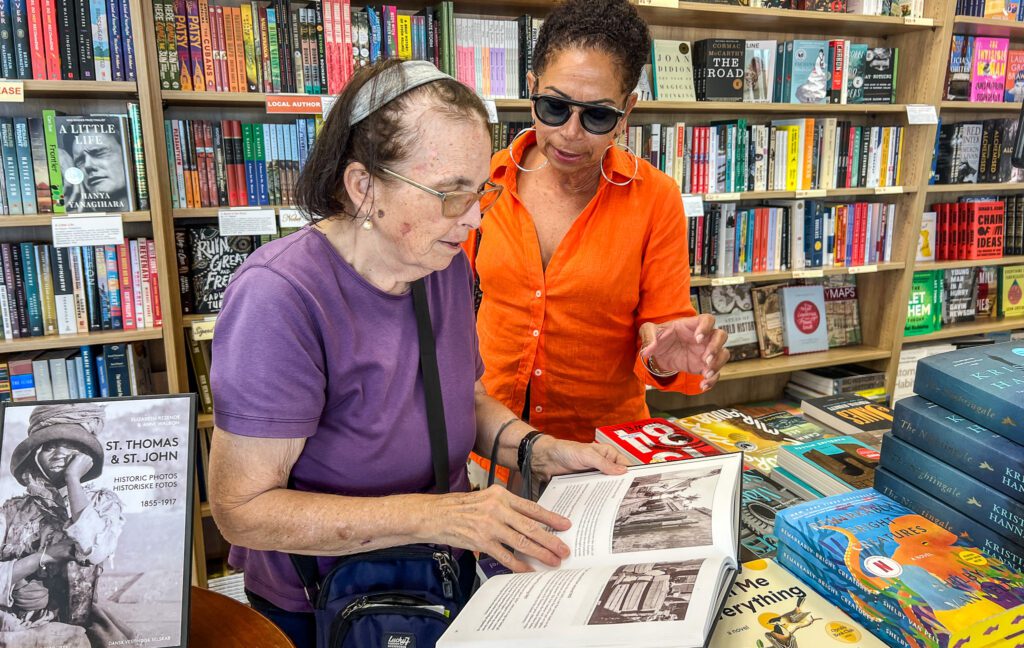
As the territory observes Virgin Islands History Month, a new publication is offering a rare window into the territory’s past — not through long narratives, but through carefully preserved moments captured in time.
“St. Thomas & St. John: Historic Photos 1855–1917,” co-authored by historian Elizabeth Rezende and Anne Walbom, brings together a collection of images from the Danish West Indian period, documenting life across the islands in the decades leading up to the 1917 transfer to the United States.
The book opens with a portrait of a place in motion — a bustling port, shaped by trade, migration, and global connection. In the late 1800s, St. Thomas was “the leading transshipment and provisioning port between Europe, South and Central America,” a hub where goods, people, and cultures intersected. The photographs, many drawn from the Danish West Indian Society’s collections, reflect that complexity — from harbor scenes and street life to labor, industry, and everyday routines.
But for Rezende, the work behind the book was as important as the images themselves.
Perusing the shelves at Island Booksellers on St. Thomas this weekend, she described a process rooted in persistence — and patience. “Newspapers first,” she said, explaining how historical research often begins. “You get a general idea of what is happening in the place, who’s doing what, and who’s being recorded.” From there, she turns to census records to understand where people lived and how they worked, and, in many cases, church archives to trace identity, status, and community.
Even then, the process is far from straightforward.
“You hit what we call black holes,” she said — moments where records simply stop, or never existed. “Or a brick wall. And sometimes, by chance, someone comes along and says, ‘I know that name,’ and everything opens up.”
That layered approach is evident throughout the book. Some images come with detailed context; others rely on careful observation — clothing, posture, surroundings — to tell their story. Walbom, Rezende’s co-author, brought a particularly sharp eye to that work, often identifying time periods based on fabrics, dress styles, and subtle visual cues.
“She could tell when a photograph was taken just by what the women were wearing,” Rezende said. “The length of the dress, the fabric — all of that mattered.”
The result is a book that reads less like a traditional history and more like a visual map — one that invites readers to look closely and draw their own connections.
In one image, women carry heavy baskets of coal on their heads, part of the labor force that supported steamships entering the harbor in the late 19th century. In another, children work alongside adults, their expressions capturing both the weight of responsibility and moments of curiosity. Elsewhere, photographs of lighter boats and crowded waterfronts reveal the mechanics of a port that once depended on smaller vessels to move people and goods from anchored ships to shore.
“There’s something in every picture,” Rezende said. “You can’t limit what you see. Everyone takes something different from it.”
That idea feels especially relevant now, as digital tools make it easier than ever to manipulate or misrepresent historical imagery. For Rezende, the authenticity of these photographs — unaltered, rooted in a specific time and place — is part of their enduring value.
“This is a picture in time,” she said. “You have to know something to understand it — but once you do, it tells you so much.”
The book itself took roughly a year and a half to complete, with Rezende based in the Virgin Islands and Walbom working from Denmark. Together, they organized the material thematically — from harbor life and street scenes to tourism, trade, and daily activity — tracing the evolution of both St. Thomas and St. John during a period of significant change.
For younger readers, Rezende hopes the images serve as more than just documentation.
“What were you doing when you were ten or eleven?” she asked, pointing to a photograph of children at work. “These are real lives. Real moments. And they matter.”
As the Virgin Islands continues to reflect on its history this month, “St. Thomas & St. John: Historic Photos 1855–1917” offers a reminder that the past is not only preserved in records and archives — but in the faces, places, and quiet details captured in a single frame.