

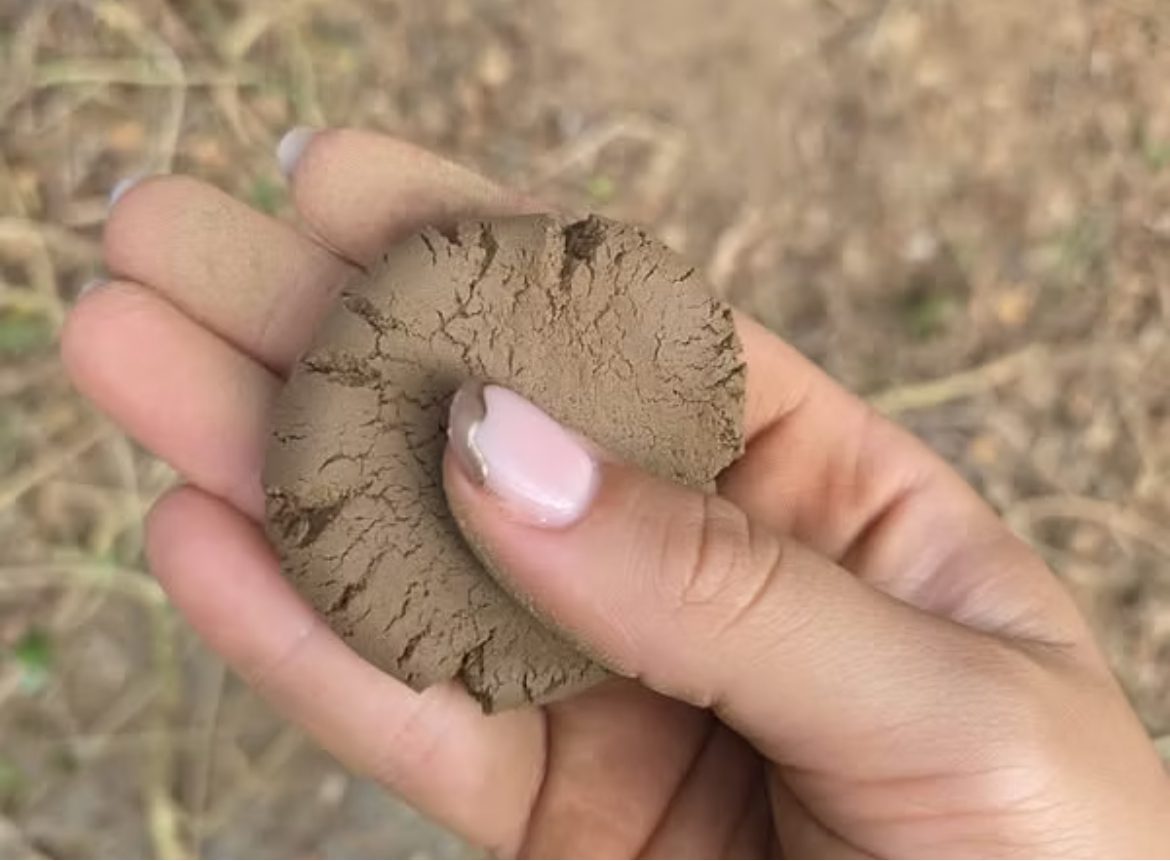
(Photo courtesy Arte-Suelo-Ser)
The Caribbean Museum Center for the Arts is continuing its series “Dialogs on Freedom” with “Our Soil, Beyond Materiality,” a groundbreaking collective exhibition exploring the vital connection between soil, art, and the Caribbean community.
The exhibition invites visitors to explore soils beyond their physical properties and to consider their ecological, cultural, and historical significance. By integrating scientific inquiry with artistic expression, the exhibit both highlights and expresses a deep appreciation for the vital role soils play in our ecosystems. On view from June 27-Nov. 7, the group exhibition features a collaboration between Arte-Suelo-Ser, The Museo de Suelos Del Caribe of Puerto Rico and St. Croix artists and farmers.
Co-curated by Alexandra Santos, Margaret Mair, Carmen González, Kimberly Santiago, Thais Ortiz, Suhey Cruz, and Zoelie Rivera, the exhibition merges scientific research with creative expression to reveal how soil health connects to human health, community resilience, and Caribbean identity. It presents a cross-disciplinary collaboration between curators, artists, scientists and participating farmers. Through hands-on workshops, film screenings, guided artist tours, and field trips, visitors discover why soil matters.
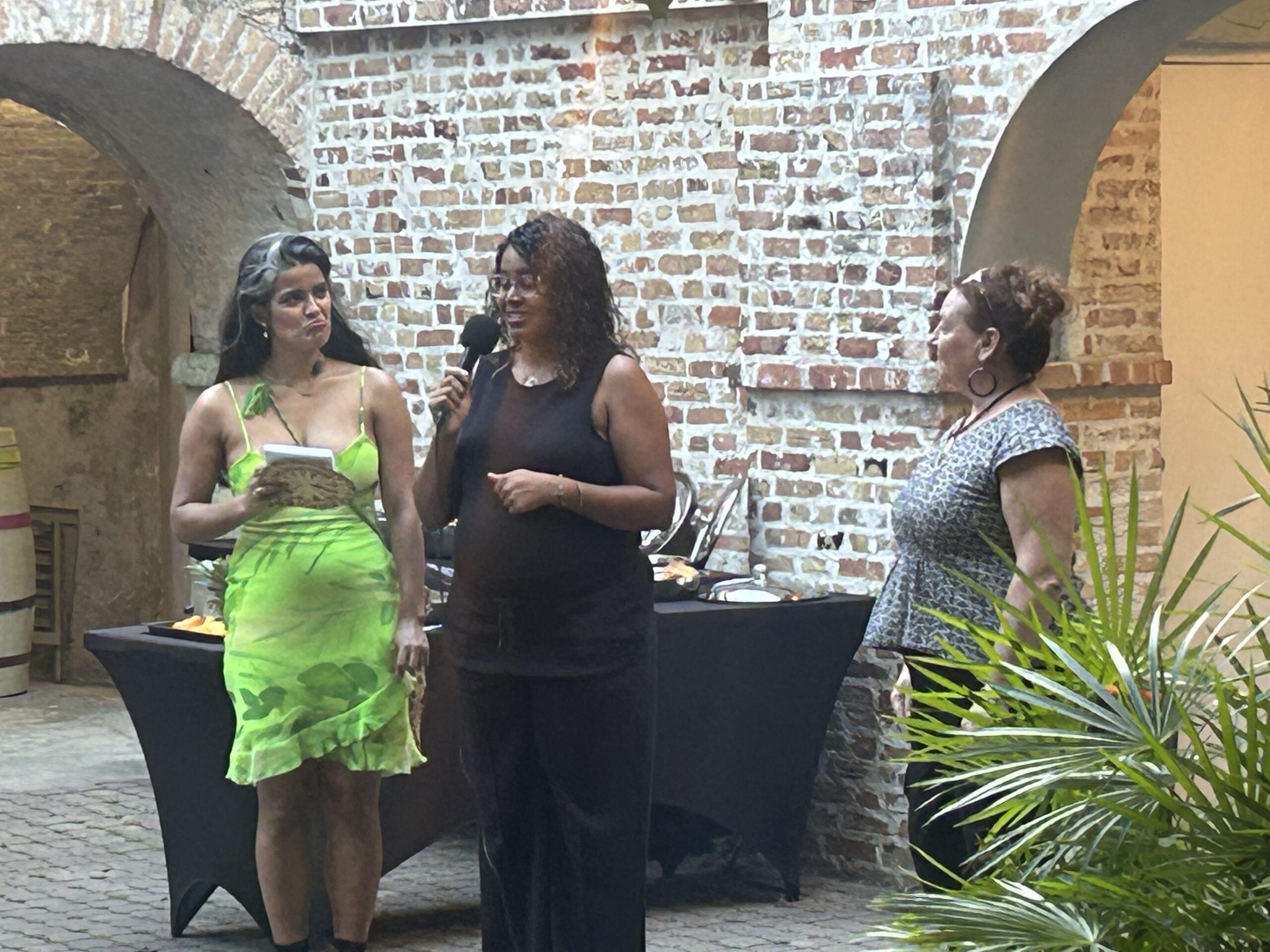
Alexandra Santos Ocasio speak in the museum courtyard during the exhibit’s opening reception on June 27. (Source photo by Josh G Canning)
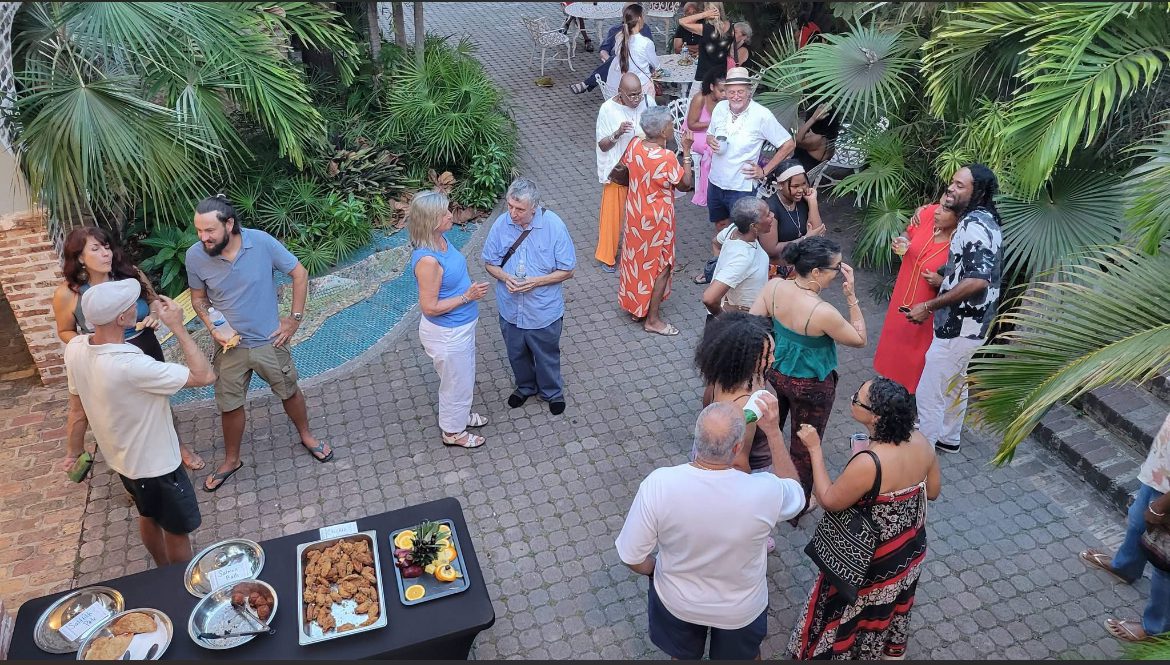
At the opening reception for the exhibit on June 27, visitors explored the museum’s upstairs galleries where the multimedia, interactive exhibition is on display while local pianist and composer Oren Levine performed jazz standards and ballads.
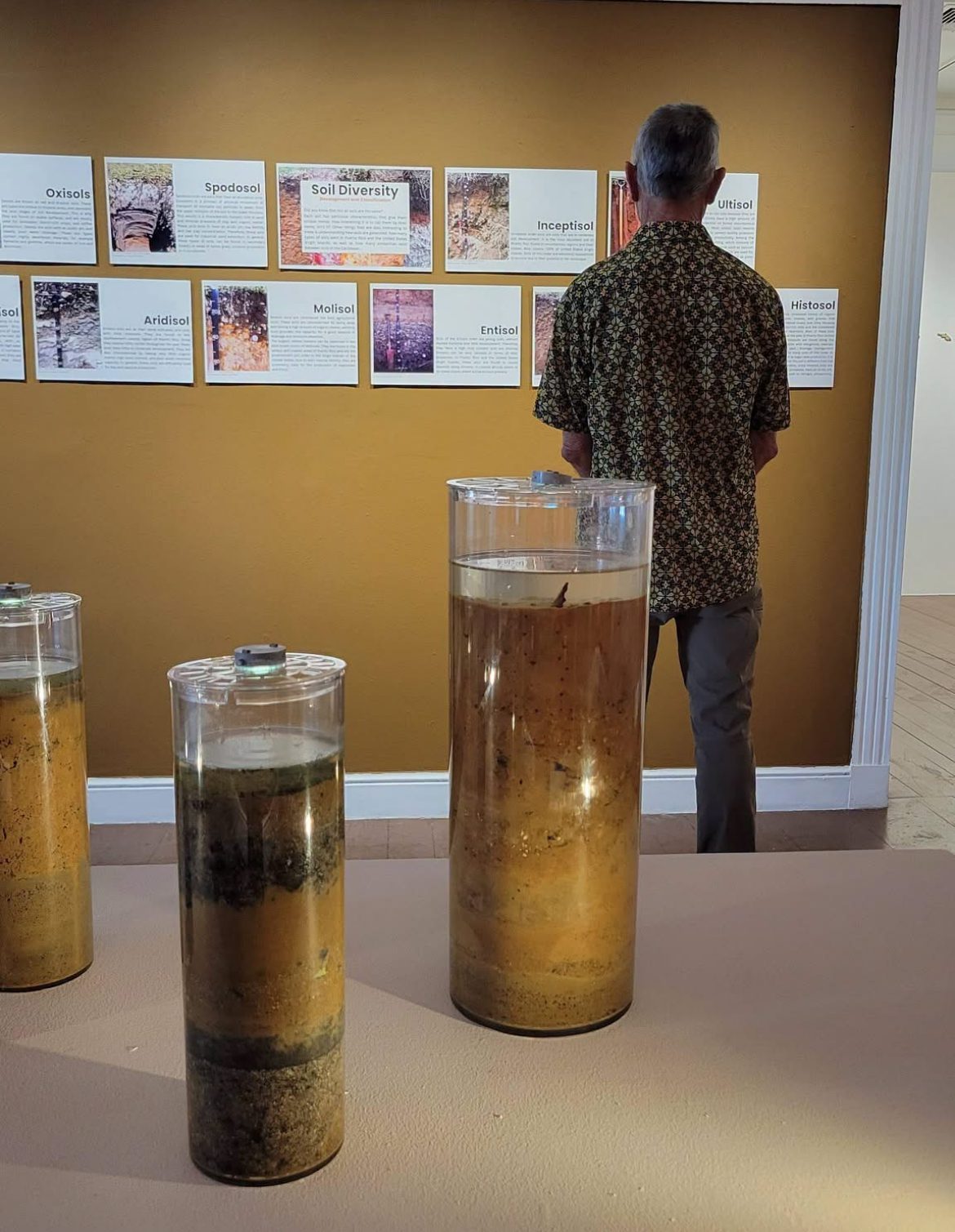
Among the exhibit’s many unique features is a series of soil monoliths that graphically illustrate how science and art can comingle as means of expression. A soil monolith is a carefully extracted and preserved vertical section of soil that allows one to study and showcase its horizons, structure, color, and formation history. “Throughout the monoliths, Winogradsky columns, chromatographies, and soil profiles,” explains curator Alexandra Santos Ocasio, “we are invited to observe the process that occurs in nature: how time, environment, and human intervention affect the soils. The results of the soil studies not only inform us; they also produce beautiful objects to observe, not only to answer scientific queries but also to enjoy the beauty that science studies produce.”
Just as one is unlikely to imagine a fish pausing to consider the myriad ways in which water provides the context for its life, it is perhaps uncommon for people to reflect upon just how fundamental soil is to our lives. But “Our Soil, Beyond Materiality” is an exhibition that demands that of visitors, just as it insistently reminds us that our lives are inextricably embedded within, and utterly interdependent upon complex webs of ecological relationships. “I believe a leaf of grass,” wrote Walt Whitman in “Song of Myself,” “is no less than the journeywork of the stars.” Something like Whitman’s vision of a world shot through with interconnection seems to be at work in the fertile ground and the germinating seeds of this collaborative exhibition.
If it is uncommon for people to consider the elemental importance of soil in their lives, it is probably equally rare for them to think of soil as a medium for artistic expression. Again, “Our Soil, Beyond Materiality” is insistent in this regard. As an exhibit dedicated to connecting scientific inquiry with creative expression, “Our Soil, Beyond Materiality” features a kaleidoscopic array of artwork in which soil functions as both a medium and a metaphor.
The thematic range of the exhibit extends beyond the scientific and artistic apprehension of soil to a profoundly spiritual appreciation of how it nourishes and sustains lives. Curator Alexandra Santos Ocasio explains that the project approaches soil “as a metaphor” and as “a historical archive and witness,” but also as “a sacred place that cares for our lives from underneath. Soil that fixes our roots geographically, culturally, and politically, sustaining and nurturing our growth with patience, like the volcanic rock that waited millennia to see us born.”
Since 2020, the Puerto Rican collective and partnership between Arte-Suelo-Ser and Museo de Suelos del Caribe has championed soil literacy as essential to environmental and human health. They’ve spent the past three years researching soil health on St. Croix, building partnerships with local farmers, UVI’s Agricultural Department, and community food security organizations. Their Virtual Soil Museum of the Caribbean invites visitors to explore regional soils through art, science, and culture.
“We are a group of Puerto Rican women,” the collective’s mission statement explains, “with allies in Latin America and the Caribbean; among them, soil scientists, environmental scientists, artists, cultural managers, health educators, anthropologists, and community leaders who share the same vision. We believe in coexistence with the living soil. We work to increase knowledge about soil health for the well-being of humans, our bodies, territories and ecosystems.”