

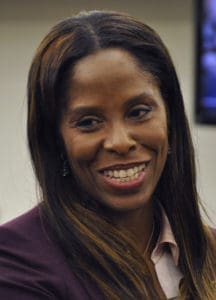
Quasi-governmental employees combing through Americans’ private data could be mining tax records and other protected information for personal profit, Congressional Delegate Stacey Plaskett warned Thursday. All the while, a freeze on funding for global nonprofits has Caribbean charities gasping.
In a Washington, D.C., press conference entitled “Taxpayer Privacy After Musk Meddling,” Plaskett and other members of the House Ways and Means Committee said billionaire Elon Musk’s apparently unchecked access to Americans’ tax, personal finance, veterans affairs, and health records, could constitute a massive data breach.
President Donald Trump, who has long refused to release his own tax records, elevated Musk to manage the newly-created Department of Government Efficiency or DOGE, designating him a part-time special government employee.
Plaskett and other House Democrats on the committee that oversees revenue, tax-writing, and trade said Musk and other nongovernment employees were running roughshod through Americans’ private information.
Allowing Musk access was not the same as other elements of Trump’s highly unorthodox first weeks in office, Plaskett said. Trump’s threat of tariffs on some of America’s closest trade partners, talk of taking over Greenland, the Panama Canal, and the Gaza strip, and enthusiasm over undoing diversity, equity, inclusion, and accessibility measures struck some as chaotic.
She said Musk’s actions were precise and planned: He may be harvesting the information to further enrich himself.
“I know people are calling this chaos. This may be chaos to us but it’s not chaos to them. They know exactly what they are doing; they know exactly why they are doing it,” she said.
“They are not just reading this information. They’re putting it in AI models, we’re finding out. They want to understand where the money is flowing. Why do they want to understand where the money is flowing?” Plaskett said. “Much of Elon Musk’s resources and his wealth is based on government contracts. $15 billion that we know of is, from one company that he owns, in government contracts.”
Having access to private citizens’ financial information as well as the other vast amount of data collected by the federal government but not publicly disseminated would present an obvious conflict of interest for someone who benefited from government contracts, she said.
Leaking or having unauthorized access to private tax information is a felony.
“President Trump says that Elon Musk is going to self-report if he has a conflict of interest? What kind of nonsense is that? And it’s no mistake, and it’s no chaotic, kind-of discombobulated happenstance that one of the first things our president did was fire the inspectors general,” Plaskett said. “The watchers are gone. The watchers are not there to do the kind of independent oversight that Congress gave them authorization to do.”
Another Trump order gave all federal employees an ominous option to take a buyout and resign or face future layoffs and furloughs. A federal judge temporarily halted the buyout plan Thursday but not before some 40,000 federal employees resigned, according to the White House.
The shiver continued through the nonprofit world. Musk and others have worked to strip funding from international and domestic humanitarian programs, as well as uproot protections for vulnerable groups.
On St. Croix, Lutheran Social Services CEO Junia John-Straker said her drawdown of federal funding took three or four days longer than usual.
Her agency took a risk to pay its vendors on time, hoping the money to reimburse themselves would arrive. Lutheran Social Services depends on such vendors to house and feed elderly and disabled people in the territory and care for young children. Without the federal funds, that would not be possible, she said.
“We were told it was under review, which had never been the case before,” John-Straker said. “We are concerned. Not necessarily for the job, per se, but to be able to pay our vendors, and pay our bills on a timely basis. Everybody should be concerned. We don’t know what’s going to happen.”
Matters were decidedly less stable for foreign organizations that depend on funding the United States. President John F. Kennedy created the United States Agency for International Development in 1961 to “partner to end extreme poverty and promote resilient, democratic societies while advancing our security and prosperity,” according to the agency’s former website. Trump ordered a near complete freeze to USAID funds and Musk has said the program that seeks to spread values of democracy, cooperation, and global health should be shuttered.
With an emphasis on so-called soft power, USAID programs range from fighting Ebola to studying the causes of and solutions to extreme poverty, advocating cultural diplomacy, health initiatives like disease control and clean water initiatives, and teacher and first responder trainings.
USAID’s staff in Barbados, where many funds were administered, did not answer emailed requests for comment. They may have been packing.
In 2023, USAID helped fund a partnership with U.S. forces and Grenada’s Royal Police Force to train 66 first responders in emergency preparedness, first aid, and more.
The exact impact USAID had on the Caribbean region was not clear because, as of Wednesday, more than 10,000 USAID webpages went dark. The message on all www.usaid.gov pages now alerts all its global employees they are on administrative leave starting at 11:59 p.m. Friday. Unless designated “mission-critical” by 3 p.m. Thursday, all these people have been told to book flights back to the United States and prepare for their contracts to be terminated.
“ … the Agency would arrange and pay for return travel to the United States within 30 days and provide for the termination of PSC and ISC contracts that are not determined to be essential,” the website reads. The curt message ends: “Thank you for your service.”
The global nonprofit Caritas has been battling poverty and helping disaster recovery for more than 50 years. In the Caribbean and Latin America, Caritas Antilles works with people forcibly displaced from their homes, natural disaster and climate change preparedness, and more from Jamaica to Guyana.
The Caritas Antilles Youth Emergency Action Committees, established in 2009, will be particularly hard hit, Caritas said in a statement sent to the Source Thursday.
“What was once a thriving network of youth-led emergency preparedness, disaster risk reduction, and community resilience initiatives has now been thrown into uncertainty, leaving vulnerable populations at heightened risk and staff unemployment. From stalled critical mitigation projects to the paralysis of emergency response programs, the stop work order has not only hindered progress but has also reversed years of dedicated efforts in disaster preparedness,” the statement said.
“This unforeseen directive has not only halted essential mitigation projects but has also disrupted ongoing preparedness initiatives, volunteer engagement, and collaborative partnerships with key community stakeholders,” the organization with offshoots in St. Lucia, Dominica, Guyana, and Jamaica said. “ … the furlough of 28 dedicated staff and the disengagement of volunteers – including 555 active and 349 supportive volunteers — undermining
program momentum, team morale, the competitive nature of competent staff recruitment and the broader disaster preparedness landscape.”
While exact figures were not available because the USAID site was down, other information via alternative federal websites gives a ballpark on what was spent in 2024.
According to alternative federal websites, Haiti received $104.6 million in 2024. Columbia, $89.7 million. Dominican Republic, $49.5 million. Barbados, potentially for many Eastern Caribbean programs, $18.1 million and Jamaica, $13.67 million. How those funds were administered was not clear.