

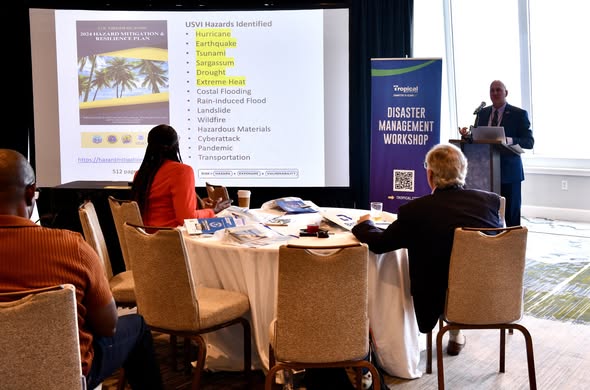
One of the territory’s leading shipping companies, along with insurance companies and a professional association, teamed up Wednesday to host a disaster preparedness workshop for businesses. Organizers from Tropical Shipping said participants were coached on how to think ahead, plan ahead and be ready to act in the face of disaster.
Gov. Albert Bryan Jr. and Delegate to Congress Stacey Plaskett welcomed attendees at the opening session of the 2026 Disaster Management Workshop Series. Participants at the Westin Resort at Frenchman’s Reef session included business operators, leaders of first responder agencies and policymakers.
“ … resilience is built long before a disaster ever arrives. And the work happening now helps ensure our Virgin Islands are ready for whatever comes next,” said a statement appearing on the Government House Facebook page.
Tropical Shipping spokesperson Jennifer Nugent-Hill explained the company’s commitment to advance disaster planning. Nugent-Hill serves as the company’s senior director for governmental and community affairs.
She called the concept of private-public sector collaboration on disaster management “an extremely important evolving concept.”
“We say the best practice in disaster preparedness, and — most important — business continuity requires us being available to each other pre-storm, post-storm; the recovery phase of it, and in the end the whole community benefits from the engagement of the private sector,” Nugent-Hill said.
Participants were also asked to consider the value of business-to-business disaster preparedness. MSI Building Supplies Vice President Tom Brunt IV told a story about his company’s interactions with Tropical Shipping over 40 years of hurricane response.
Brunt also detailed the elaborate disaster preparedness plan developed by MSI over time; increasing inventory ahead of Hurricane Season’s official start (June 1); making sure staff members are familiar with the plan and preparing their own homes ahead of time;
Enhancing communications channels, and — Brunt said — knowing when to call on neighboring shops like Tropical when that technology falls short.
“We’re a materials supply company; we try to be the last to close and the first to open after a major disaster, so people can take care of their homes,” Brunt said.
VI Territorial Emergency Management Agency Director Daryl Jaschen served as the day’s expert presenter. “We’re considered the subject matter expert for disaster, so I was providing a reminder of all the natural disasters we have. I was covering hurricanes, I was covering earthquakes; I was covering tsunamis, droughts, sargassum. I was covering extreme heat. It’s important for awareness,” the VITEMA director said.
Jaschen also told a story of how his agency helped the Juan Luis Hospital on St. Croix replenish its oxygen supply during the 2017 double hurricane strike. He said it’s nearly impossible to divert a shipping route, but with help from Tropical VITEMA was able to do so and deliver the needed oxygen.
Caribbean Hotel and Tourism Association Senior Advisor Frank Comito told the crowd how advance planning makes the difference as to whether a small business can stay afloat during major disruptions. He did so through the lens of the tourism industry.
“Tourism in the U.S. Virgin Islands represents in 2025 almost 60 percent of your gross domestic product. Sixty cents out of every dollar — whether you’re in the business or not — came from tourism. When you look at it from an employment point of view, we’re looking at 36 percent of the jobs,” he said.
And for that reason, Comito said, tourism must bounce back quickly post-disaster, so that revenues fuel an economy that helps other businesses get back on their feet.
Then came the work of putting plans in place; participants were split into two groups, where they went through exercises designed to promote advanced planning. For Nugent-Hill, it was a chance to encourage business-to-business mutual aid.
“Let’s say (a business) is affected; you’ve got debris all around you. If only you could get someone to move the debris from in front of your business, you could reopen your store, bring back your workers and the economy starts to flow again,” she said.