

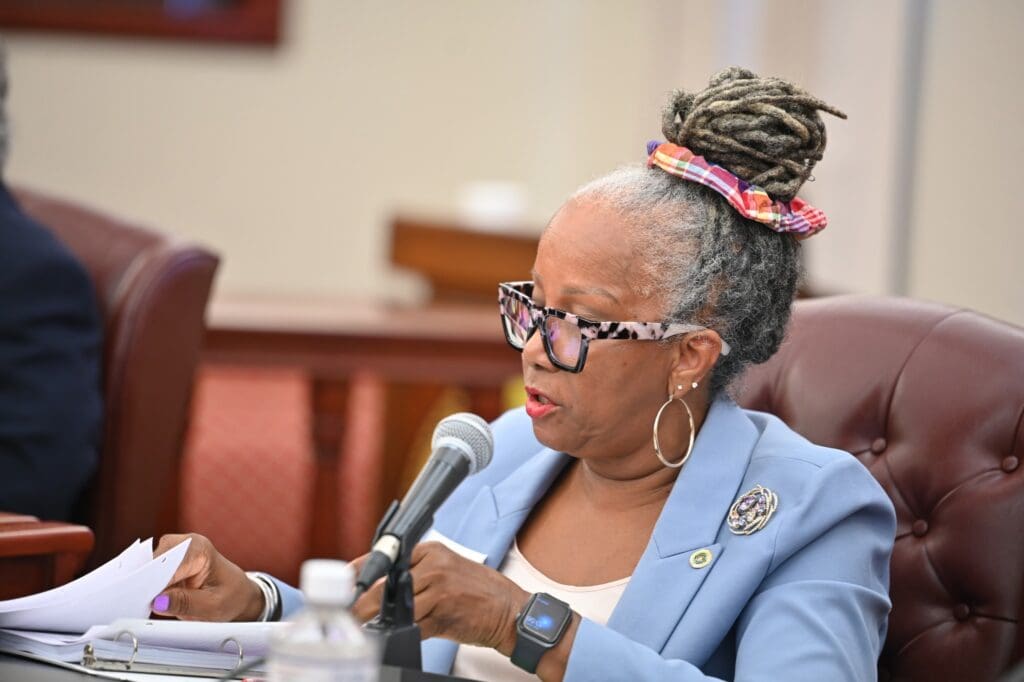
The Virgin Islands Public Services Commission is preparing to launch a series of high-stakes investigations into the territory’s public utilities — while warning lawmakers Monday that chronic mismanagement, outdated infrastructure and nonpayment of regulatory assessments are threatening the commission’s ability to carry out its duties.
Testifying before the Senate Committee on Government Operations, PSC Executive Director Sandra Setorie laid out a packed agenda for 2025 that includes full-scale rate reviews of the V.I. Water and Power Authority’s electric and water systems, along with local ferry franchises and both arms of the Waste Management Authority. The process is mandatory, Setorie said, and long overdue. “It is the statutory responsibility of the commission to undertake rate investigations of each of the regulated utilities at least once every five years,” she said, citing the V.I. Code.
For WAPA, a new electric system rate case will begin April 8, with the commission expected to appoint a hearing examiner. The last full rate investigation concluded in January 2020, and Setorie emphasized the urgency of the upcoming probe — especially with WAPA facing ballooning debts and questions about whether it is charging ratepayers enough to cover real costs. The process, she added, will incorporate the long-awaited final report from Ernst & Young, the turnaround firm hired last year to assess WAPA’s operations. That report is due March 29.
The PSC is also watching closely as WAPA receives more than $800 million in federal recovery grants — $660 million for St. Croix’s electrical system, $205 million for St. Thomas, and $30 million for a full rebuild of the territory’s metering infrastructure, she said. Setorie shared that those funds, along with the future of WAPA’s renewable energy commitments, will be evaluated as part of the new rate case. Solar generation on St. Croix is expected to reach 25 megawatts by April, she noted, with similar gains projected for St. Thomas by the end of the year.
But, the commission’s oversight responsibilities are being tested by an escalating assessment dispute with the very agencies it regulates. Setorie revealed that neither WAPA nor the Waste Management Authority has paid its annual regulatory fees to the PSC – contributions that fund the commission’s entire operating budget. “We should also acknowledge that the commission did not receive any of its annual assessment from WAPA in fiscal year 2024,” Setorie said. “WAPA simply asserts that it is too financially strained.”
The Waste Management Authority’s position has been more defiant. According to Setorie, WMA stopped making assessment payments in 2021 and only recently began challenging the commission’s authority, arguing that government appropriations should not count as revenue. “As the laws of the Virgin Islands expressly reject Waste Management’s argument, we do not expect any appeal to be filed — and if one is, we expect it to be denied,” Setorie said.
That refusal, she added, has directly undermined the PSC’s ability to function. “The impact of this dispute has been to deplete the PSC of its carefully developed reserve and restrict its operating funds,” Setorie told lawmakers. “However, the commission considers the matter resolved, the dispute closed, and is moving forward in performing its assigned tasks.”
The PSC’s investigation into WMA, meanwhile, will be split into two separate dockets this summer: one for wastewater and another for solid waste operations, which Setorie said have been riddled with failure. Among the commission’s findings: landfills remain unclosed and noncompliant, no major recycling operations have begun, tires and landfill fires continue to pose environmental hazards, and vendor payments remain unreliable.
Meanwhile, ferry companies will also be facing rate scrutiny in 2024 under Docket No. 691. The PSC recently appointed SFT Solutions LLC and principal Jed JohnHope as hearing examiner for that case, which will factor in the newly completed DPW-owned ferry, Spirit of 1733, expected to be leased to one of the franchisees.
As for the territory’s telecommunications market, the PSC is preparing to recommend legislative changes following significant shifts in landline service. Local provider Viya now manages fewer than 20,000 lines — down from nearly 100,000 two decades ago — and has lost the majority of its federal support, Setorie said, noting that with the rise of mobile and VoIP services, the commission is reevaluating the need for full regulation of Viya’s remaining landline business.
During the hearing Monday, Setorie emphasized the scale of what lies ahead and the importance of independent oversight. “Improvements to our electrical and water systems are critical to our economy, tourism, industry, and quality of life,” she said. “No modern environment can function without high-quality telecommunications. And no regulator can function without the means to do so.”