

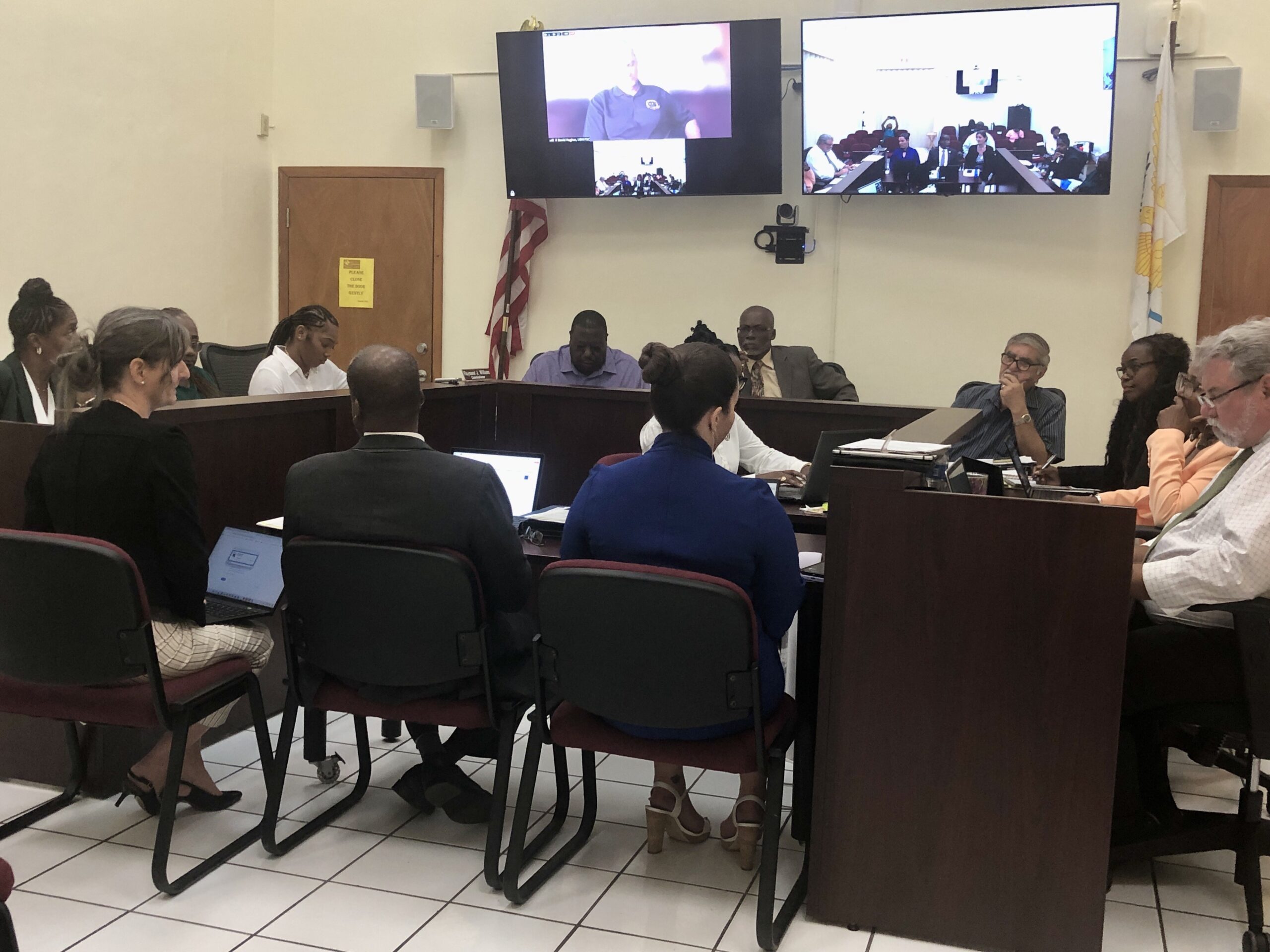
Officials from WAPA faced challenges from regulators at the Public Services Commission during their appearance at a public meeting on Tuesday. Newly appointed Chief Executive Officer Karl Knight and his team were pressed over the size of utility bills causing customer disputes.
Utility officials were also questioned about a pending agreement with VI Electron to procure a battery storage array to work with a recently approved solar-powered alternative energy system. PSC Vice Chairman David Hughes questioned how WAPA would cover the cost of the deal given its precarious financial state.
In its current state, the battery storage system would extend over 25 years and cost $250 million. “That would make it the largest single contract that WAPA has ever signed,” Hughes said.
In his first appearance before the commission, Knight made several references to financial challenges facing the public power company. Right now, he said, WAPA is “biting a very hard bullet” to keep from raising its rates for water and electrical services.
Although Knight had been in the lead position for about a month, the chief executive shared what he knew about the pending agreement. “We signed the lease; we didn’t have a dispatch study, we didn’t bid it,” Knight said.
Hughes suggested that had a study been done, WAPA would have an idea about how the storage system would work alongside some of the aging generating units in power plants on St. Thomas and St. Croix.
They might also be able to assess the cost factor on the utility’s future fiscal health. “Whatever the cost of this lease is, how does the utility plan to pay for it?” the vice chairman asked.
There was no immediate answer. Utility officials were better equipped when pressed about some eye-popping electrical bills presented to the PSC by unhappy customers. Both Knight and WAPA’s interim chief financial officer pinned the blame on estimated charges.
Estimated billing is here to stay, Knight said, not only in the Virgin Islands, but for utilities nationwide. Regulators asked why WAPA was sending estimated bills without printing a notice on the bill.
Hughes asked if customers facing outrageous bills would also risk disconnection. The utility chief said no as long as they take steps to dispute the bill and pay the undisputed charges.
“ … if you have a bill that’s in dispute we’re not going to disconnect you. We will put a hold on that account, but we are not going to disconnect you if you are legitimately going through the appropriately administrative channels of disputing that charge,” Knight said.
“I am being reminded that you should, however, pay an undisputed portion of the bill. If you are accustomed to paying a certain bill, you suddenly get a bill that is unreasonable you should pay what you are accustomed to paying while we dispute the unreasonable adjustment,” Knight said.
Muted smirks could be heard in the conference room at Barbel Plaza. “The customer gets to decide what they’re accustomed to paying?” asked PSC Chairman Pedro Williams.
“ …our system will tell us what you’re accustomed to paying,” WAPA’s CEO said. Knight pinned much of the blame on WAPA’s Advanced Metering Infrastructure system (AMI), made up of smart meters that are supposed to allow the utility and its customers to communicate. The smart meters are also supposed to supply data that helps formulate billing.
Since the passage of hurricanes Irma and Maria the AMI system hasn’t worked the way it should, Knight said, adding that even though seven years have passed since the 2017 storm cycle, the Federal Emergency Management Agency just recently confirmed WAPA’s assessment about its faulty meters.
WAPA’s Interim Chief Financial Officer Lorraine Kelly also pointed to WAPA’s inability to fully read electrical usage. Billing calculations are required to be based on a 30-day cycle, Kelly said. That leads to irregular billings in months that are either longer or shorter than 30 days.
“We know at that point we cannot count the full cycle which means we cannot bill that full cycle on that day, given that we have to have actual reads. There are many instances in any given week and any given month when we have the actual reading at hand but for efficiency purposes have to get the bill out on that day to comply with the 30-day billing rule, and so we estimate billing,” the financial officer said.
The vice chairman urged his fellow regulators to take a stance about the billing practice.
“The PSC needs to take a position on this because we review all these complaints, and we now directly have to resolve all of those disputes on behalf of either the authority or the customer,” Hughes said. “I have a lot of sympathy for the authority when people just don’t pay their bills, but this is not one of those times.”