

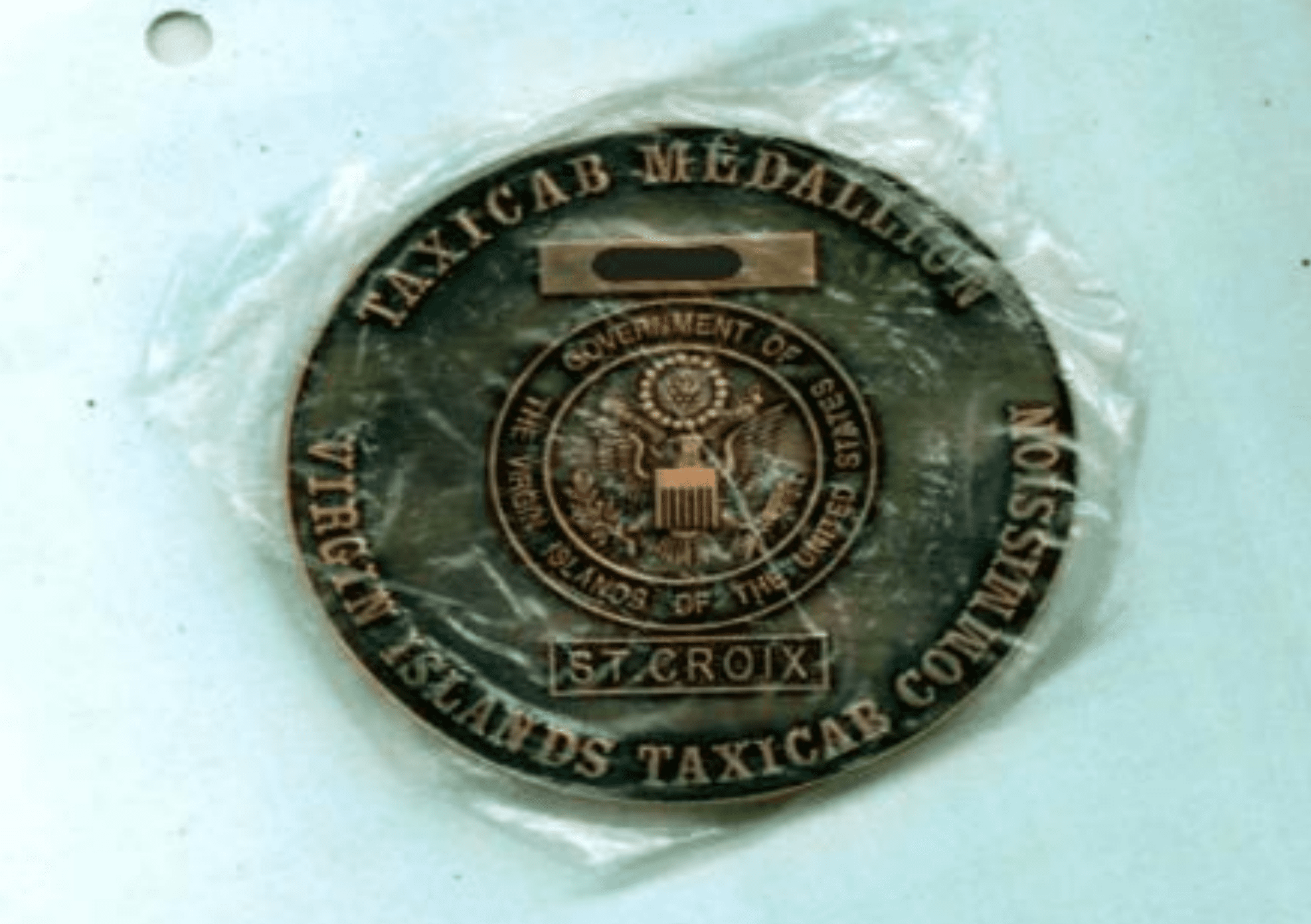
An Inspector General’s report issued Wednesday found missing taxi medallions, misplaced money, and broad failure to follow established procedure at the Virgin Islands’ long-troubled Taxicab Commission.
The report, compiled by Virgin Islands Inspector General Delia M. Thomas, covers operations at the commission from 2018 to 2022. Inspectors found multiple problems at the Taxicab Commission:
- It did not responsibly maintain accurate medallion registries and implement biannual inspections of taxis.
- It did not follow established rules and regulations for medallions auctioned.
- It did not approve the issuance of taxi licenses in accordance with established laws, rules, and regulations.
- It failed to appropriately safeguard and account for revenue collections.
- Commission officials did not safeguard the physical condition of all medallion registries or even keep complete and accurate medallion registry records.
- The commission did not always ensure that medallion owners’ files contained required documents
- It failed to ensure all its medallions were accounted for.
- It accepted late payments from two customers for medallions sold at auctions and allowed two medallion bid winners to pay less than the 10% required.
- The commission also did not return an extra $200 that a customer overpaid for a medallion.
- It issued certificate of entitlements and medallions to nine auction buyers up to seven months late.
- It approved taxi licenses for 10 applicants who did not meet the exam requirements.
- It did not conduct routine taxi patrols.
- Commission officials deposited $44,622 in revenue collections late and, separately, posted $258,342 in other cash revenue collections late.
- It regularly failed to report revenue to the government’s Enterprise Resource Planning system, which keeps track of collections — not reporting $54,811 from medallion sales and bungling reports for another $18,587 in cash payments.
The alleged mismanagement resulted in lost records and revenue, potentially unfair medallion auctions and taxi drivers, potentially unsafe vehicles, and general confusion.
Information about medallions was at risk of being lost and could not be verified independently, the report said. Thirteen unsold medallions were unaccounted for, potentially missing since at least 2005.
Some taxi operators did not meet the minimum requirements needed for a taxi operator’s license. Still, the commission granted taxi driver’s licenses to seven applicants who failed the written exam and to three other applicants for whom there is no evidence that they took the written exam.
In all, from 2018 to 2022, the commission lost at least $170,310 in revenue by not collecting vehicle inspection fees and took in 94% less in fines from citations issued each year, according to the report.
What money the commission did collect was not adequately accounted for, hindered by late deposits and government reporting postings, “thereby increasing the risk of mismanagement of government funds,” the report said.
The Taxicab Commission had not been audited since 2005, the report said. In that audit, a quarter century ago, inspectors found 13 missing medallions, misuse of commission funds, and failure to maintain accurate records, among other instances of mismanagement.
The audit released Wednesday found the Taxicab Commission had not made significant improvements in the 26 years since the last audit despite a 14-year effort to digitize its records.

In 2007, the commission was reestablished as a semiautonomous government agency — after being disbanded in 2000 — overseen by a board of directors. Both the board and its executive directors have been recent and historical points of concern for Senators inquiring about the commission. The Legislature suggested disbanding the board in 2023 and placing the commission under another agency.
Taxi drivers are often hailed as the gateway to the Virgin Islands’ tourism-dependent economy, as they are often one of the first people visitors encounter. Source reporters have privately heard top cruise officials grouse, however, that taxis were the number-one complaint from cruise line visitors about the territory.
The audit report released Wednesday came at the request of a former commission executive director in September 2021. Rancor between the commission’s board and its professional staff led to a revolving door of executive directors in recent years.
Taxi drivers have also expressed exasperation with the taxi commission, saying haphazard management has hindered legal operations and pushed some drivers into running gypsy cabs.
The audit report attributed troubles at the commission to failures in basic function and oversight, including not updating registry records promptly to reflect changes in medallion status, not maintaining medallion owners’ files and the medallion inventory, not looking after medallion sales and transfers, deviating from guidelines for medallions sold at auctions, bypassing requirements to ensure taxi operators met minimum standards, not addressing or resolving the long-standing issue of taxi operators’ contention with the biannual vehicle inspections, and failing in revenue collections.
“Also, the commission is severely understaffed,” the report said.
Recommendations in the inspector general’s report covered record keeping, equal application of rules around medallion auctions, and consulting with law enforcement if taxi license holders are found in violation.
The report also recommended inspecting vehicles biannually and considering conducting annual or semiannual inspections. The commission should also consider adequately staffing its inspection unit and, when possible, conduct spot field inspections “to ensure the safety of passengers and the public.”
Inspectors said the commission’s executive director should establish revenue control policies or formally adopt and follow the Finance Department’s recommendations. The commission should also implement adequate internal controls and oversight of revenue collections, ensure all collectors are appropriately trained in their duties and responsibilities, and verify that all forms of payment are clearly identified on receipts. All collection discrepancies should be reviewed and investigated to minimize instances of fraud, the report suggested.
Commission Executive Director Melissa Smith responded to the report, saying the commission was “undergoing a period of significant transition and rebuilding,” and was actively seeking to fill critical vacancies.
Smith said the commission followed U.S. Virgin Islands Standard Operating Policies and Procedures. She said funding was the “critical obstacle to implementing several recommended system improvements, particularly the modernization of the medallion registry and enforcement operations.”
She wrote: “Without adequate financial resources, the commission must prioritize the most immediate corrective measures while seeking additional funding avenues.”