


A developer’s bid to rezone land above the Westin Beach Resort & Spa at Frenchman’s Reef in Estate Bakkero on St. Thomas for dense workforce housing drew sharp opposition Monday during a public hearing, with neighbors warning the project would permanently alter a quiet residential area already strained by hotel traffic.
Sweetgrass Valley Properties LLC is asking the V.I. Department of Planning and Natural Resources to change several parcels from R‑1, low‑density residential, to R‑3, a medium‑density zone that allows multifamily and taller buildings. The company’s initial plan is a dorm‑style compound to house hundreds of off‑island workers for federally funded disaster‑recovery projects.
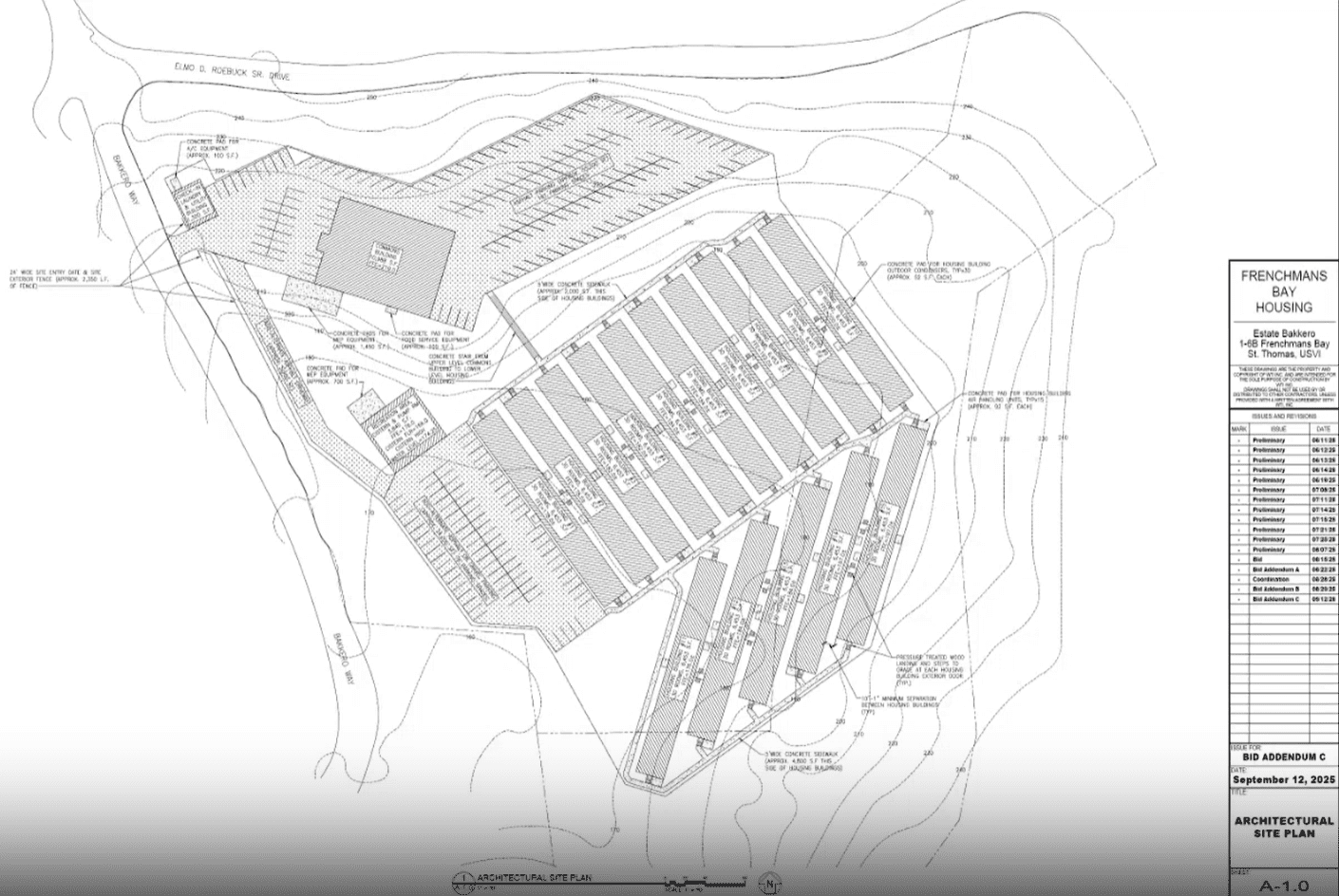
The proposal centers on Parcel 1‑68 and a portion of 1‑61‑4 on the hillside above the resort. Site plans show 15 modular housing buildings with about 30 single‑occupancy rooms each, space for roughly 450 workers, along with a commons building that would house a kitchen, game and fitness rooms, laundry facilities and support space, plus a small pump building over a cistern. The applicant lists parking at about 257 spaces.
Project representative Mirella Cornelius said the territory cannot meet its disaster‑recovery obligations without dedicated worker housing. “Without sufficient housing capacity, contractors will be unable to staff projects adequately,” she said. “If we fail to provide appropriate housing through necessary rezoning, we risk losing this critical funding.”
Todd Donahue, owner of Sweetgrass Valley Properties, framed the project as part of the wider recovery effort. He said “they need 3,500 people from off island for both St Thomas and St Croix” to work on government projects and noted that “St Croix has a lot more flat land, a lot more land. St Thomas is very limited.” He told residents and DPNR that his company is “trying to be a help with what’s coming and trying to get this done in a timely manner for the betterment of the island.”
Government staff raised technical red flags without outright opposing the project. Floodplain manager Ellerton Maynard noted that the property “is not located within the floodplain” but said it still “poses some storm water issues,” warning that “unregulated storm water becomes flood waters.” Pointing to “a tremendous drop off” south of the site and “the very dense green area to the bottom of the structures” where the gut runs, he questioned whether the applicant’s proposed erosion controls would be sufficient.
“Silt fence is not really going to be appropriate,” Maynard said, urging the use of bush berms and best‑management practices from the Virgin Islands stormwater handbook.
Rukia Andrews of the Division of Fish and Wildlife said a check of the federal IPaC system indicated “possible V.I. tree boa presence” and a sensitive St. Thomas plant in the area. She told the applicant that “with the V.I. tree boa … we do have protocols that need to be followed before any heavy machinery and things can be enacted on the site,” and said she would rerun the site through the system and, if needed, send those protocols through DPNR staff.
The strongest objections came from nearby homeowners, who said the proposed density and use are incompatible with an R‑1 neighborhood that already handles heavy resort and beach traffic. Several described the neighborhood as a quiet, family-oriented area.
“We strongly oppose … requesting a rezoning from R‑1 to R‑3 for the stated purpose of developing workforce housing,” said Kurell Sheridan. “I do not support placing a large-scale workforce housing camp, a trailer camp, into a family-oriented, low-density residential neighborhood.” In a written comment, Matthew Rafa called the plan “very concerning and very upsetting,” adding that the area “is a very quiet and family neighborhood, not a location to install a man camp.”
Neighbors said hotel-related cars and taxis already frequently clog the narrow road, block driveways, and even impede mail delivery. Some have posted their own “no parking” and towing signs to keep access clear. One homeowner said that with roughly 450 workers on site, “buses will be running perhaps 24 hours a day,” adding to traffic and noise. Residents argued that hundreds of workers, along with service vehicles and company shuttles, would overwhelm the neighborhood, particularly in a hillside community they described as “not walkable” and without public transit.
Linda Solberg said stormwater from the slope already “dumps … onto my property.” She warned that the site’s steep topography, additional hard surfaces and buildings, and on-site amenities such as a large dining hall and bar could worsen runoff as well as noise and light pollution.
Several speakers highlighted the long-term consequences of changing the zoning to R‑3. Donahue told DPNR that Sweetgrass’s “long-term goal would be to make mid-income housing for the hotel staff as well as other…condos that are affordable” once the current wave of government construction is complete. Sheridan said, “Once the scale is broken, it cannot be restored,” arguing that R‑3 would allow much taller and denser condo development even if the temporary modular units are eventually removed. Solberg added, “This is our only chance … to address these concerns” before any rezoning becomes permanent.
Sheridan also questioned why DPNR is considering the request when the territory’s recently adopted Comprehensive Land and Water Use Plan designates the Tutu Park area as “an appropriate and thoughtful use for workforce and other housing,” not Bakkero. She called the proposal part of “cumulative rezoning” in the neighborhood, undertaken without a clear, long-range vision for Estate Bakkero and without DPNR “standing up” for its own plan.
The public comment period remains open until Friday, Jan. 9, 2026. Written comments can be emailed to Territorial Planner Leia Laplace at leia.laplace@dpnr.vi.gov. All testimony, including letters read into the record Monday, will be included in DPNR’s recommendation report.
Under Title 29 of the Virgin Islands Code, planning technician Gail Pagan explained, DPNR has 30 days after the hearing to prepare a written recommendation report for the commissioner. The report can recommend approval, denial, or modification of the rezoning request. Once the commissioner signs it, the report goes to the Legislature, which must hold a committee-of-the-whole hearing where DPNR reads its findings into the record before senators vote on any zoning bill.