

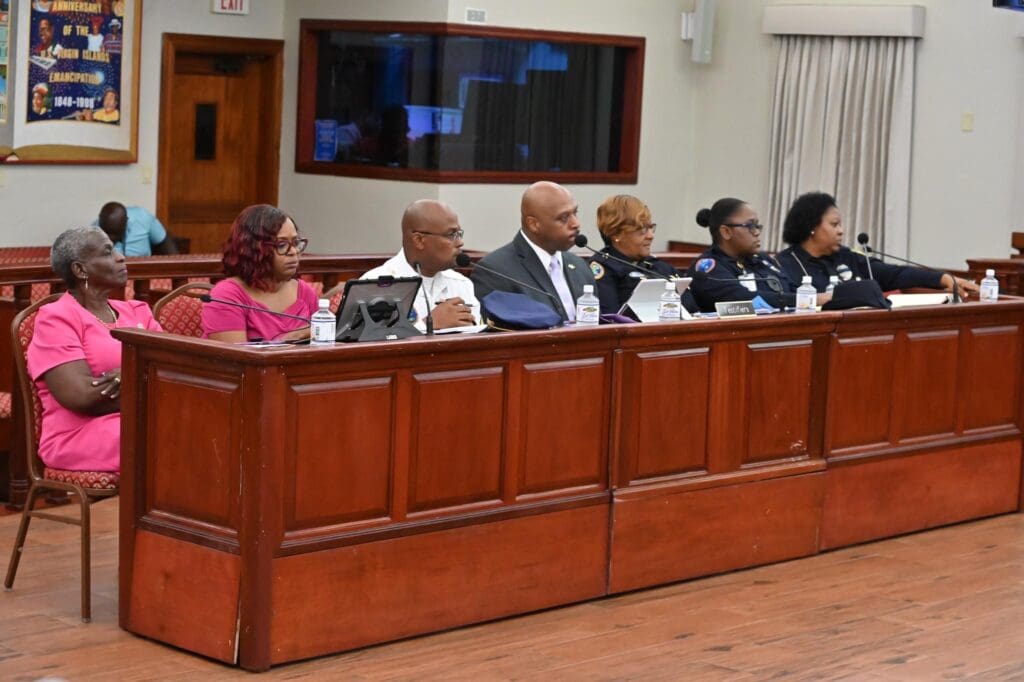
When the Committee on Homeland Security, Justice, and Public Safety addresses crime in the territory, it’s usually concerned with homicides, guns and drugs – but, on Tuesday, it turned its attention toward traffic infractions.
Sidney Elskoe, the assistant commissioner of the Police Department, testified that his department upholds traffic regulations, conducts accident investigations, monitors sobriety checkpoints, manages traffic flow and educates the public on safe driving practices.
Senators questioned him about a new traffic initiative, off-road vehicles using public roads, and the lack of speed limit enforcement. However, they often diverged to discussions about why noise ordinances were not enforced.
Sen. Franklin Johnson of St. Croix said that loud music had become a “menace” in his community.
Elskoe said that the department could not enforce the noise ordinance because it did not have the tools to measure noise levels. Johnson countered that officers arriving at a noise complaint scene could easily note the “disturbance of the peace” and cite the guilty party. Johnson said elderly people could not sleep on Sunday mornings because of the music. He said the music was so loud that people’s pacemakers were affected.
Elskoe said there was a smartphone application that could measure noise levels, but the department could not require officers to download the application on their phones.
Sen. Alma Francis-Heyliger didn’t like that excuse. She said the department could buy cheap smartphones.
Sen. Kenneth Gittens, committee chair, asked about the Traffic Safety Initiative Plan and how it would address people driving dirt bikes and off-the-road vehicles without a license. Elskoe said the plan was not in writing but later rescinded that remark and said it was. Gittens asked for a copy to be emailed to him but he did not receive a copy before the end of the meeting.
Gittens said offenders had gotten so bold that not only were they driving their unlicensed vehicles on the main road, but they would also drive them in front of the police station.
He concluded, “I am not seeing aggressive enforcement.”
Elskoe said the department once had an aggressive program of seizing vehicles, but it was not sustainable. He said the department could not hold onto the vehicles after a resident paid their citation.
Gittens said he would introduce a bill to establish an impound lot where vehicles would be kept and not retrieved until the owner showed proof of a license, registration, and insurance.
Elskoe testified, “It has become clear; many members of the motoring public have mistakenly taken the position that displaying license plates on vehicles while operating on the roadway is optional.”
He added, “Operating a motor vehicle on the road is not a human right. It is a privilege afforded to those who have proved through a legally mandated process that the driver can safely operate a motor vehicle.”
Sen. Angel Bolques asked whether it would be possible to modify off-road vehicles and then legally register them.
Traffic Division Commander Arthur Joseph of the St Croix district answered that he did not believe so, and it was unlikely that any insurance company would insure them for use on the highway. He said, “Those vehicles are not as safe as people think.”
Senators present at the committee meeting were Gittens, Bolques, Jr., Javan James Sr., Diane Capehart, Marise James, Ray Fonseca, Francis-Heyliger, Dwayne DeGraff, Novelle Francis, Jr., and Johnson.