

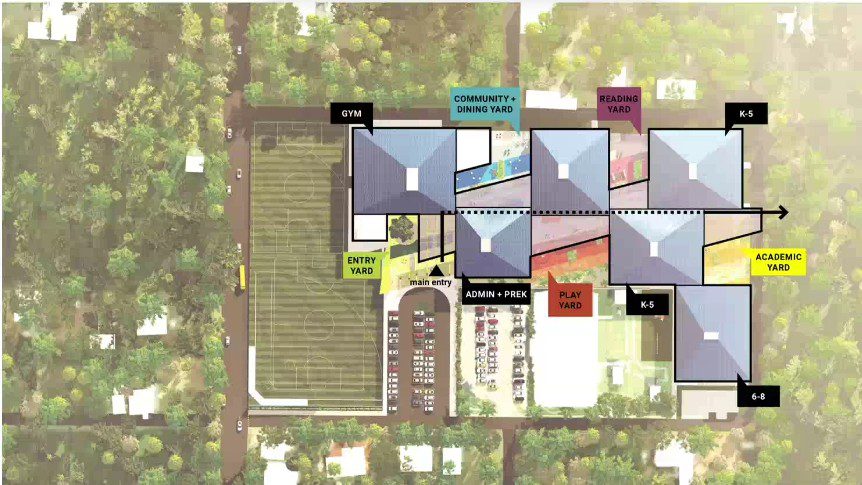
Developers shared design plans for Claude O. Markoe and Alexander Henderson PreK-8 schools with the St. Croix Coastal Zone Management Committee and the public in a federal consistency hearing Thursday evening.
The two campuses are among a handful of schools slated for demolition and rebuild by Suffolk Construction and CBNA. The V.I. Public Finance Authority last year approved a contract with the joint venture for the Henderson, Markoe, and Alfredo Andrews elementary schools, as well as the Pearl B. Larsen PreK-8 and an administrative center. Suffolk-CBNA bid came in just under $790 million. Suffolk has also been tasked with rebuilding the Lockhart K-8 School, Ivanna Eudora Kean High School, and the Yvonne Milliner Bowsky, Jane E. Tuitt and Emanuel Benjamin Oliver elementary schools.
V.I. Education Department new schools architect Chaneel Callwood said Thursday evening that the plan for Markoe involves building a large part of the campus as quickly as possible before moving students there and demolishing the old campus.
“So you don’t have to worry about students having to move right away,” she said. “Everything is going to be done in a way that keeps them safe and allows them to continue use of the new playground that they recently got and all the new improvements until the first set of buildings have been constructed.”
Representatives from the design firm DLR Group offered specifics about the campus’s layouts, with senior principal Pam Loeffelman describing Markoe as “not your typical double-loaded corridor with classrooms on both sides.”
“It’s really about putting together those places of teaching and learning together, so that students can interact together — and with teachers — and really teach and learn within that collaboration that’s so important in today’s world,” she said. Loeffelman later said that a key part of the Education Department’s master plan involves giving each school its own identity in a way that reflects the communities they’re in. Henderson, she said, will have more of an arts focus.
“Obviously, all of the curriculums will be, if you will, holistic, but each school has a slightly different nuance in terms of exactly … what their focus could be,” she said.
The presentations came during a public hearing to determine whether the federally funded projects are compliant with the Coastal Zone Management Act. Several questions put to presenters Thursday centered around student safety, including management of nearby traffic and the potential for exposure to harmful environmental contaminants during demolition.
Callwood said students’ safety is their top priority and noted that buildings will be tested thoroughly as part of the demolition permit application process.
“So once we get those test results, we’ll know what we’re talking about and what we’re dealing with, and we will adjust accordingly — if needed — based on where any hazardous materials are found,” she said.
Callwood later said that the territory is “up against” escalating costs because the Federal Emergency Management Agency has allocated a set amount of funding and the price of construction continues to rise.
“So that is part of our drive to build as much new space as quickly as possible. So we really are working to try to get the most built, and also negotiating with contractors so that we are not paying unfair prices,” she said, adding that the Arthur Richards K-8 School was scaled back for that reason. “This is a different design-build team, a different contractor … and we don’t expect that to happen with this particular project, but we are up against time.”