

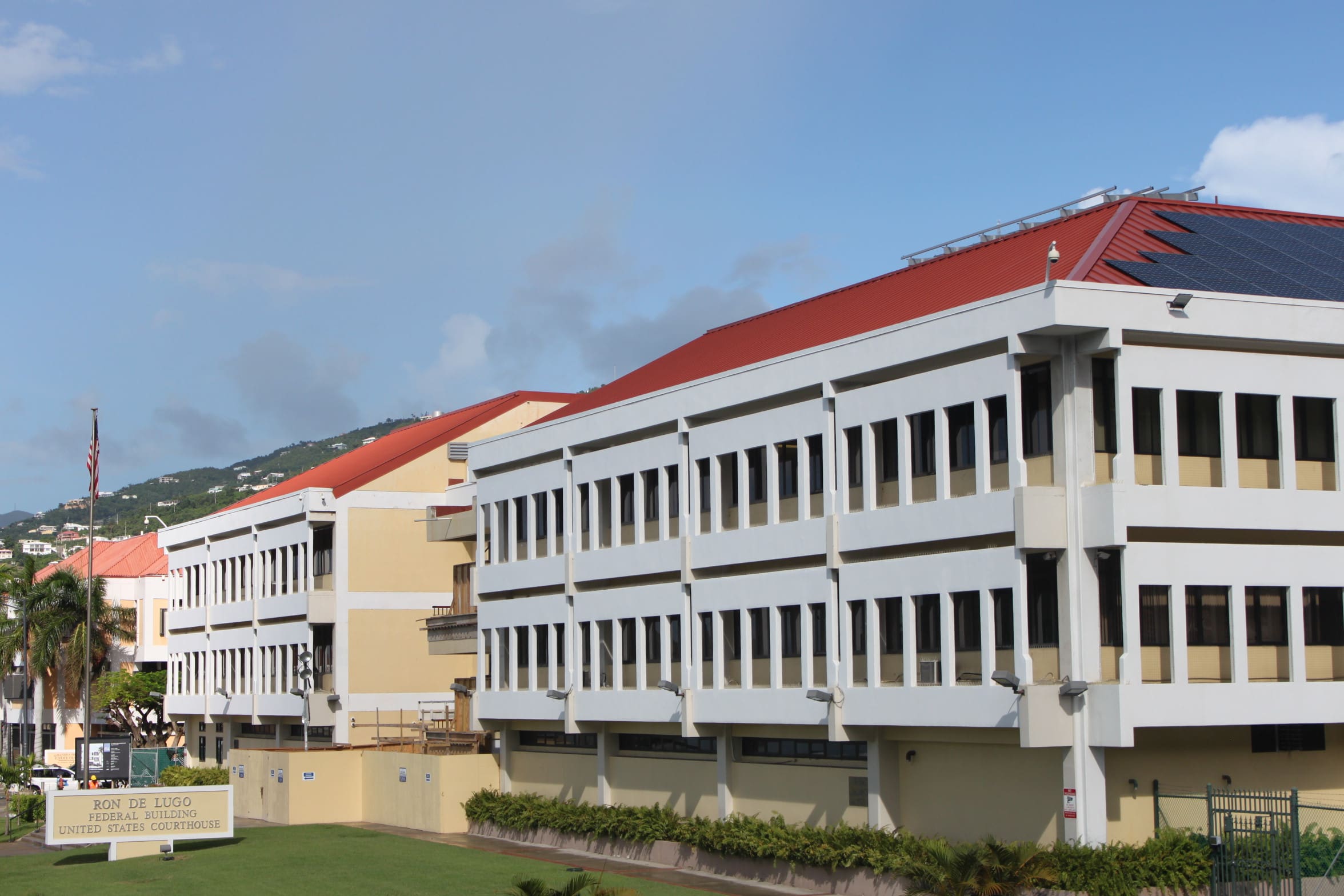
A federal trial began Monday over a longstanding dispute between the Virgin Islands National Park and a St. John family claiming a parcel of land as their ancestral home. Close to a dozen members of that family filled the seats in the courtroom of Chief District Judge Robert Molloy as the bench trial began.
Attorneys for the U.S. Department of Justice in the Virgin Islands are demanding that the family is occupying Parcel 5a on Bordeaux Mountain without providing proof of ownership. Relatives of the named defendant in the case USA v. Donna Roberts et al. took turns on the witness stand, telling the court how they came to live there and why they believe the government is wrong.
The trial is expected to last three days, according to a statement filed by U.S. Attorney Delia Smith. The Justice Department — on behalf of the national park — is demanding that Roberts and her relatives leave the property and remove alleged nuisances they created, including a fence, dogs, goats and a fraco stand.
The Virgin Islands National Park was established on St. John on Aug. 2, 1956. In legal filings, park officials claim that Parcel 5a was given to them as a gift from Jackson Hole Preserve, Inc.
“The United States argues that Jackson Hole Preserve, Inc. bought the property from David Stick. The United States claims that Mr. Stick acquired the property from Emily Creque. The United States maintains that Emily Creque inherited the property from her husband Herman Creque. Herman Creque’s estate was probated in the District Court of the Virgin Islands,” court records say.
Government officials also point to aerial photos of the land dating back several years to support a claim that most of the structures seen on 5a today did not exist before 2007.
But the filing goes on to say that the adjudication records of Herman Creque never mention Parcel 5a, Estate Bordeaux, St. John, Virgin Islands, adding that Creque’s widow gave David Stick a deed for Estate Lameshur, a different property in another part of the island.
Defendants claim the property in question was bequeathed to them through a different person — William Nerkitt, and that Parcel 5a was passed down to his granddaughter, Felicia Nerkitt.
Those who testified on Monday also claim Felicia Nerkitt as either their grandmother or their great-grandmother. Court documents also point to a statement provided by former National Park Property Manager Paul Thomas (retired), who said he saw a deed with the name William Nerkitt in the park’s property records. A deed and U.S. Census records pre-date the establishment of the national park.
The defendants cite Virgin Islands law, which says the title of real property vests in the heirs at law when a property owner dies without leaving a will, as Felicia Nerkitt did. They also point to her name in 1920 and 1930 census records (spelled Felicia Norket) as part of a household living in Bordeaux and the great-grandmother’s burial site on Parcel 5a.
At the time of her death, the family matriarch was known as St. John midwife, tradition bearer and basket maker Felicia Caines.
“The United States admits that Emily Creque received her interest in Herman Creque’s real properties via the Amended Adjudication of the Estate of Herman Creque. The United States also admits that No. 5a Estate Bordeaux is not listed in the Adjudication nor the Amended Adjudication of the Estate of Herman Creque,” government officials state in documents being used at trial.
Neither side is willing to give any ground in their claims. It will be up to Molloy to come up with a ruling in the case.