

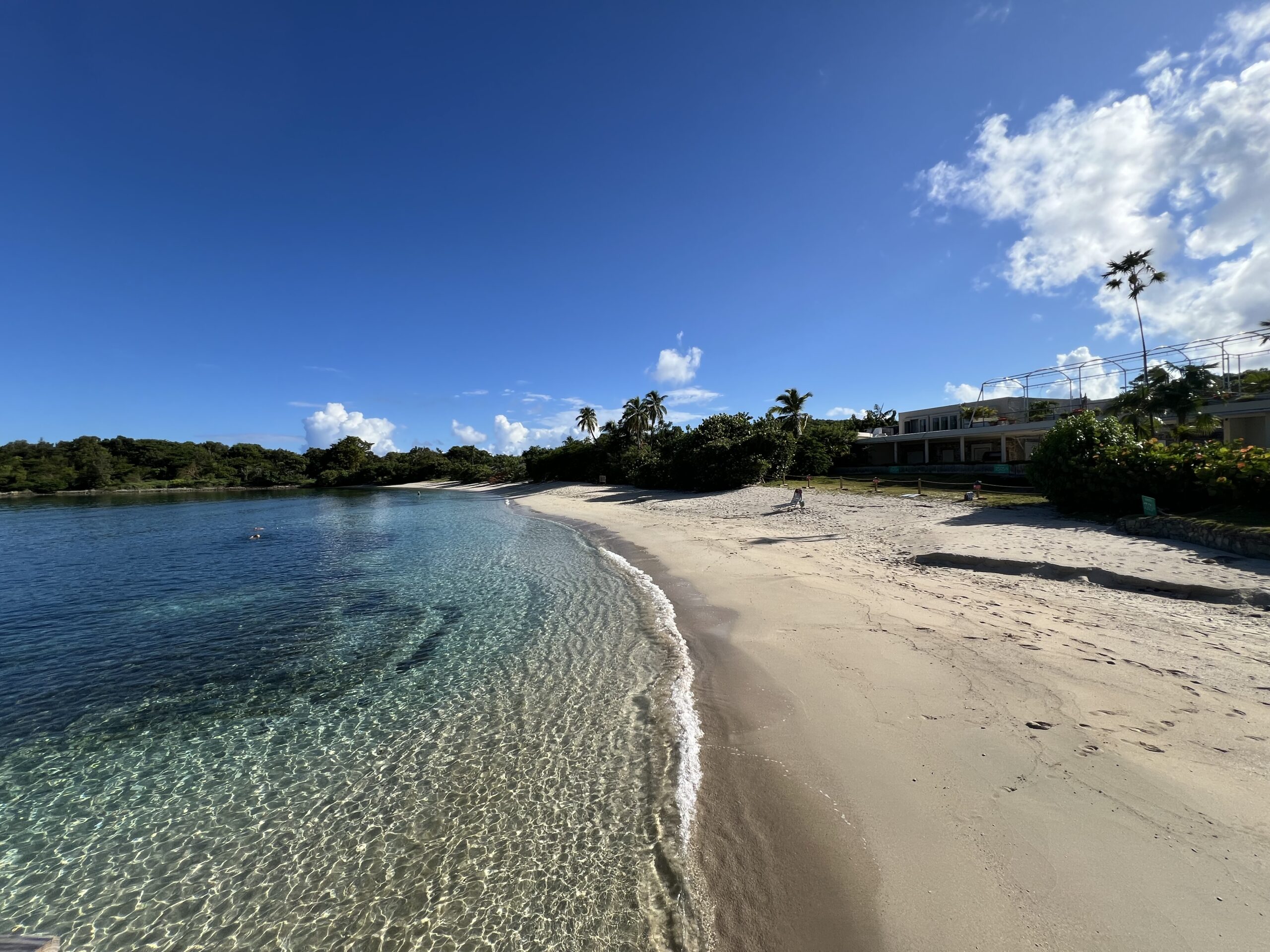
A panel of Third Circuit Appeals Court judges heard oral arguments Friday in EHI Acquisition’s appeal of a 2024 V.I. District Court ruling granting ownership of St. John’s Caneel Bay Resort and its improvements to the National Park Service. As with the lower court case, the meaning of the words “to convey an offer” factored heavily in the hourlong discussion.
At issue is whether the resort on 150 acres of prime St. John beachfront real estate belongs to EHI Acquisitions, which had managed the property since 2004 under an agreement known as a Retained Use Estate, or to the federal government after the RUE expired Sept. 30, 2023.
The RUE was created in 1983 by Laurance Rockefeller, who donated some 5,000 acres of St. John land to the National Park Service but reserved the Caneel Bay property for the Jackson Hole Preserve, the family’s land trust. Under the agreement, the preserved land was transferred to the NPS with the understanding the RUE — also known as the 1983 Indenture — would remain in place for 40 years. The resort has been managed by different entities since then, the latest being EHI Acquisitions, an affiliate of CBI Acquisitions.
The question in the District Court case, and that the appeals court pondered Friday, is whether language in the RUE obligated the federal government to pay EHI for its improvements to the property over the years; whether it reverted to EHI because the Interior Department rejected its 2019 offer to relinquish the RUE for $70 million after the resort was destroyed by hurricanes Irma and Maria in 2017; or whether it belongs to the NPS free and clear.
Third Circuit Judge Cheryl Ann Krause, who was appointed to the case in December 2023 after V.I. District Court Chief Judge Robert Molloy was removed without explanation, ruled last April that the intent of the indenture was clear: The property and its improvements were to be given back to the government at the expiration of the RUE for a nominal consideration of $1.
“Examining the plain language of Paragraph eight in the context of the whole Indenture, we are convinced that this meaning was entirely philanthropic. The dispute between EHIA and the United States hinges on the meaning of the word ‘offer’ as it is used in the Indenture,” she wrote.
“It does not say that the Grantor shall make ‘an offer to convey for value’ or ‘an offer to sell.’ Indeed, commercial language like ‘bargain’ or ‘fair market value’ is conspicuously omitted from the Indenture. When parties use clear and unambiguous terms, we will not insert additional terms that are contrary to the parties’ plain meaning,” Krause stated. “Thus, here, the plain language of Paragraph eight indicates that the parties did not intend to make the improvements’ transfer contingent on payment.”
EHI appealed the decision to the Third Circuit Court of Appeals last July and on Friday its attorney Julien Adams argued before the panel of three judges sitting on St. Croix that the RUE did indeed set commercial terms “to address how to run this for-profit entity and is silent on what would happen to the improvements” when it ended.
“The context is not philanthropic. The context is commercial” and “an offer to convey” under normal contract terms means a bargain for consideration, Adams said. Otherwise, the RUE would have included words such as “gift,” he said.
Appearing for the government, V.I. Acting U.S. Attorney Adam Sleeper argued that in the context of the entire document, the intent of the RUE was for the land and its improvements to revert to the NPS without charge when the 40-year term ended.
“At every step in this contract, steps were taken to ensure that the United States did not bear the cost for these improvements. If we expand out even further, we see the philanthropic intent that Judge Krause emphasized. We see that this says it’s in way of a gift, that there is one dollar of consideration. We see the intent that it be part of the property, that it composes the park,” said Sleeper. “At every step, there’s this contemplation of a philanthropic agreement.”
Not in dispute by either side on Friday was the fact that the RUE was not particularly well written, with Judge Theodore A. McKee calling it “confusing” and “not artfully drafted.”
“My argument will not be that this is an artfully drafted contract,” Sleeper replied.
“Let’s assume hypothetically that we find the contract is not clear. What do we do and what do we make of these other documents that have been referenced?” McKee asked, referring to extrinsic evidence — letters from Rockefeller about his plans, a press release announcing the RUE, among others — that the government says supports a transfer free and clear, and that EHI argues should have no bearing on the case.
“When you look at the terms of the contract as a whole … [it] is fundamentally a philanthropic document. What was contemplated here was a donation of land, followed by the transfer of improvements after enough time had passed for those improvements to be built so they could be used for the Park Service. It is not, as the plaintiff advances here, a commercial document seeking to provide the greatest incentive to a for-profit entity to maintain the [RUE] as long as possible and extract as much value as possible from the property. That is not what was contemplated here,” said Sleeper.
Adams, however, argued that the “parties are bound by the ordinary meaning of the words they put in the document. In any other scenario, I would say this is a straightforward application of well-established rules of contract interpretation,” he said.
Adams also said that should it regain ownership of the resort, EHI has pledged that the property “will always be in the possession of the people of the Virgin Islands,” referring to public statements by Caneel Bay director of marketing Patrick Kidd when the company filed suit in June 2022 that EHI would create a charitable trust for the benefit of the people of St. John and the USVI and donate the resort property to the trust.
“I say this for a reason. I’ve been doing this for 30 years. I practice in the United States. I practice in California. I am what is known as a child of the soil. I was born and raised here. This is the very first time I’ve ever spoken to a panel in an appellate court, and I appreciate the opportunity to come home and talk to your honors and have you entertain my argument,” Adams said.
The judges — McKee, L. Felipe Restrepo and Arianna J. Freeman — will take the arguments under consideration and issue a ruling at a future date.