

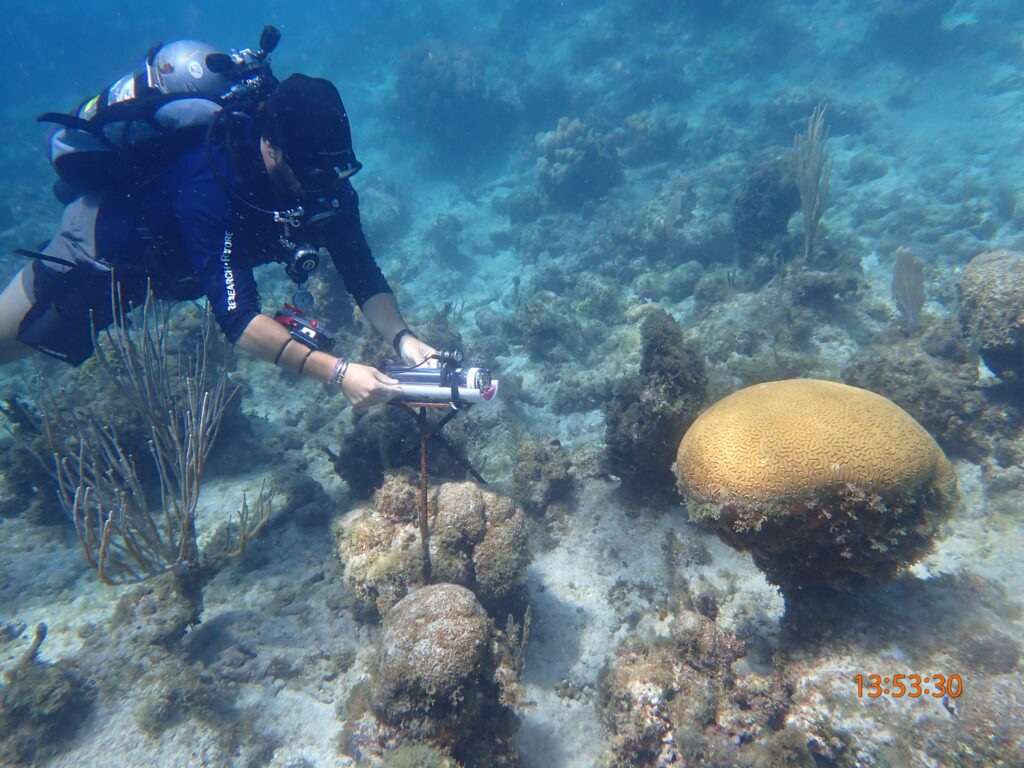
During the evenings of this week’s predicted coral spawning window, residents near Peterborg and Hull Bay on St. Thomas may observe intermittent flashes emanating from specialized camera equipment positioned along the shoreline. These devices are apart of a targeted research initiative by VI Reef Response, a coral restoration program based at the University of the Virgin Islands.
The objective is to determine whether large colonies of grooved brain coral on the north shore are reproducing successfully, and compare their spawning timing with southern reefs already under observation. The spawning camera work is led by Gillian Coleman, Coral Restoration Specialist at Reef Response.
A team of divers have been monitoring the south side of Brewers Bay, where they also collected coral gametes for transport to UVI. Those collections resulted in successfully fertilized and settled thousands of coral larvae, which were subsequently released back onto the reefs at Brewers and Perseverance Bay. According to Coral Restoration Specialist Brad Arrington, “The north shore cameras fill a critical data gap. Without continuous monitoring, researchers cannot confirm whether northern colonies are reproducing on the same schedule or at all.”
The time-lapse cameras operate continuously throughout the night during peak spawning periods, which typically occur 10-13 nights after the full moon in May and June. From the resulting footage, researchers can document precise spawning time, volume and density, duration and pattern, and relative spawning strength. An additional analytical layer involves assessing the apparent health of the gamete bundles themselves. Bundle density and condition provide indirect evidence of how these colonies have recovered from recent thermal stress events.
“Coral spawning is governed by a hierarchical system of environmental cues. Rising water temperatures signal that conditions are appropriate for reproduction. The lunar cycle provides precise timing and whether a colony spawns in a given year depends on energetic condition. If water temperatures were anomalously high during the prior year, causing thermal stress and bleaching, colonies redirect energy toward survival rather than reproduction”, said Arrington.
Record-breaking ocean temperatures in 2023 and 2024 resulted in spawning failures that extended into 2025. A reef where corals are actively spawning is not mere a biological event, but a direct indicator of ecosystem health following recent stress events. Rising ocean temperatures will make bleaching events more frequent and shorten recovery windows. Part of Reef Response’s work involves breeding thermally resilient corals, though progress is restrained by the slow growth rates of stony coral species.
Diver surveys conducted on Monday and Tuesday of this week observed successful spawning at Brewers Bay. Fertilized coral babies were released back into the water around Brewers and Perseverance Bay on the following day.
“All reefs in the Caribbean will need restoration efforts in order to achieve historic levels. The data from this spawning monitoring will inform future decisions about where to focus out planting efforts. Specifically, sites that demonstrate successful natural reproduction become priority locations for out planting genetically diverse corals, as the sites offer favorable conditions for those new genotypes to integrate into the existing spawning population”, explained Arrington.
Reef Response has indicated that they are willing to share findings with the public and post updates via their social media channels throughout spawning season. All research activities are conducted under the guidance of Dr. Marilyn Brandt, Director of Reef Response and Research Professor at UVI, with support from Davis Strobel a Restoration Ecology Specialist. The organization’s broader mission includes not only coral restoration but also community outreach and citizen science engagement.
Residents living near Peterborg and Hull Bay who observe evening flashes from the shoreline cameras are asked not to disturb the equipment. The cameras are deployed for a limited monitoring window and will be retrieved by Reef Response personnel upon completion of data collection.