

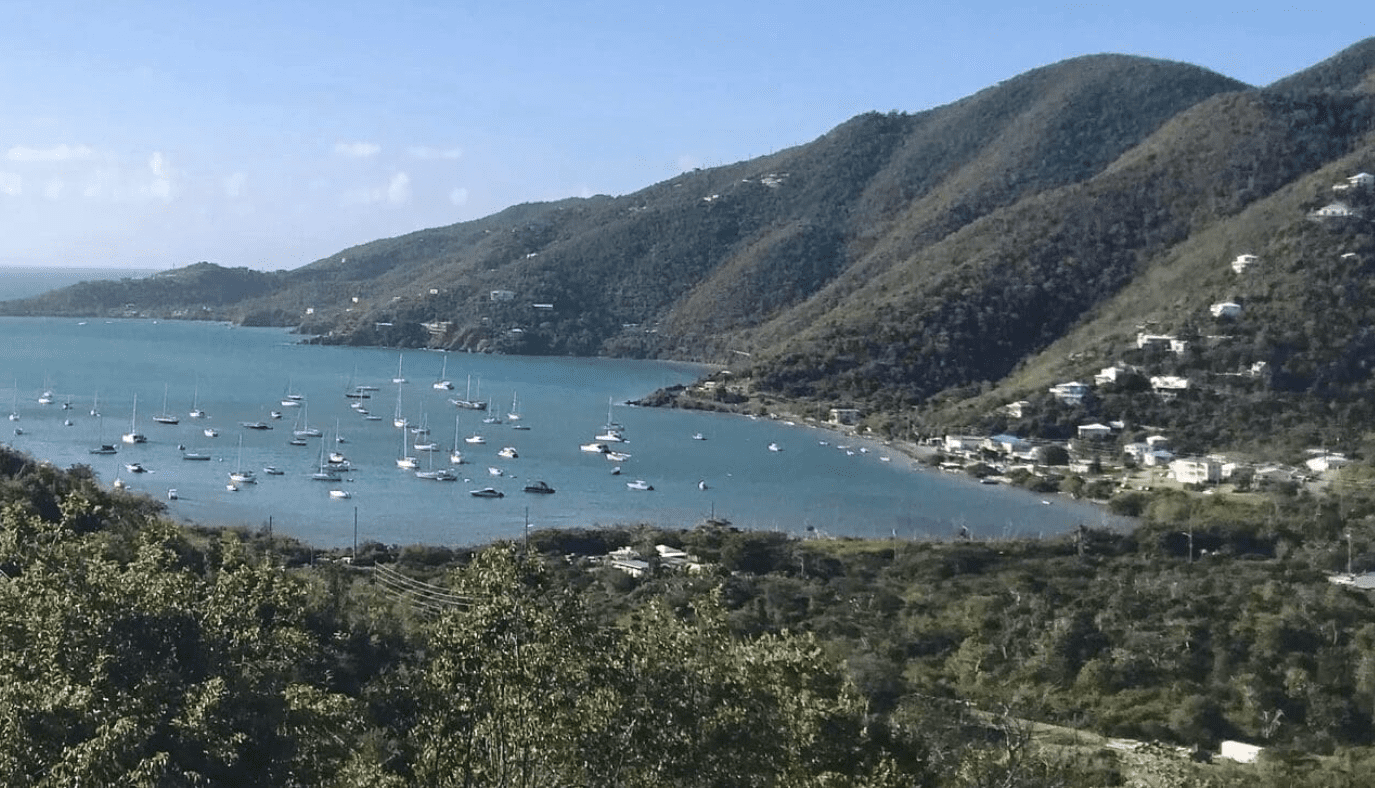
What’s really going on with Summers End, the controversial marina project planned for Coral Bay, St. John?
Representatives for the project presented a list of 20 permitting and legal challenges they claimed to have met during a meeting of the Senate Subcommittee on Economic Development and Agriculture on Nov. 13. (Testimony on the project can be seen starting four hours and 20 minutes into the video recording using this link by clicking here and written testimony can be viewed here.)
“The project is fully ready to proceed …. With any luck at all, we should be able to break ground very soon,” said Jeff Boyd, a Summers End Group partner. Boyd said developers anticipated a 12-month build out and should be able to complete the facility in time for the 2026 tourist season.
This optimistic viewpoint took some senators by surprise. “I’m very confused as to what is the reality here,” said Sen. Alma Francis Heyliger, noting that she had received correspondence indicating otherwise.
It also spurred David Silverman, president of Save Coral Bay — the grassroots community organization leading the opposition — to clarify the status of the project’s readiness and remind the public of the many concerns that led to opposition throughout the years.
The project, officially titled The St. John Marina but locally known as Summers End, received approval by the St. John Committee of the Coastal Zone Management Board in 2014. Since its initial approval, it has been delayed by government requests for further studies, public outcry, and legal challenges.
The project has evolved since it was first presented to the public in 2014. After multiple issues caused the V.I. Senate to reject legislation enacting the plan, the Legislature approved it in December 2020. This led Save Coral Bay to petition the U.S. Supreme Court to hear the case in 2022, an effort that failed.
Since then, much has gone on behind the scenes to secure approval from the National Marine Fisheries Service (protecting marine resources, including fish, sea turtles, corals and sea grass), the Environmental Protection Agency, and the U.S. Army Corps of Engineers. None of these required approvals have been obtained by Summers End.
Summers End Group has made some modifications to the project to avoid impacts to historic resources and to respond to issues raised by the Army Corps. At the same time, Summers End has increased the project’s size by adding a 500-foot boardwalk along the shoreline of the project.
Many members of the public who have followed the marina’s progress have lost track of what the project actually looks like now and where it truly stands in the permitting process.
This article presents an update on some of the many issues that still surround the project.
Size and scope of the marina
Among the many concerns about the Summers End Marina was the size of the project. In general, the community supports the idea of a marina in Coral Bay, but they found Summers End’s size to be overwhelming.

When the proposal for the Summers End Marina was first approved by the St. John Coastal Zone Committee in 2014, its design included 144 slips, including berths for mega-yachts with 16-foot drafts. According to documents submitted by Summers End, the marina structures covered 1.42 acres (66,115 square feet) of seabed.
The number of slips has since been reduced to 115 wet slips and 12 moorings. Chaliese Summers, the project’s managing partner, said, “Federal documents are circulating calling it 127 slips but that is not correct.” On page three of her testimony in front of the Senate subcommittee on Nov. 13, Summers said the original number of slips (169) had been decreased to 127, a reduction of 25 percent.

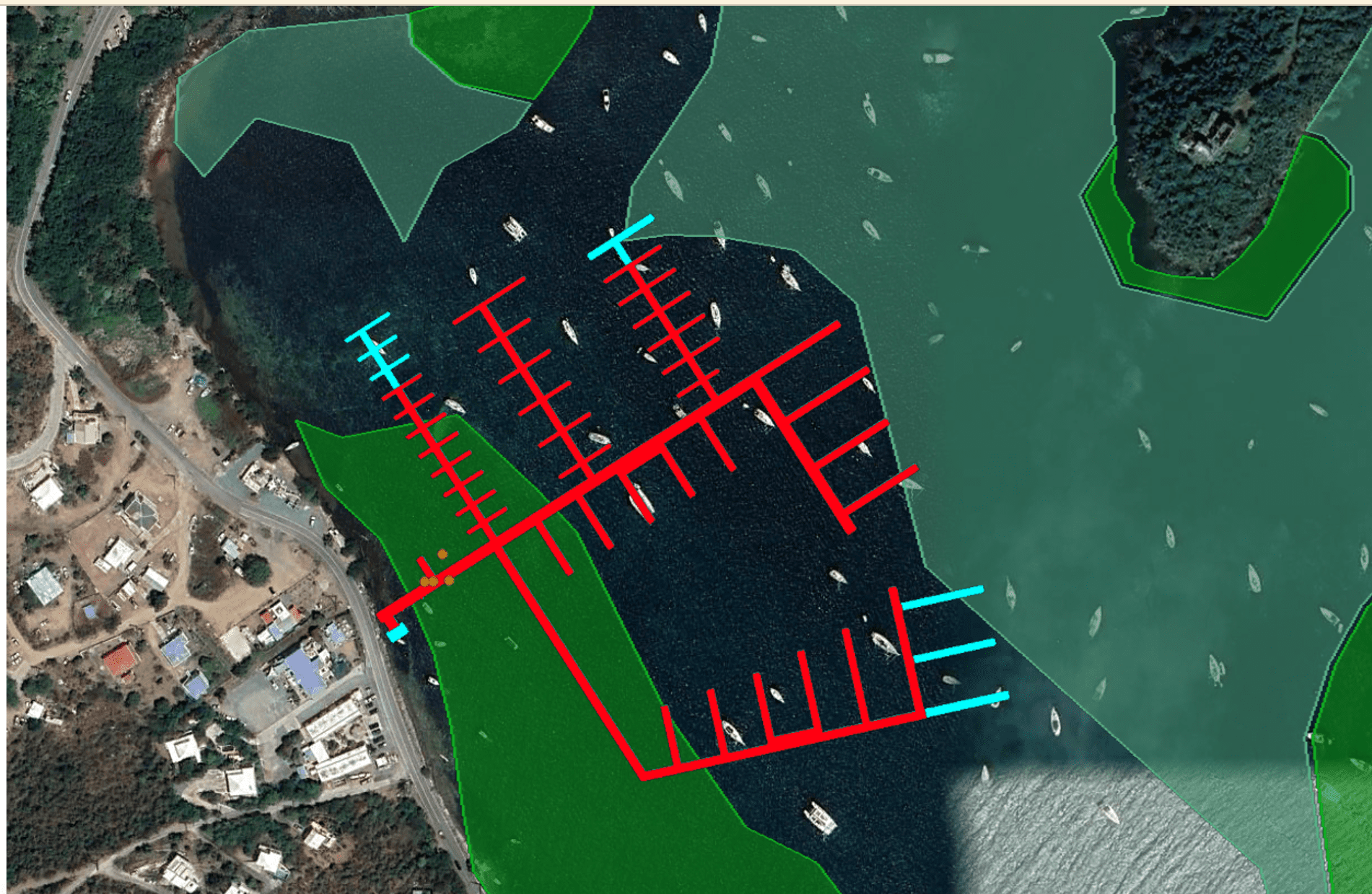
The actual engineering drawings submitted by Summers End to the Army Corps depict the elimination of three finger piers for mega-yachts, which were located directly over an 18th-century shipwreck, and eight finger piers for smaller vessels for a total reduction of 17 vessels. This brings the vessel count down from 144 to 127, a reduction of 12 percent.
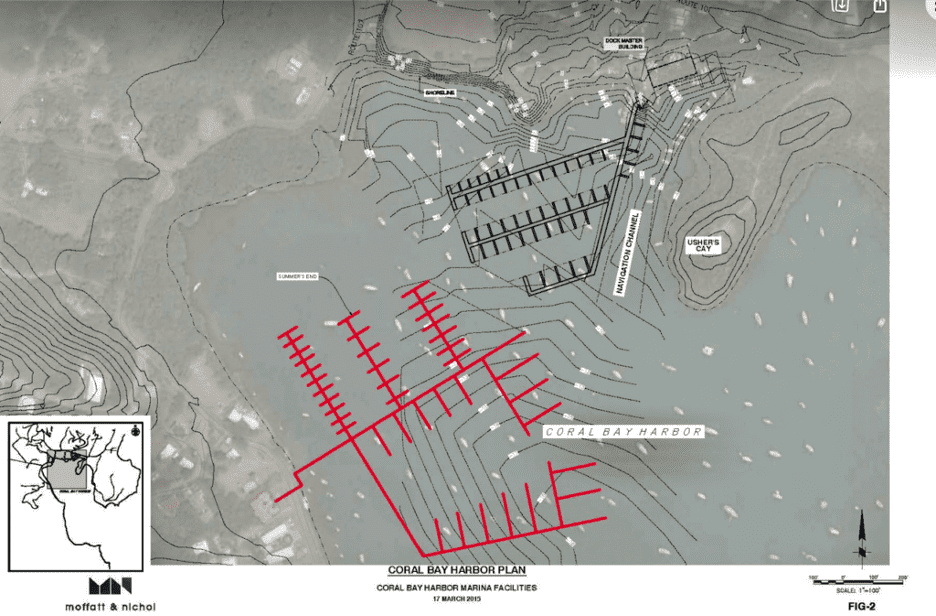
A comparison of the original dock layout with the current dock layout was composed by Save Coral Bay with the eliminated finger piers shown in turquoise.
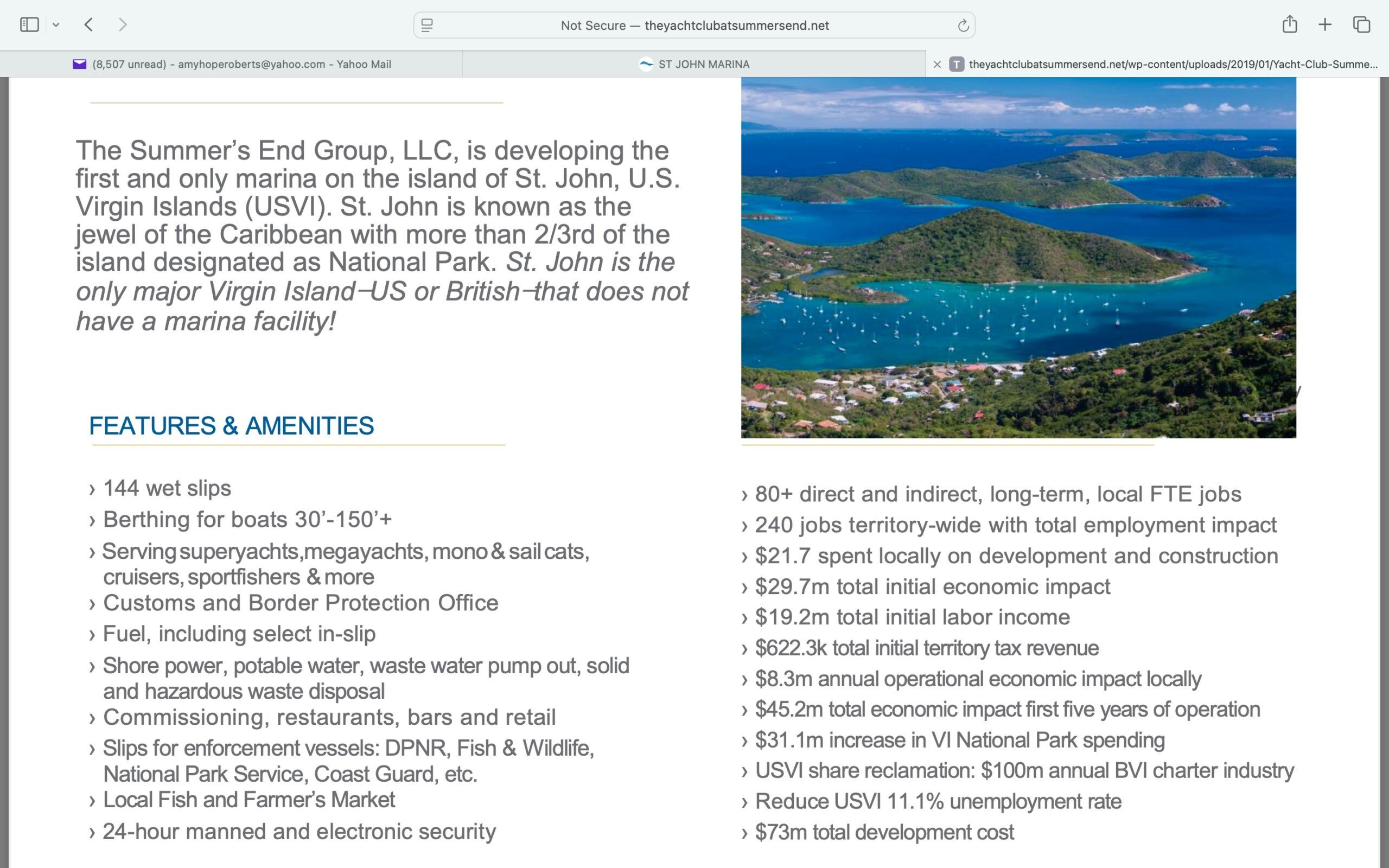
When asked by the Source to clarify the number of slips for mega-yachts, Summers did not directly answer the question. She wrote the marina would provide “slips for center console and day boats, monohull and catamaran sailboats, sport fishers and yachts, all vessels currently plying the waters of St. John and nearby islands.” She attached a brochure stating the marina would include 115 slips for boats ranging from 30 to 150 feet.
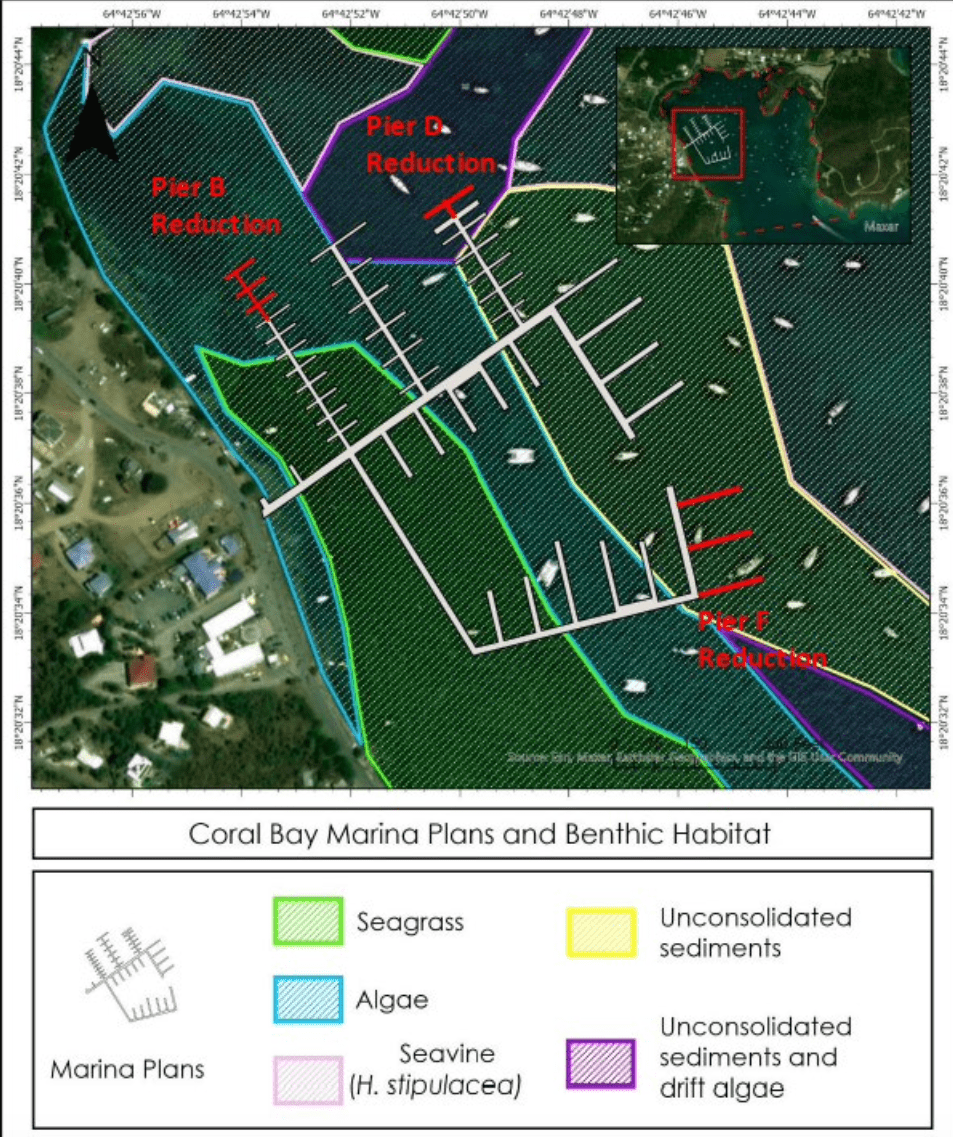
Silverman said the reduction in slips from 144 to 127 would not decrease the marina’s effect on protected sea grasses in the harbor. “There has been no attempt made to reposition the structure so that it does not impact sea grass beds,” he wrote in a Sept. 26 letter to the Army Corps and the EPA. “In fact, none of the 11 finger piers identified as being eliminated in the current plan are located over sea grass beds, so this ‘minimization’ does nothing to reduce direct and indirect impacts to sea grasses.”
In 2014, Summers End Group initially proposed taking over the current mooring field in Coral Bay Harbor and installing 70 moorings for the marina to manage. The mooring field is no longer included in Summers End’s plan, Summers confirmed.
But the project’s footprint in Coral Bay Harbor is considerable. “Overall, the ‘Trust Land Occupancy Agreement’ is for 28.5 acres, which is dedicated to use by Summers End. Of this, the actual structures of the marina occupy somewhere between one and two acres,” said Silverman. “The remainder will be used for vessels, navigations channels, turning basins, and so forth.”
Legal matters still persist
However, the fact that the project will still take up close to 30 acres of Coral Bay Harbor continues to be the basis of a lawsuit filed by the Moravian Church Conference, which has also developed plans to build a marina.
Their case, filed on Oct. 21, 2022, in the District Court of the Virgin Islands, maintains that “Summers End’s proposed marina would effectively prevent the development and/or viability of Plaintiff’s proposed marina by consuming virtually all navigable water in Coral Bay.”
Whether Summers End would consume “virtually all of the navigable waters” has not been argued within a courthouse, but a sketch of the two proposed marina plans prepared by Save Coral Bay does indicate congested conditions for marine traffic.
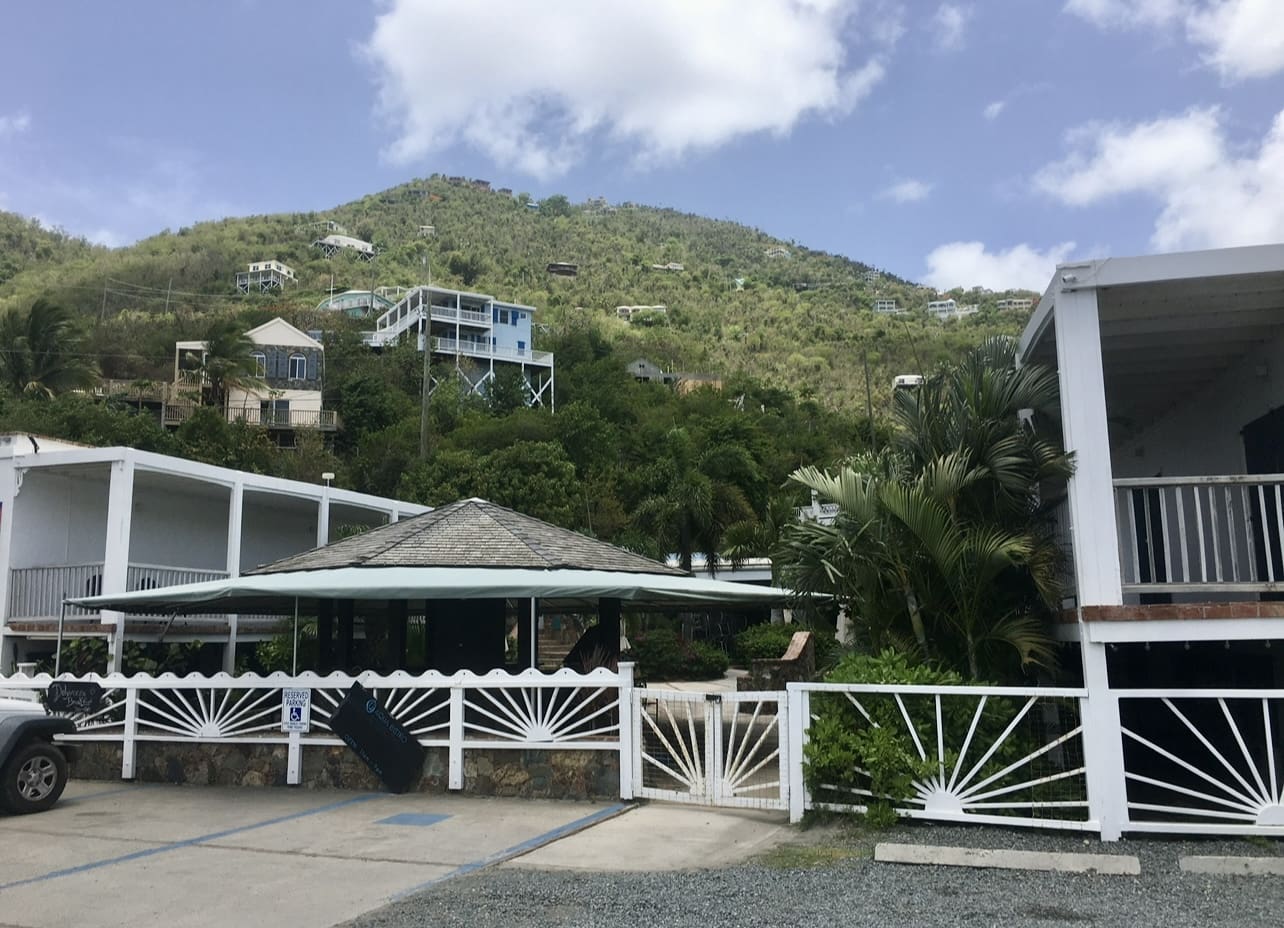
In other legal matters, in the last several months, the Summers End Group has bought the property previously known as “Coccoloba Plaza.” This property had been the subject of a lawsuit that was settled by the sale of the property to Summers End.
Questions about the lawsuits involving property owned by St. John families were a main concern expressed by Francis Heyliger and Sen. Donna Frett-Gregory at the Nov. 13 Senate subcommittee hearing.
Coccoloba Plaza was previously owned by Jim Phillips and Beva Rodriguez. Silverman posted on Facebook on July 24, “After many years of protracted litigation between Summers End Group [SEG] and the Phillips, their disputes were settled last week with a sale of Coccoloba to SEG, financed by an investor from Baton Rouge, Louisiana.”
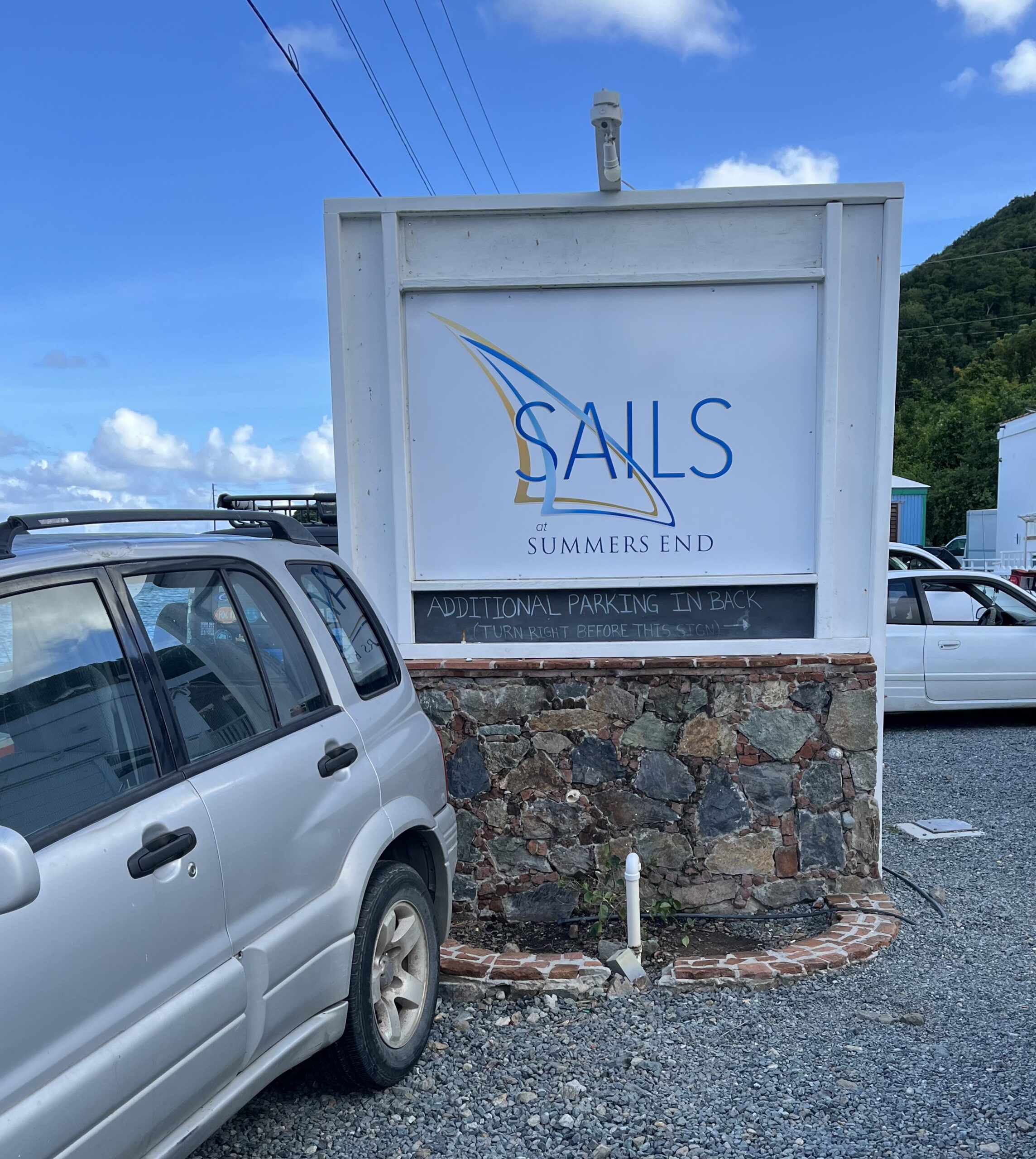
Summers confirmed that the Summers End Group had purchased the site at REM 13 Estate Carolina. “We are excited to announce that the former Coccoloba complex is now Sails at Summers End,” she told the Source. “It is one of four complexes of the St. John Marina destination development. It will initially serve as the location for our provision partner, an alfresco restaurant and marina headquarters while new buildings are built for those purposes and others.”
James Phillips, the son of Jim Phillips and Beva Rodriguez, declined to go into any details regarding the sale of the property, but he did say his family had been worn down by years of litigation.
“My parents, like many involved in this saga, had been at it for over a decade,” Phillips told the Source. “Our involvement was emotional, personal, financial, and just about any other expense one might think a person exerts in defending their legal interest in a family asset. For them, an off-ramp presented itself in court at the 11th hour; albeit not the most desirable one, but one nonetheless, enabling them to move on with their lives.”
Phillips said, “Other families are not so lucky. They remain burdened by the costs associated with property ownership, bad counsel, a sluggish legal system, and no income from what they believed would be profitable leases of their lands.”
Although he didn’t specify, he was likely referring to the Clendenin family members who filed a lawsuit against the Summers End Group in 2019.
At the Senate subcommittee hearing on Nov. 13, senators were told that the dispute involving parcels 10-17 and 10-18 in Estate Carolina had been resolved, and an agreement was being drawn, but Francis Heyliger expressed some doubts. “I’m still getting letters up to yesterday saying [matters] hadn’t been resolved,” she said. According to the Superior Court Docket, the parties have until Jan. 9, 2025, to settle the dispute or else go to trial.
Francis Heyliger said she was in favor of the marina plan. “I am all for economic development, but I’m not about trampling on the people to get it done.” The Source reached out to a Clendenin family member for comment but did not receive a response.
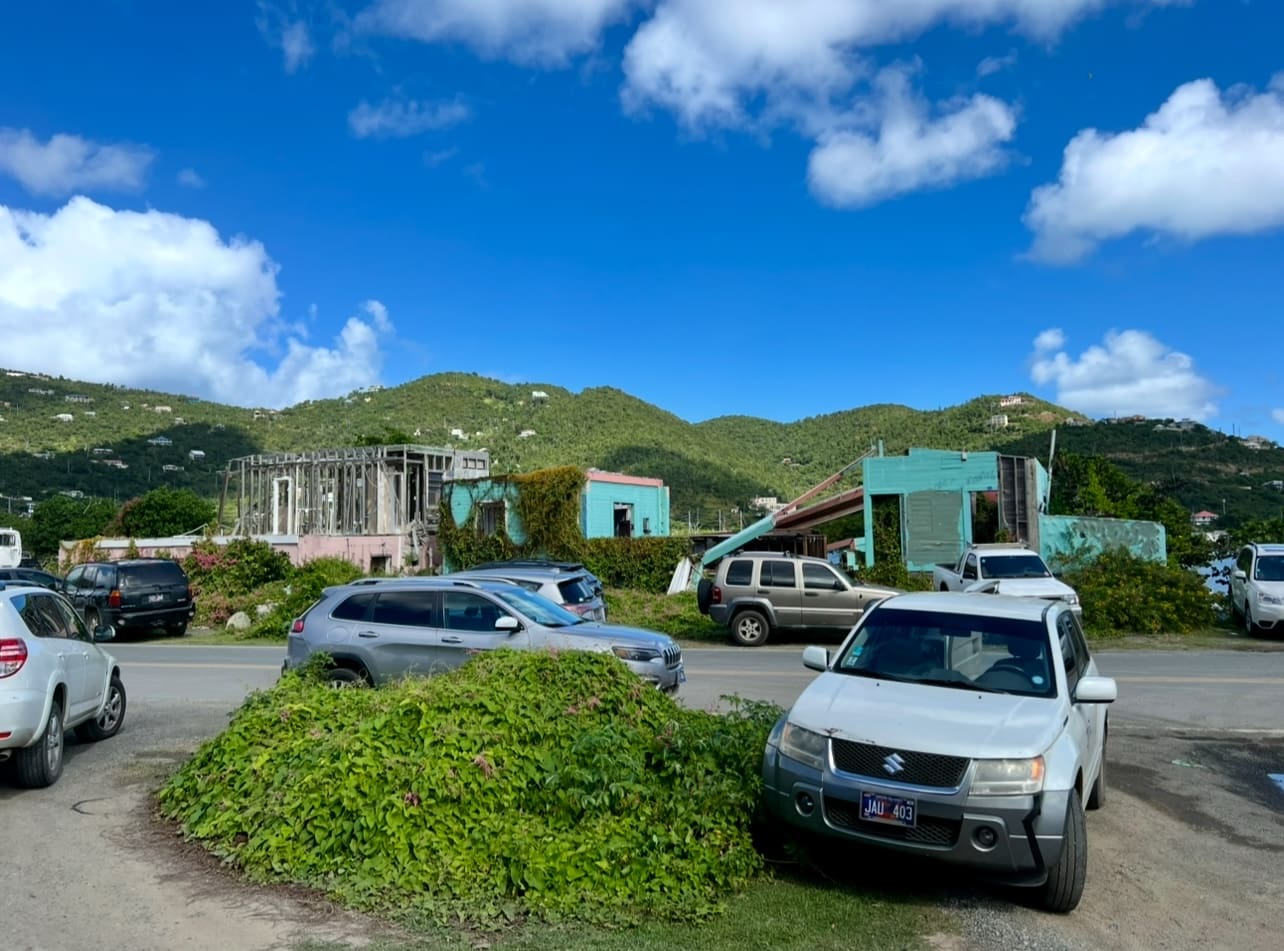
Perhaps the most visible sign of the changes involving the Summers End marina is the demolition of the structure once known as Island Blues. This building — on land leased to the Summers End Group — was largely destroyed by hurricanes in 2017. Its dilapidated condition was a source of irritation voiced by community members on social media.
Editor’s note: The Source will continue to update readers about other issues surrounding the marina’s development, including permits, environmental issues, design, and infrastructure.