

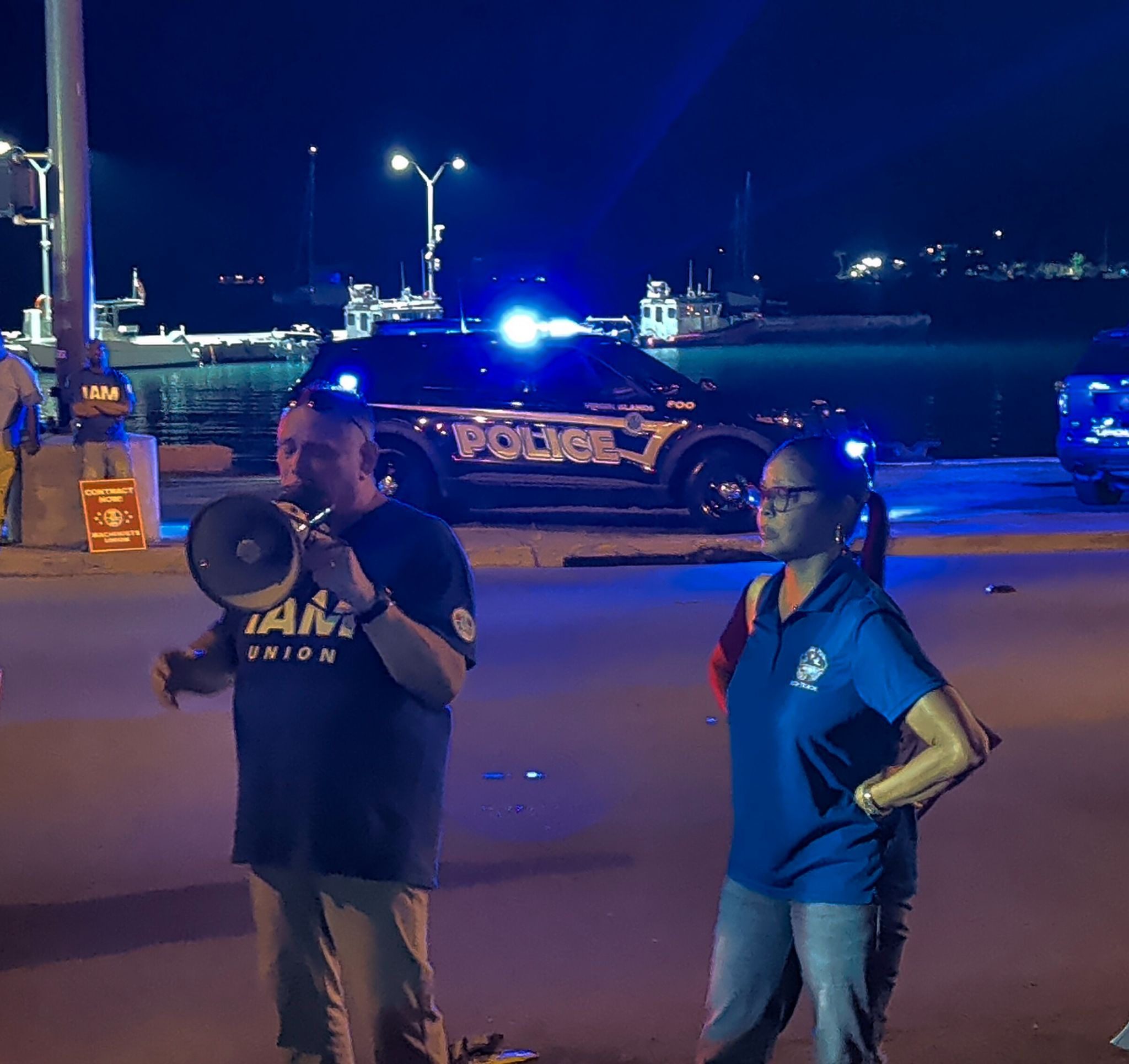
After years of stagnant wages and contract negotiation frustrations, area labor leaders collectively representing approximately 4,000 U.S. Virgin Islands workers hope to ratchet up pressure on this year’s candidates for office.
“This is an election year,” said Carver Farrow, executive board president of the newly minted U.S. Virgin Islands Area Labor Federation, during a recent call with the Source. “If we don’t do it this year, it’s not going to get done for the next three years. That’s the facts.”
Farrow said the collective plans to sit down with each of the gubernatorial candidates to gauge their labor friendliness before putting together a voting slate of preferred candidates. Farrow said organized labor has to have more “skin in the game” because up until now, elected officials haven’t been accountable to their constituents.
“That’s not what we’re going to do from this point on,” he added. “If they know that this group pretty much is responsible for getting them elected, then they’re going to be responsible. They will respond to this group.”
Local unions participating in the area labor federation include the International Association of Machinists and Aerospace Workers, American Federation of Teachers Local 1825, United Steelworkers, V.I. Police Benevolent Association, V.I. Law Enforcement Supervisors Union, Seafarers International Union, American Federation of School Administrators and the American Association of University Professors at UVI, according to a recent press release.
John Vigueras, special representative for IAM’s Southern Territory, said the joint effort stemmed from conversations with other unions and the AFL-CIO.
“This is what we had to do,” he said. “We had to create this because it makes no sense, if we’re all having the same issues, to have each one fight on their own. Let’s pool our resources, let’s pool our efforts, and let’s work as one.”
Jacqueline Dickenson, of the territory’s United Industrial Workers-Seafarers International Union, pointed to the amount of federal assistance the territory received following the 2017 hurricanes and the COVID-19 pandemic.
“According to the governor, there was such money — the Virgin Islands had never seen so much money. Where are those monies right now?” she asked. Dickenson said workers have yet to see any of it. “It’s time to get back to the table. It’s time for us to negotiate. The members deserve better; the community-at-large deserves better — look at our hospitals, look at our schools, look at our roads. I mean, deplorable.”
Labor groups have complained for years about the slow pace of grievance resolution and collective bargaining negotiations, while the cost of living in the U.S. Virgin Islands has continued to increase. The territory’s chief negotiator, Joss Springette, has on several occasions advocated for an amendment or expansion to Act 4440 that would allow the government to offer general salary increases for employees awaiting new contracts. The 36th Legislature last summer approved a general wage hike for the government’s lowest-paid employees — from $27,000 per year to $35,000 — after overriding a veto from Gov. Albert Bryan Jr. In January, lawmakers unanimously approved a three-phase plan that will bring the territory’s minimum wage to $15-per-hour by 2029.
“They did that recent adjustment in the minimum wage, but that was on the lower end. Everybody else got nothing out of this, really,” Vigueras said, adding that the unions have continued to have problems with the territory’s Collective Bargaining Office, Public Employees’ Relations Board, and Government Employees’ Retirement System. “Some agencies are still not paying the correct amount into it, so some people are having issues when they go to retire.”
Farrow and Vigueras both said that the goal is to improve the lives of all workers — not just union members.
“Maybe collective bargaining agreements don’t affect the majority of people, but other labor issues do affect the majority of people,” Vigueras said, “like having to work two jobs, three jobs because you can’t make ends meet with one.”
“All of us are treated pretty shabbily,” Farrow said. “And we don’t want that. We want to put a stop to that. We want a seat at the table, and we’re going to demand that.”