

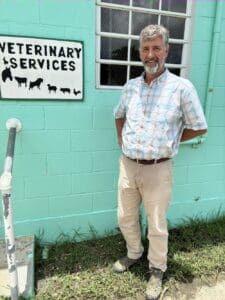
Traveling the width and length of the United States from Oregon to St. Croix, Dr. David Wenger joined the V.I. Agriculture Department less than two weeks ago, as the veterinarian to work with and advocate for the territory’s ranchers and farmers.
Commissioner Louis Petersen and the Ag Department conducted a nationwide search to replace Dr. Bethany Bradford, who retired, and Wegner was selected.
“Dr. Wenger cares about his work, he cares about animals and their well-being, and he cares about the growth of our department. We are honored to have him on our team and look forward to his contributions to the territory,” Petersen said in a press release.
No stranger to traveling great distances, Wenger moved around as a child with his father, an international educator. In his youth, he lived in Colorado, Wyoming, Virginia, Taiwan, Taipei and other countries. He graduated from the American School in Taiwan, earned a degree from the University of Wyoming and his doctorate at the College of Veterinary Medicine at Washington State University.
After college, over the last 28 years, he has settled in Oregon, opened a private practice, married, and raised two children. He gained experience in large animals — especially cattle, sheep, and goats and eventually kept his own herd of goats.
The Wengers decided to accept the St.Croix position because their children are adults living in “other parts of the country.”
A part of Wenger’s job at the department is to support agriculture, in particular the large animal population, he said.
“I’ve been tasked with developing, supporting, advocating for the animal production and the producers,” he said.
Wenger said there are farmers and ranchers with methods for and interest in producing more meat for export. Some of the local breeds, Senepol cattle and White sheep, have been exported in the past. They are valuable elsewhere because of their heat resistance and other qualities.
“The Tropical Bont tick is invasive and a big barrier,” he said. He added that if it becomes established there will be restrictions on exporting animals, which will affect farm business in a very negative way.
So one of Wenger’s first projects has been to work with the USDA Cooperative to study the Bont tick. He said so far they have collected lots of ticks and sent them off island for identification.
He noted that most of the animals bred and grown on the island are consumed locally. However, “… we need to get where we can provide more (meat) locally. Most of what you see in stores, if not all, is imported,” he said. “It would be a great thing. Getting fresher meat with better quality.”
There are challenges, as he stated in his 10 days on the island he has learned that farmers have lost a large number of stock to packs of roaming dogs.
“In fact, some pretty dramatic losses. One fellow had lost over 80 head in one attack,” he said. “When they (dogs) get to doing that it isn’t for any purpose but to kill.”
As Wenger gets settled, his personal goal this first year is to meet and get to know the local farmers and ranchers, he said. He said he understands animal production well, but not Virgin Islands animal production yet.
Wenger said he has met around 20 producers on St. Croix so far and with his knowledge, he hopes “to be able to offer advice and be a resource for folks to help them to be more productive.”
Wenger’s division also produces documents to allow animals to travel off-island. A big project is to tag and record individual large animals to track disease outbreaks and identify owners.
In addition, he said the abattoir is not under his direct supervision, but getting it running is critical. He said they hope to reopen it soon.
Editor’s Note: A previous version of this story incorrectly spelled Dr. Wenger’s surname. It is Wenger, not Wegner.