

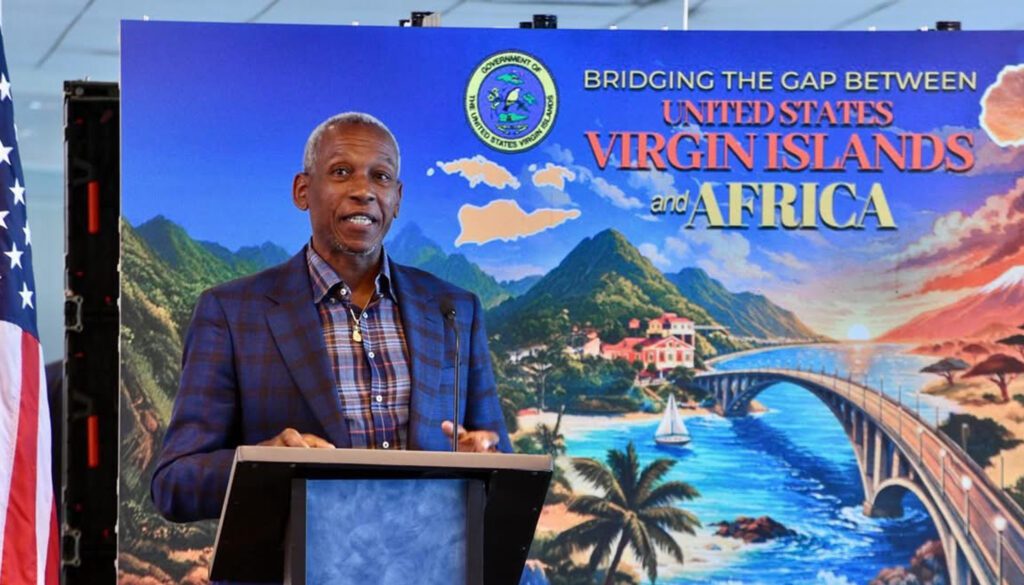
In a little less than two weeks, officials from the Virgin Islands Next Generation Network (viNGN) will return to Ghana to advance an ambitious project that could position the U.S. Virgin Islands as a digital gateway between Africa and the United States — a vision viNGN President and CEO Stephan Adams described as “building a satellite-empowered bridge for connectivity and economic opportunity.”
Adams outlined the plan during the recent USVI–Africa Mini Summit, where he stressed that digital infrastructure — particularly broadband access — is increasingly integral to economic growth and inclusion. “What we’re talking about is a digital gateway,” Adams said at the summit. “We saw there are hundreds of undersea fiber cables everywhere — but not a single one connecting Africa directly to the United States. We believe the Virgin Islands are perfectly positioned to help make that connection.”
The proposal centers on two major components: an undersea fiber optic link — termed DiasporaLink — that would run from St. Croix to Ghana, and a communications satellite to bring high-speed internet to rural and hard-to-reach areas across West Africa. Adams said viNGN has already shared the idea with Ghanaian officials and is returning this month, accompanied by representatives from Astranis, a San Francisco-based satellite manufacturer, to present a detailed plan to ministers of infrastructure and telecommunications.
Adams described DiasporaLink as a fiber optic cable that would span the Atlantic, with landing points in the Virgin Islands and Ghana before connecting onward through the U.S. mainland — creating a direct digital route between the continents. “Once that cable is in place,” he said, “it’s not just infrastructure — it’s opportunity. It means digital access for people who’ve been unconnected, and it means economic activity traveling both ways.”
How It Would Work: Cable and Satellite Together
Astranis — which builds small geostationary satellites — would play a key role in the project’s satellite component. The company has raised more than $1 billion and built satellites for multiple national and commercial customers, including Oman, Taiwan, Mexico, and the Philippines. Unlike traditional satellites, which often take years to build, Astranis says its satellites can be constructed in about 12 months on a fixed-cost schedule.
In simple terms, the fiber cable would act like a superhighway for internet traffic, carrying huge amounts of data between continents. Under the ocean, a bundle of fiber optic strands — encased in steel and protective armor — would connect St. Croix to Ghana. Once ashore, that connection would link to fiber routes across Africa and then back through the Virgin Islands to major internet hubs on the U.S. mainland, like New York or Miami.
The satellite, meanwhile, would extend connectivity beyond urban centers, providing broadband access to rural areas that don’t have dense fiber infrastructure. “The fiber is the backbone. The satellite is how you reach communities that don’t have fiber yet. Together, they unlock high-speed internet for people who’ve never had it,” according to represntatives.
By tying satellite coverage into fiber infrastructure, the initiative aims to deliver more affordable, reliable internet across Ghana’s rural and underserved regions — enabling digital banking, e-commerce, telehealth, education, and other services that depend on connectivity.
Why is this a Project for the USVI?
Officials say the proposal is not just about international goodwill — it’s about positioning the Virgin Islands at the center of a new digital corridor. Adams has noted that nearly 94% of global internet traffic travels over undersea cables, and with no direct link between Africa and the U.S. Virgin Islands, the territory currently overlooks a major route of digital commerce.
“There’s no cable connecting the continent of Africa directly to North America,” Adams said in an interview with The Source. “And if we don’t build it, others — Europeans, Asians — will. The Virgin Islands can be the hub between these two growing digital economies.”
If realized, the partnership could generate jobs in engineering, construction, network management, and operations — not only in the Caribbean but across the broader Atlantic economy. A landing station for a fiber cable would require technical staff and infrastructure support, while satellite operations bring opportunities for high-skill labor and ancillary services.
Adams said the next tangible milestone is the February 10–11 trip to Ghana, where viNGN and Astranis plan to meet with ministers of infrastructure and telecommunications to refine the proposal and explore potential financing and partnerships. They’ve already held early conversations with the African Development Bank about funding a combined cable, satellite, and base station project.
Now, Adams added, the focus will be on translating the concept into concrete agreements — and determining whether the Virgin Islands can move quickly enough to claim a role in what he described as the next phase of global connectivity.