

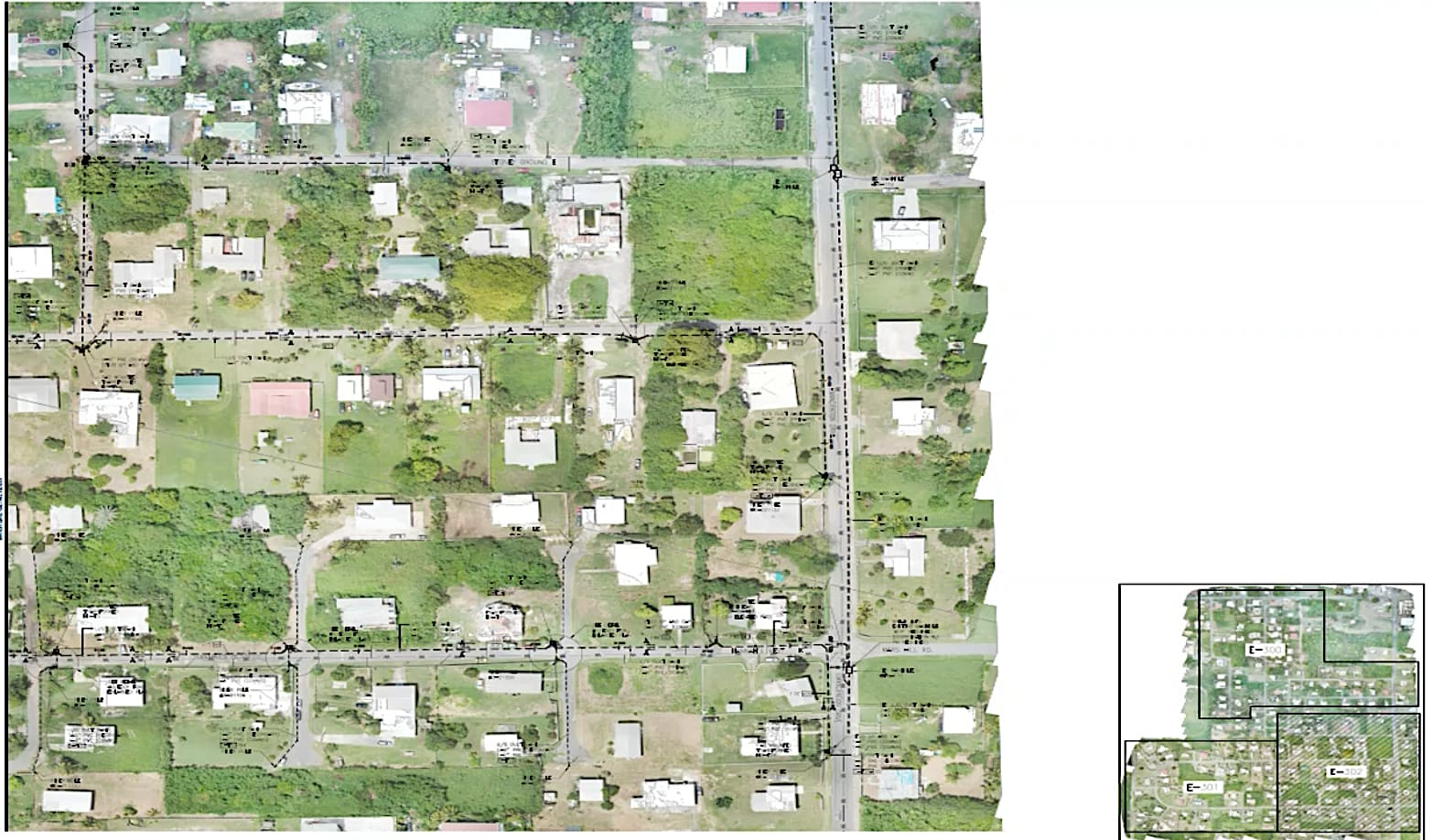
The board governing the Water and Power Authority voted to amend a solar-power agreement Thursday to clarify it won’t be paying for electricity twice. WAPA also planned to start running power lines underground in a residential area — Estate Hannah’s Rest, St. Croix — for the first time.
Hannah’s Rest was chosen because of the Frederiksted area’s dense population. It was among the worst damaged by 2017’s hurricanes, WAPA officials said. The plan would add 25 transformers and pads, six manholes and other hardware, and nearly 12,500 linear feet of medium-voltage cable underground. WAPA selected Christiansted-based J. Benton Construction to carry out the work and planned to start contract negotiations soon. The company’s bid came in more than $3.6 million less than the $11.16 million WAPA estimated the work to cost. Two other firms bid $1.2 million and $5.1 million less than WAPA’s estimates.
Other residential areas, including a phase-two project at Hannah’s Rest, were planned, WAPA CEO Karl Knight said. In other areas where terrain would not allow underground cabling, hurricane-resistant composite poles were planned.
Reducing operating expenses, including costly repairs, was key to shrinking budget deficits that have long plagued the utility, Knight said. Part of that was reducing use of older gasoline-powered power generators during times of high electrical demand.
WAPA was nearing a contract agreement and interconnectivity with two solar farms on St. Croix owned by VI Electron: the 10-megawatt Petronella plant and its Estate Hogansborg site, which is scheduled to be completed before the end of the year. VI Electron also proposed a third project near Frederiksted.
A wrinkle in the proposed contract, however, meant the agreement needed to be amended to ensure WAPA was only paying for each Watt once.
Under the proposed deal, VI Electron would sell WAPA electricity directly from its solar farm at a rate of $0.109. Electricity from its batteries would be sold to WAPA at half that rate, $0.0545. Some auditors feared it could be misconstrued as 10.9 cents and 5.45 cents per watt.
“There’s been a lack of clarity as to the payment terms,” Knight said. “My clear understanding is that power coming off the solar farm is to be metered at the point of interconnection and the power coming off the battery has a separate point of interconnection and is to be metered separately than the solar farm. Under no circumstance is power provided by the solar farm destined to the battery to be metered.”
Knight said he’d heard concerns that language in the agreement may allow VI Electron to charge for the direct solar power to be sent to the battery and then charge again for it to be used by WAPA.
Language clarifying WAPA would be paying only once for each watt used was being added to the agreement, he said.
Knight said rumors that the Petronella deal had been scuttled were false. He hoped to have three or more megawatts from the solar plant by the end of October. At three or more megawatts, WAPA generates a savings over their standard petroleum fuel use.
“Once we get up to the full 10 megawatts, of course, that’s when we realize the maximum savings,” Knight said.
At two-to-four megawatts from the solar plant, WAPA could save as little as $110,000 a year, he said. At 10 or more megawatts, the savings rises to as much as $4 million annually.
The Virgin Islands has been under a state of emergency to keep the utility from running out of fuel. That is due to change Oct. 19 unless the Senate takes action extending it to Nov. 19.
Knight said the deal with VI Electron required full transparency and information sharing on both ends as WAPA commissions interconnection with the solar farms.
“We have a wonderful working relationship with VI Electron,” he said. Knight and the WAPA team were working through details of the interconnection with the solar plant and hoped to have it ready for board approval soon.
Relations with a solar energy provider on St. Thomas are in a less chummy state. At a Sept. 10 Public Services Commission meeting, the territory’s only currently functioning solar farm, BMR Energy, threatened to turn off the power if WAPA didn’t pay its mounting bill — estimated at more than $5 million.
BMR Energy’s contract with WAPA runs through 2039 on St. Croix and 2048 on St. Thomas. At the current rate, the solar energy provider would be long out of business by those dates, said CEO Bruce Levy. WAPA attorneys have characterized the situation as a contract dispute.
Recent rolling blackouts on St. Thomas were not from fuel shortages but caused by a mechanical failure at the Harley Power Plant. A replacement fuel clutch was not available and had to be sent from St. Croix. In the meantime, WAPA suffered an eight-megawatt shortfall, Knight said.
Wednesday evening, WAPA announced Schneider Regional Medical Center on St. Thomas would receive a backup battery system, made possible through a grant WAPA secured from the Office of Insular Affairs. This system is supposed to improve emergency electricity capabilities to the hospital during natural disasters and unforeseen electrical interruptions, WAPA officials said.
The project includes installing a four-hour, two-megawatt Battery Energy Storage System at the hospital. It’s WAPA’s goal to enhance grid reliability across the territory by strengthening the hospital’s power continuity, support the hospital’s energy management, and protect sensitive medical equipment from power disruptions, safeguarding patient care.
Schneider now has underground power lines, their own backup generators, and, soon, four hours of battery power if needed, Knight said.
An Insular Affairs grant will also fund a new fleet of electric vehicles, including additional bucket trucks, essential vehicles for its line department, and trucks for meter-reading crews, WAPA officials said. Meter readers have been especially busy since automatic metering systems failed in spring 2023.
The vehicles could replace fuel-inefficient Jeep Wranglers in areas without especially rugged terrain, board members said.
A third-party contractor studied WAPA’s automated system and confirmed the problem, officials said in August of this year. Virgin Islanders had been complaining on social media platforms about bills suddenly skyrocketing from less than $200 a month to more than $700. A St. John customer said in July their WAPA bill went from an average of between $175 to $300 to more than $3,000.
“The impact on the customers is well documented,” Knight said. “What’s not discussed as much is what it’s costing us on the revenue side.”
Each district currently has six meter readers — four total less than Knight would like as the territory works to install thousands of new, accurate meters.