

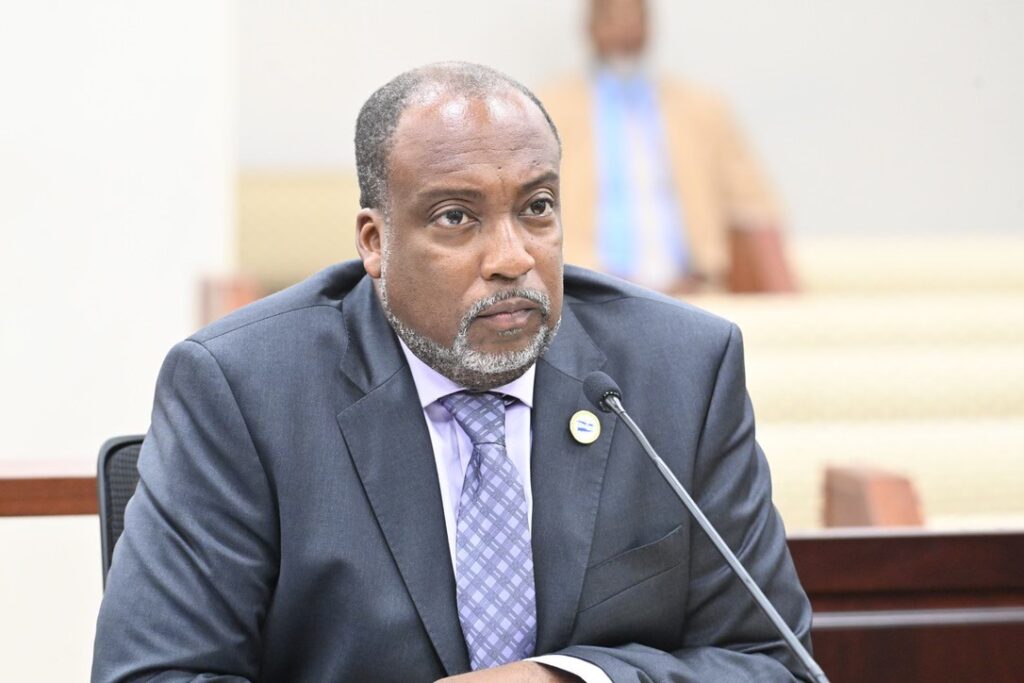
The Water and Power Authority is projecting a $9.6 million shortfall in its current fiscal cycle, lawmakers on the Senate Budget, Appropriations and Finance Committee heard Monday, an estimated 75-percent decrease over last year’s. The utility’s chief executive, Karl Knight, said there are a number of things lawmakers could do to take WAPA out of the red.
“In prior years, the appearance of the authority at budget hearings in the Senate was just a formality,” he said, because WAPA does not receive an appropriation from the government’s General Fund. “However, given the precarious fiscal state of the authority, we will surely take full advantage of the opportunity to discuss potential legislative action to support the authority’s fiscal stability.”
Those included: paying for streetlighting services, for which the central government underpaid in 2025 by $4.7 million; adjusting a legislative mandate to read meters every thirty days, which Knight said occasionally forced the utility to check meters twice in one month; modifying a restriction on back-billing; implementing a flat water charge, regardless of usage; placing a liability cap on the authority except in cases of gross negligence; upping fees for electric disconnections when they’re done at the pole; and raising an antiquated $10,000 cap that currently requires competitive bidding on purchases or contracts.
Knight also asked lawmakers to subsidize a recent mandate to increase minimum annual salaries to $35,000, a move by the Government Employees Retirement System to increase employer contributions by three percent, and $2.8 million the authority owes to the Public Services Commission for assessments.
The authority’s fiscal year runs from July 1 to June 30, unlike other government agencies which start the fiscal year on Oct. 1. On Monday, Knight told lawmakers that the utility’s expected $325.2 million in revenues this year will not keep pace with an estimated $334.8 million in expenses, which include nearly $31 million for debt service and a half-million-dollar payment in lieu of taxes, or PILOT. WAPA is expecting an additional $2.5 million from the Federal Emergency Management Agency to cover administrative costs associated with disaster recovery projects.
Knight said the authority has been operating with a structural deficit for years, primarily because of fuel rates that don’t fully recover the utility’s expenditures. The PSC permits WAPA to include a 33-cent per gallon LEAC rate, Kight said, but the authority regularly spends 59 cents per gallon in transportation costs under its current liquid petroleum gas contract.
“I want to make sure the Senate is aware of our challenges, how far behind we are — which, we are closing the gap,” he said. “We still have a little bit more to close. We’ve laid out how we think we get that gap closed over the course of the current fiscal year that we’ve already started. There are some legislative things that we feel can expedite our closing of that gap — some of those are things that you can consider as part of the upcoming markup of the executive budget. Others are just general legislative actions that we think would have… a positive financial impact on the authority. So if there’s an ask, it would be to consider those initiatives.”
During his prepared testimony, Knight stressed that the budget projections assumed no rate reductions for the next 12 months. In June, the PSC voted to lower electric rates from 22 cents per kilowatt/hour to 17 cents. The authority called the move a “deliberate, ill-considered decision” in a statement and petitioned for a stay.
“I fully understand the desire to provide rate relief to the customers of the Virgin Islands Water and Power Authority,” Knight said at the time. “We all share that same desire, and WAPA has been working aggressively to get to that point, but we must do so in a responsible manner that does not immediately jeopardize our ability to provide electric and potable water services in the Virgin Islands.”
The PSC is scheduled to hear WAPA’s petition Tuesday. If commissioners reaffirm their June decision, WAPA will have 60 days to appeal the decision in V.I. Superior Court.